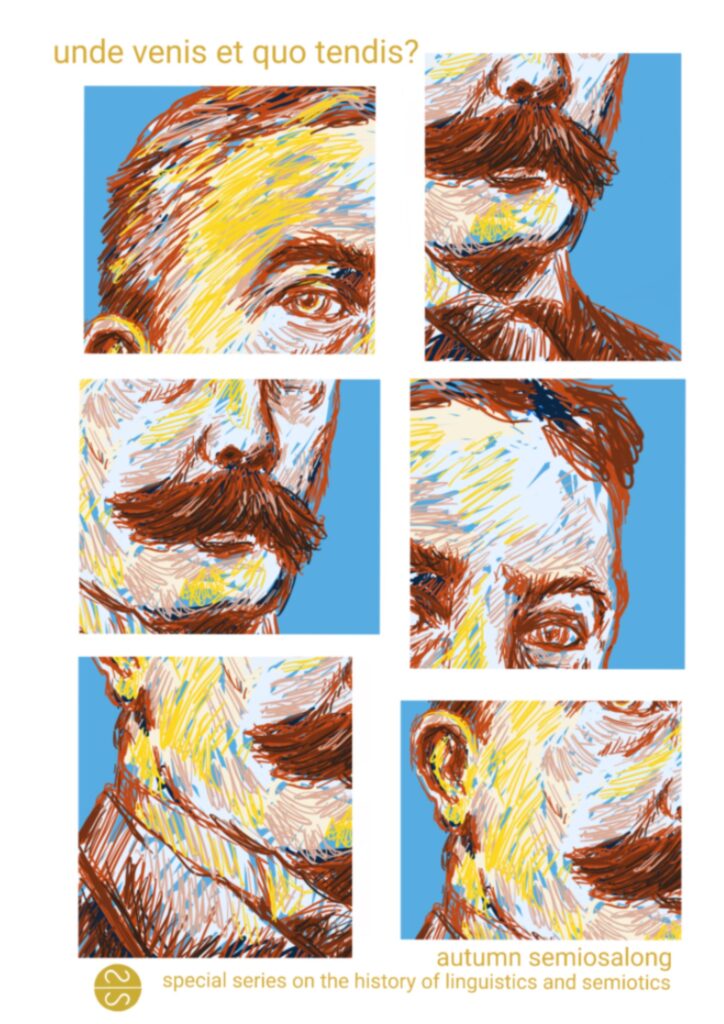
It is hard to deny that the history of European linguistics during the second half of the twentieth century was marked by the publication of the Cours de Linguistique Générale. The reception of this particular work gave rise to a variety of schools and trends in linguistics across Europe, attracting many thinkers even from outside the continent. One of the more distinctive traits of the book was the conception of language as a system of signs, and thus, its reception is intrinsically linked to the rise of another discipline, to wit, semiotics, or sémiologie. By the turn of the century, the theoretical proposal advanced by the book, and by its many interpreters, from Éric Buyssens to Roy Harris, has been often deemed as either surpassed, or as not suitable to bring forth a comprehensive understanding neither of language, in all its dynamicity, nor of sign systems, as they extend beyond the human sphere. Yet, in recent years, numerous scholars have turned their eyes to the Cours, to Saussure, and to some of his intellectual heirs, and have pointed out that the theoretical depth of the Cours, of Saussure’s original writings, and of the ideas advanced by the different schools that are sometimes grouped under the label of “(linguistic) structuralism” —and which uphold Saussure as a central figure— can bring new insights into our understanding of language, especially when conceived as a semiotic phenomenon, and thus bring new insights into our understanding of sign systems in general. The aim of this Semiosalong series is to present to a broad audience, including students of linguistics, semiotics and adjacent fields, the relevance that “structural linguistics” and “structural semiotics” can have today, as well as the interrelations between linguistics and semiotics as disciplines that share, at least to some extent, their fields of study.
Special series on the history of linguistics and semiotics