
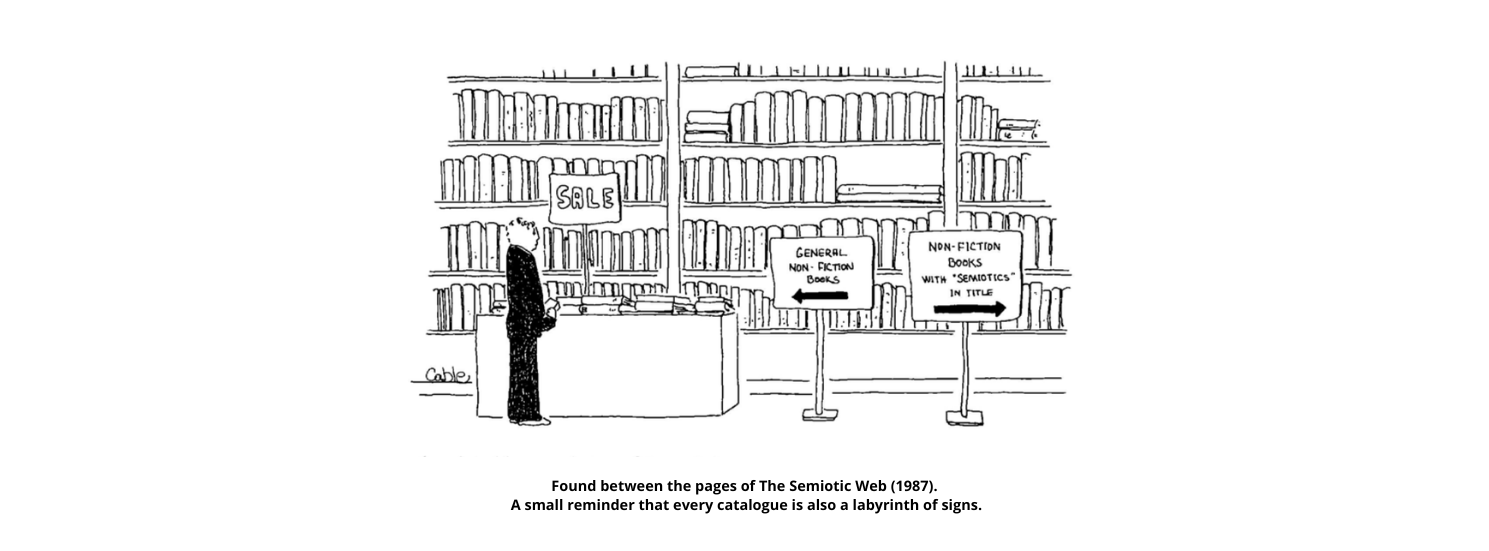
A unified academic catalogue for books, journal articles, book chapters, proceedings papers, conference abstracts and semiotic research materials.
A unified academic catalogue for books, journal articles, proceedings papers, collection articles and semiotic research materials. Search across the full database; results are shown with pagination.
Reviving the American Society for Cybernetics
In: Cybernetics & Human Knowing 2016, Volume 23, Issue 1: 50th Anniversary Retrospective of the ASC
- Pages
- 19
View details
Size and shape depictions in the manual modality: A taxonomy of iconic devices in Adamorobe Sign Language
In: Semiotica 2016, Issue 210
View details
Identifier: DOI: 10.1515/sem-2016-0049
Synchronicity as Time: E-Series Time for Living Formations
In: Cybernetics & Human Knowing 2016, Volume 23, Issue 3: Batesonian Facets
View details
The Dark Side of Technological Singularity: New Barbarism
In: Cybernetics & Human Knowing 2016, Volume 23, Issue 4: Cybersemiotics and Technology-Based Arts
View details
The free slave paradox
In: Semiotica 2016, Issue 210
- Pages
- 57-74
View details
Identifier: DOI: 10.1515/sem-2016-0054
The Mutual Benefits of Cybersemiotics and the Field of Technology-Based Arts
In: Cybernetics & Human Knowing 2016, Volume 23, Issue 4: Cybersemiotics and Technology-Based Arts
View details
The Path to Steps to an Ecology of Mind
In: Cybernetics & Human Knowing 2016, Volume 23, Issue 3: Batesonian Facets
View details
The thematic structure of homepages: An exploratory systemic-functional account
In: Semiotica 2016, Issue 210
- Pages
- 105-127
View details
Identifier: DOI: 10.1515/sem-2016-0048
Three Levels of Semiosis: Three Kinds of Kinds
In: Cybernetics & Human Knowing 2016, Volume 23, Issue 2: Challenges of, and to, Pragmatics
View details
Toward a Recursive Theory of Everyday Double Binds
In: Cybernetics & Human Knowing 2016, Volume 23, Issue 3: Batesonian Facets
View details
Transparent Dialogues: On Complex Affective Systems (CAFFS)
In: Cybernetics & Human Knowing 2016, Volume 23, Issue 4: Cybersemiotics and Technology-Based Arts
View details
Two approaches to defining internal, external, and zero-focalization
In: Semiotica 2016, Issue 210
- Pages
- 191-207
View details
Identifier: DOI: 10.1515/sem-2016-0056
Virtual Logic—Finite Language and the Imagination of Infinity
In: Cybernetics & Human Knowing 2016, Volume 23, Issue 1: 50th Anniversary Retrospective of the ASC
- Pages
- 103
View details
Virtual Logic—George Spencer-Brown (2 April 1923 – 25 August 2016)
In: Cybernetics & Human Knowing 2016, Volume 23, Issue 3: Batesonian Facets
View details
Waddington, Bateson, Evolution, and Cybernetics
In: Cybernetics & Human Knowing 2016, Volume 23, Issue 3: Batesonian Facets
- Pages
- 9-27
View details
Why Do We Want To Live In Cybernetics?
In: Cybernetics & Human Knowing 2016, Volume 23, Issue 2: Challenges of, and to, Pragmatics
View details
Zero sign duality in visual semiotics
In: Semiotica 2016, Issue 210
- Pages
- 209-214
View details
Identifier: DOI: 10.1515/sem-2016-0051
A History of Biophysics in Contemporary China
- Edition
- 1 edition
View details
Annotation: This book gives a concise history of biophysics in contemporary China, from about 1949 to 1976. It outlines how a science speciality evolved from an ambiguous and amorphous field into a fully-fledged academic discipline in the socio-institutional contexts of contemporary China. The book relates how, while initially consisting of cell biologists, the Chinese biophysics community redirected their disciplinary priorities toward rocket science in the late 1950s to accommodate the national interests of the time. Biophysicists who had worked on biological-sounding rockets were drawn to the military sector and continued to contribute to human spaceflight in post-Mao China. Besides the rocket-and-space missions which provided the material context for biophysics to expand in the late 1950s and early 1960s, Chinese biophysicists also created research and educational programs surrounding biophysics by exploiting the institutional opportunities afforded by the policy emphasis on science's role to drive modernization. The book explores and demonstrates the collective achievements and struggles of Chinese biophysicists in building their scientific discipline.
Identifier: 9783319180922
Status: Available
Between emotion, imagination and cognition: Play as a hybrid neuro-evolutionary concept in bridging Saussure, Hegel and Alexander von Humboldt
In: Sign Systems Studies 2015, Volume 43, Issue 2/3
- Pages
- 249-268
View details
Identifier: 10.12697/SSS.2015.43.2-3.07
Heroizability
View details
Other title information: An anthroposemiotic theory of Literary characters
Annotation: It is commonly believed that some approaches of structural semiotics, narratology and cognitive science have not yet succeeded in constructing a complete and coherent theory of literary character. The author argues that the primary explanation of the failure is the artificial separation between characters and their actions. One of the chief implications of such separation is treating characters in terms of structures, agents, actants, functions, roles, and signs, which obviously mean that actions can hardly be explained as intended, motivated, performed and experienced. Survival, as a motivation-based concept, is one of the key concepts making the separation between character and action something impossible. Humans in literary narratives search for survival as an aware process of knowing and meaning making. Meaning in literary narratives can be produced by heroizability, which treats literary characters as living anthroposemiotic entities aware of their natural motivation to achieve in order to survive and produce meanings of their survival. As such, characters in literary narratives have active cognitions, and their cognitive activities remain meaningless without a process of semiosis. Applying Anthroposemiotic theory with Modeling System Theory, heroizability provides methodical tools to explain how the narrative text is represented and, thus, how it is to be interpreted properly by the reader not only to find, but also to make meaning in narrative world.
Identifier: 9781501510816
Status: Available
Lexikon der Mensch-Tier-Beziehungen
View details
Annotation: Our relationship with "other" animals is not only becoming socially ever more significant, it has also been rediscovered as a topic for the humanities and sciences. This volume is the first encyclopedia to devote itself comprehensively to the relationship between humans and animals. In contrast to traditional introductions into animal ethics, the large-scale work does not limit itself to issues of moral philosophy but also explores the human-animal relationship from a historical, sociological, ethological and cultural perspective
Identifier: 9783837622324
Status: Available
Philosophy of Education in the Semiotics of Charles Peirce
- Edition
- 1 edition
View details
Other title information: A Cosmology of Learning and Loving
Annotation: This book investigates the philosophy of education implicit in the semiotics of Charles Peirce. It is commonly accepted that the acts of learning and teaching imply affection of some sort, and Charles Peirce’s evolutionary semiotics thoroughly explains learning as an act of love. According to Peirce, we evolved to learn and to love; learning from other people has proved to be one of the best ways to carry out our infinite pursuit of truth, since love is the very characteristic of truth. As such, the teacher and the student practise love in their relation with one another. Grounded within an edusemiotics framework and also exploring the iconic turn in semiotics and recent developments in biosemiotics, this is the first book-length study of Peirce’s contribution to the philosophy of education.
Identifier: 9783034318822
Status: Available
Scales in Lithuanian traditional music
View details
Other title information: Acoustics, Cognition, and contexts
Annotation: This book presents a cross-cultural perspective on Lithuanian traditional music, with the aim of revealing the phenomena of musical scales from acoustics, cognitive and contextual viewpoints.
Identifier: 9786098081855
Status: Available
The importance of Lotmanian semiotics to sign theory and the cognitive neurosciences
In: Sign Systems Studies 2015, Volume 43, Issue 2/3
- Pages
- 347-364
View details
Identifier: 10.12697/SSS.2015.43.2-3.10
Displace
View details
Other title information: a Migrating Art Academies compendium of ideas
Annotation: This book - the third Migrating Art Academies (MigAA) publication - marks the end of the third phrase of the MigAA program, whcih over the course of seven years has grown into a dynamic an vital network of art academis and universities, independent arts organizations, many hundreds of people, and endless ideas. [...] Conducted over the last four years, phase three has seen an expanded and evolved MigAA network implementing a radican new scheme for creative collaboration and learning. This phase has explored the process of develping ideas while being displaced: away from one's usual environmnet at school, work, and home and far from family and friends. This volume, subtly titled Displace, traces the wide-randing results of this latest MigAA phase.
Identifier: 9786094471438
Status: Available
Mathematics as a Modeling System
- Edition
- 1 edition
View details
Other title information: a Semiotic Approach
Notes: Editors of the series: Kalevi Kull, Silvi Salupere, Peeter Torop
Annotation: Mathematics and semiotics share many intellectual features and interests, from the study of how representations stand for specific kinds of referents to philosophical considerations of how these interrelate with reality. Nonetheless, in-depth studies of this intrinsic relation between the two have rarely been undertaken, with a few notable exceptions (as will be discussed in the book). Especially relevant to the study of the nature of mathematics is the concept of model – a term and notion that is used widely in both disciplines. However, to the best of our knowledge the theory of models in semiotics, known as Modeling Systems Theory, has rarely, if ever, been applied to the study of mathematical modeling. The purpose of this book is to do exactly that since it is our view that mathematics is a de facto modelling system in the semiotic sense and it is our hope that from this it will be possible to gain considerable insights into how mathematics works and achieves the discoveries and forms of knowledge that it has since the dawn of antiquity. Hopefully, this will allow both mathematicians and semioticians to pursue similar or analogous research objectives with regard to understanding the biological and cognitive etiology of sign systems and their connection to reality.
Identifier: 9789949326105
Status: Available
Semiotic models of legal argumentation
- Edition
- 1 edition
View details
Notes: Articles included: Charles Sanders Peirce, A Mastermind of (Legal) Arguments (2012), On relationships between the logic of law, legal positivism and semiotics of law (2011), The Semiotic Model of Legal Reasoning (2012), The Case of Lauris Kaplinski: A Guide to a Semiotic Reading of Incitement of Hatred in Modern Criminal Justice (2013), The Splendors and MIseries of Constitutional Reasoning in Times of Global Crisis: A Critical look from the Realist Perspectives of Semiotics (2013)
Annotation: The present doctoral dissertation is an exercise in exposition, comparison, criticism and construction, and this is the result of a project conceived ten years ago. We have taken different traditions of legal reasoning, and by juxtaposing them have sought to clarify and assess semiotic presuppositions, in order to outline a theoretical framework of legal semiotics that would help to lay the foundations for semiotic theory of legal argumentation. These semiotic presuppositions have been the object of our study at the University of Tartu since our bachelor's thesis (defended in 2001) and master's thesis (defended in 2006). Our interest in legal semiotics was motivated by a very strong sense of dissatisfaction with the traditional methods and paradigms of contemporary jurisprudence, especially with those ones of legal argumentation. Traditional jurisprudence committed to a model of legal unity, does not for the most part seeks to describe how the views of legal actors interact with the views of other legal actors/participants of legal discourse in real situations of legal communication. Thus, it was the consideration of legal communication as a semiotic activity that caused us to doubt that law could be conceived in terms of traditional legal concepts. Legal semiotics can be regarded as a major advance because it debunks the prevailing assumptions about the nature of legal reasoning and replaces them with what seems a far superior explanation. The main scientific objectives of this dissertation can be briefly formulated as follows: 1) to develop a conceptual framework for practical handling of complex problems of legal argumentation as they occur in the stages of legal communication; 2) to assess issues of compatibility/conflict between existing methods of legal reasoning and our semiotic model of legal reasoning; 3) to bridge the compatible aspects of different theories/models of legal argumentation to establish a generalizable model of legal argumentation.
Identifier: 9789949325016
Status: Available
A History of Psycholinguistics
- Edition
- 1 edition
View details
Other title information: The Pre-Chomskyan Era
Annotation: How do we manage to speak and understand language? How do children acquire these skills and how does the brain support them? These psycholinguistic issues have been studied for more than two centuries. Though many Psycholinguists tend to consider their history as beginning with the Chomskyan "cognitive revolution" of the late 1950s/1960s, the history of empirical psycholinguistics actually goes back to the end of the 18th century. This is the first book to comprehensively treat this "pre-Chomskyan" history. It tells the fascinating history of the doctors, pedagogues, linguists and psychologists who created this discipline, looking at how they made their important discoveries about the language regions in the brain, about the high-speed accessing of words in speaking and listening, on the child's invention of syntax, on the disruption of language in aphasic patients and so much more. The book is both a history of ideas as well of the men and women whose intelligence, brilliant insights, fads, fallacies, cooperations, and rivalries created this discipline. Psycholinguistics has four historical roots, which, by the end of the 19th century, had merged. By then, the discipline, usually called the psychology of language, was established. The first root was comparative linguistics, which raised the issue of the psychological origins of language. The second root was the study of language in the brain, with Franz Gall as the pioneer and the Broca and Wernicke discoveries as major landmarks. The third root was the diary approach to child development, which emerged from Rousseau's Émile. The fourth root was the experimental laboratory approach to speech and language processing, which originated from Franciscus Donders' mental chronometry. Wilhelm Wundt unified these four approaches in his monumental Die Sprache of 1900. These four perspectives of psycholinguistics continued into the 20th century but in quite divergent frameworks. There was German consciousness and thought psychology, Swiss/French and Prague/Viennese structuralism, Russian and American behaviorism, and almost aggressive holism in aphasiology. As well as reviewing all these perspectives, the book looks at the deep disruption of the field during the Third Reich and its optimistic, multidisciplinary re-emergence during the 1950s with the mathematical theory of communication as a major impetus. A tour de force from one of the seminal figures in the field, this book will be essential reading for all linguists, psycholinguists, neuroscientists, and psychologists with an interest in language.
Identifier: 9780199653669
Status: Available
Peircean semiotics in the context of design praxis: Abduction and perception in dialogue
In: Sign System Studies 2013, Volume 41, Issue 4
- Pages
- 424-432
View details
Identifier: 10.12697/SSS.2013.41.4.03
The Edusemiotics of Images
View details
Other title information: Essays on the Art-Science of Tarot
Notes: a printed version
Annotation: Semetsky’s new book offers a bracing account of Tarot semiotics in view of its deep significance for educational experience. Analyzing the symbolic language of Tarot images that express the intimations of the unconscious, she invites readers to explore novel ways of learning about the nature of ourselves and the world we are situated in. Combining thorough research with an accessible style, this groundbreaking book is essential reading for present and future generations of practitioners, academics and students across disciplines. Pia Brînzeu, Professor of English Literature and Vice-Rector of the Universityof Timis¸oara, Romania; author of Corridors of Mirrors. A sequel to the author’s Re-Symbolization of the Self: Human Development and Tarot Hermeneutic and Semiotics Education Experience, Semetsky’s new book presents the Tarot sign-system as a school of ethical living. Bringing the philosophies of Peirce, Deleuze, Dewey, Whitehead and Gebser in a dialogue with the cutting-edge science of coordination dynamics, she grounds the art of Tarot in the logic of signs acting across nature, culture and human mind. Building on Noddings’ “maternal factor”, Semetsky demonstrates how the lessons embodied in Tarot symbolism recover the feminine value of relations and contribute to Self~Other integration. Such is the message of Tarot images. The Image is the Message. Igor Klyukanov, Professor of Communication, Eastern Washington University, USA; editor, Russian Journal of Communication; author of A Communication Universe: Manifestations of Meaning, Stagings of Significance. Semetsky’s amalgamation of the techniques of visual communication with the emerging field of edusemiotics is an absolute masterpiece in transdisciplinarity. By forging diverse strands of inquiry into an overall model of how images enhance learning, Semetsky’s new book provokes us to take a fresh look at iconic information and is a required reading for everyone who is engaged with the artand science of visual semiotics at the intersection of nature and culture. Marcel Danesi, Professor of Anthropology, University of Toronto, Canada; editor-in-chief, Semiotica; author of The Quest for Meaning: A Guide to Semiotic Theory and Practice. Finally. An in-depth look at Tarot from within the field of semiotics, a perspective that had been inexplicably overlooked until now. As a language of exile from language, Tarot cards are silent words that became images. Here is a book that turns our thirst for symbols into a learning tool. The sign sings in Inna Semetsky’s work.
Identifier: 9789462090538
Status: Available
Tuning the Self
- Edition
- 1 edition
View details
Other title information: George Herbert’s Poetry as Cognitive Behaviour
Annotation: This book provides a cognitive analysis of the poetry of George Herbert (1593- 1633). From Herbert’s own thinking, recorded in his prose treatises, can be deduced that his poems should serve a specific function: teaching self-knowledge to his readers. Self-knowledge is a necessary skill, to be applied in one’s strife for ‘temperance’: the regulation of body, house, church, mind, and community. To Herbert, the meaning of his poems is subservient to this function: poetry should aid his readers to temper their lives. The cognitive framework applied here can serve to explain this function. Following Merlin Donald’s theory of cognitive evolution, art serves the purpose of mimetic meta-cognition: a specific cognitive strategy at the disposal of a county priest. Moreover, a cognitive framework can serve to explain why the Herbert-tradition has paid so little attention to this artistic function; this tradition operates within specific confines, the same confines that Herbert sought to compensate with his poetry and his thinking.
Identifier: 9783034313780
Status: Available
Gatherings in Biosemiotics
- Edition
- 1 edition
View details
Notes: Editors of the series: Kalevi Kull, Silvi Salupere, Peeter Torop
Annotation: This is a special commemorative edition of Gatherings in Biosemiotics. It includes new material on the basics of biosemiotics, as well as a complete history of the Gatherings as told by their organizers. The first part, Approaches to Biosemiotics, includes five short papers on the importance of semiotics for biology. The second part, History of the Gatherings, begins with two retrospectives, by Jesper Hoffmeyer and Donald Favareau. The third part features nearly the entire set of submitted abstracts for this year's conference.
Identifier: 9789949320486
Status: Available
The Shared Mind
View details
Other title information: Perspectives on intersubjectivity
Annotation: The cognitive and language sciences are increasingly oriented towards the social dimension of human cognition and communication. The hitherto dominant approach in modern cognitive science has viewed social cognition through the prism of the traditional philosophical puzzle of how individuals solve the problem of understanding Other Minds. The Shared Mind challenges the conventional theory of mind approach, proposing that the human mind is fundamentally based on intersubjectivity: the sharing of affective, conative, intentional and cognitive states and processes between a plurality of subjects. The socially shared, intersubjective foundation of the human mind is manifest in the structure of early interaction and communication, imitation, gestural communication and the normative and argumentative nature of language. In this path breaking volume, leading researchers from psychology, linguistics, philosophy and primatology offer complementary perspectives on the role of intersubjectivity in the context of human development, comparative cognition and evolution, and language and linguistic theory.
Identifier: 9789027239068
Status: Available
Mapping the child’s world: The cognitive and cultural function of proper names in the book series Paula’s Life
In: Sign System Studies 2011, Volume 39, Issue 2/4: Tartu Semiotics
- Pages
- 224-248
View details
Identifier: 10.12697/SSS.2011.39.2-4.08
On Musical Self-Similarity
- Dependent title
- intersemiosis as synecdoche and analogy
View details
Annotation: In this study, Gabriel Pareyon presents a theory of musical meaning formation in the context of intersemiosis, that is, the translation of meaning from one cognitive domain to another cognitive domain (e.g. from mathematics to music, or to speech or graphic forms). From this perspective, the degree of coherence of a musical systems relies on a synecdochic intersemiosis: a system of related signs within other comparable and correlated systems. The author analyzes the modalities of such correlations, exploring their general and particular traits, and their operational bounds. Accordingly, the notion analofy is used as a rich concept through its two definitions quoted by the classical literature - proportion and paradigm, enormously valuable in establishinf mesurement, likeness and affinity criteria. At the same time, original arguments by Benoit B. Mandelbrot (1924-2010) are revised, alongside a systematic critique of the literature on the subject. In fact, connecting Charles S. Peirce!s synechism with Mandelbrot's fractality is on of the main developnets of the presents study.
Identifier: 9789525431322
Status: Available
The space of culture
View details
Other title information: the place of nature in Estonia and beyond
Annotation: This volume sets out to construct a tentative bridge between the physical and perceived (academic) worlds, between the understandings of culture and nature, their spatiality and temporality by tackling the spatiality of culture phenomena across disciplinary boundaries. The contributions are arranged around a general question of how humans organise the spaces in which they live. The book is divided according to three themes: the humanities and ecosemiotic approach to nature, constructing nature, and examining environmental and landscape change. The first provides an historical review of the humanities and expands on the more theoretical themes. The second section discusses some ways in constructing (wild) nature with specific examples. The final one illustrates the changes that various cultures have brought about in the environment examining landscapes and domestication. The space of culture and the place of nature in various cultures are discussed critically throughout the volume in a way that challenges their ontological separations and invites to discuss culture-nature relationships on a more balanced basis
Identifier: 9789949196234
Status: Available
What is actually essential in biosemiotics?
In: Sign System Studies 2011, Volume 39, Issue 2/4: Tartu Semiotics
- Pages
- 366-382
View details
Identifier: 10.12697/SSS.2011.39.2-4.15
Cross-modal iconicity: A cognitive semiotic approach to sound symbolism
In: Sign System Studies 2010, Volume 38, Issue 1/4: Semiotics of Resemblance
- Pages
- 298-348
View details
Identifier: 10.12697/SSS.2010.38.1-4.10
Semiosis and Catastrophes
- Edition
- 1 edition
View details
Other title information: René Thom’s Semiotic Heritage
Annotation: The central concern of this volume is semiogenesis, i.e. the evolution and differentiation of meaningful («pregnant») forms in the field of symbolic systems – from bio-communication to language and cultural forms like music, art, architecture or urban forms. The basic questions are: How are meanings created and further differentiated? Where do they come from? What kind of forces drive their unfolding? How can complex cultural forms be understood based on simple morphodynamic principles? Applications concern the perception of forms by animals and humans, the categorization of forms e.g. in a lexicon, and predication or other complex symbolic behaviors which show up in grammar or in cultural artifacts like the unfolding of urban centers.
Identifier: 9783034304672
Status: Available
Conditioning or cognition? Understanding interspecific communication as a way of improving animal training (a case study with elephants in Nepal)
In: Sign System Studies 2009, Volume 37, Issue 3/4: Zoosemiotics
- Pages
- 542-557
View details
Identifier: 10.12697/SSS.2009.37.3-4.08
Ludomir Michał Rogowski
- Dependent title
- Sylwetka życia i twórczości
View details
Annotation: This book covers the life, work and critics perception of a Polish composer Ludomir Michał Rogowski
Identifier: 9788387182854
Status: Available
Space in musical semiosis
View details
Other title information: an abductive theory of the musical composition process
Annotation: Space in Musical semiotsis examines key issues of musical signification. It employs C. S. Peirce's semiotics and cognitive metaphor theories to establish a theory of the musical composisiton process, an epitome of musical signification.
Identifier: 9789525431285
Status: Available
Studying the cognitive states of animals: Epistemology, ethology and ethics
In: Sign System Studies 2009, Volume 37, Issue 3/4: Zoosemiotics
- Pages
- 369-422
View details
Identifier: 10.12697/SSS.2009.37.3-4.01
The Parallax View
View details
Annotation: The Parallax View is Slavoj Žižek's most substantial theoretical work to appear in many years; Žižek himself describes it as his magnum opus. Parallax can be defined as the apparent displacement of an object, caused by a change in observational position. Žižek is interested in the "parallax gap" separating two points between which no synthesis or mediation is possible, linked by an "impossible short circuit" of levels that can never meet. From this consideration of parallax, Žižek begins a rehabilitation of dialectical materialism. Modes of parallax can be seen in different domains of today's theory, from the wave-particle duality in quantum physics to the parallax of the unconscious in Freudian psychoanalysis between interpretations of the formation of the unconscious and theories of drives. In The Parallax View, Žižek, with his usual astonishing erudition, focuses on three main modes of parallax: the ontological difference, the ultimate parallax that conditions our very access to reality; the scientific parallax, the irreducible gap between the phenomenal experience of reality and its scientific explanation, which reaches its apogee in today's brain sciences (according to which "nobody is home" in the skull, just stacks of brain meat—a condition Žižek calls "the unbearable lightness of being no one"); and the political parallax, the social antagonism that allows for no common ground. Between his discussions of these three modes, Žižek offers interludes that deal with more specific topics—including an ethical act in a novel by Henry James and anti-anti-Semitism. The Parallax View not only expands Žižek's Lacanian-Hegelian approach to new domains (notably cognitive brain sciences) but also provides the systematic exposition of the conceptual framework that underlies his entire work. Philosophical and theological analysis, detailed readings of literature, cinema, and music coexist with lively anecdotes and obscene jokes.
Identifier: 9780262240512
Status: Available
Biosemiotics
View details
Other title information: An examination into the signs of life and the life of signs
Notes: originally published in Danish as Biosemiotik. En afhandling om livets tegn og tegnenes liv (2005)
Annotation: Recent debates surrounding the teaching of biology divide participants into three camps based on how they explain the appearance of the human race: evolution, creationism, or intelligent design. Biosemiotics discovers an intriguing higher ground respecting those opposing theories by arguing that questions of meaning and experiential life can be integrated into the scientific study of nature. This groundbreaking book shows how the linguistic powers of humans imply that consciousness emerges in the evolutionary process and that life is based on sign action, not just molecular interaction. Biosemiotics will be essential reading for anyone interested in the nexus of linguistic possibility and biological reality.
Identifier: 9781859661691
Status: Available
Comprensione e malinteso
- Dependent title
- Presentazione di Augusto Ponzio
View details
Other title information: Tra Babele e Pentecoste
Annotation: Comprensione e malinteso: non si tratta di una polarizzacione, di una copia oppositiva. Comprensione e malinteso vanno a braccetto e generalmente la comprensione e fatta di malinteso. Eliminare il malinteso significa spesso mettere in discussione una relazione, un consenso, un'adesione, un rapport di reciproca comprensione. Understanding and misunderstanding: it is not a polarization, an oppositional copy. Understanding and misunderstanding go hand in hand and generally understanding is made of misunderstanding. Eliminating misunderstanding often means questioning a relationship, a consensus, an adhesion, a rapport of mutual understanding. (Translated with Google Translate)
Identifier: 9788882314699
Status: Available
Biosemiotics in Transdisciplinary Contexts
- Dependent title
- Proceedings of Gathering in Biosemiotics 6, Salzburg 2006
View details
Annotation: Proceedings of the Gathering in Biosemiotics in Salzburg 2006
Identifier: 9789525576030
Status: Available
The Logos of the Bios 2
- Dependent title
- Bio-Communication
View details
Annotation: In Volume 2 the practical application of the early developed pragmatic philosophy of body follows. Articles from 1 to 5 are reviews which cover all organismic kingdoms in special examples, except that of Archaea. The aim was to demonstrate Bio-communication in all domains of life as rule-governed sign-mediated interactions.
Status: Available
The origins of meaning
- Dependent title
- Vol. 1
View details
Other title information: Language in the Light of Evolution
Annotation: Hurford integrates findings from ethology and neuroscience with concepts from philosophy and linguistics to make an explicit and convincing case that animals have rich concepts, and thus that meaning predated language
Identifier: 9780199207855
Status: Available
Zoosemiotics
- Edition
- 1 edition
View details
Other title information: proposals for a handbook
Annotation: Zoosemiotcs is more than forty years old. It was in 1963 when Thomas Sebeok established its birth and, partly, definitons. As most people in their forties, zoosemiotics, too, seems to be driven by a desire to reflect about its life, its identity and its experiences. We know very little about zoosemiotics, and the amount of information at our disposal is sometimes quite confusing, if not confused. Forty years is a very young age, scientifically speaking, for a discipline to answer its most important questions. The present book consists of a series of esssays with a homogenous and causally correlated structure. It summarises all the author's interests in the field, including his attempt to extend the field to the areas of anthrozoology (i.e., the study of the human-other animal relationship) and a string ethical input.
Identifier: 9789525431162
Status: Available