
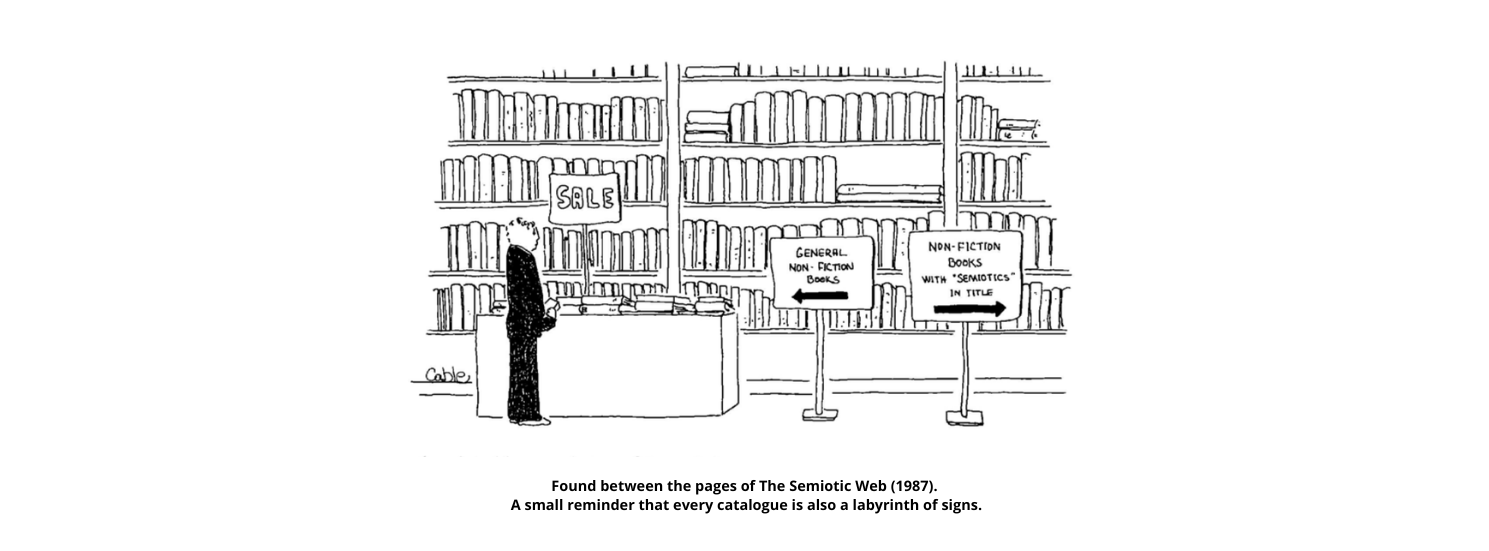
A unified academic catalogue for books, journal articles, book chapters, proceedings papers, conference abstracts and semiotic research materials.
A unified academic catalogue for books, journal articles, proceedings papers, collection articles and semiotic research materials. Search across the full database; results are shown with pagination.
Thesaurus
Browse authorized terms and raw keywords indexed across books, journals, articles, collections and proceedings. Authorized terms search variants and related concepts.
The Shared Mind
edited by Jordan Zlatev | Timothy P. Racine | Chris Sinha | Esa Itkonen
Social John Benjamins Publishing Company 9789027239068 Available
View details
Other title information: Perspectives on intersubjectivity
Annotation: The cognitive and language sciences are increasingly oriented towards the social dimension of human cognition and communication. The hitherto dominant approach in modern cognitive science has viewed social cognition through the prism of the traditional philosophical puzzle of how individuals solve the problem of understanding Other Minds. The Shared Mind challenges the conventional theory of mind approach, proposing that the human mind is fundamentally based on intersubjectivity: the sharing of affective, conative, intentional and cognitive states and processes between a plurality of subjects. The socially shared, intersubjective foundation of the human mind is manifest in the structure of early interaction and communication, imitation, gestural communication and the normative and argumentative nature of language. In this path breaking volume, leading researchers from psychology, linguistics, philosophy and primatology offer complementary perspectives on the role of intersubjectivity in the context of human development, comparative cognition and evolution, and language and linguistic theory.
Identifier: 9789027239068
Status: Available
René Thom's Semiotics: An Application to the Pathological Limitations of Semiosis
Laurent Mottron
In: The Semiotic Web 1988
- Pages
- 91-127
The Semiotic Web
View details
THE CASE FOR A POST-STRUCTURALIST MIMESIS: JOHN BARTH AND IMITATION
Robert Con Davis
In: The American Journal of Semiotics 1985, Volume 3, Issue 3
- Pages
- 49-72
The American Journal of Semiotics
View details
Herman Parret et ale (eds.): Possibilities and Limitations of Pragmatics: Proceedings of the Conference on Pragmatics
Richard L. Lanigan
In: The American Journal of Semiotics 1984, Volume 2, Issue 4
- Pages
- 171-176
The American Journal of Semiotics
View details
Palimpsestes
Gérard Genette
- Dependent title
- la littérature au second degré
Literature Seuil 2020061163 Available
View details
Annotation: Un palimpseste est litéralement, un parchemin dont on a gratté la première inscription pour lui en substituer une autre, mais où cette opération n'a pas irrémédiablement effacé le texte primitif, en sorte qu'on peut y liter l'ancien sous le nouveau, comme par transparence. Cet état de choses montre, au figuré, qu'un texte peut toujours en cacher un autre ,ais qu'il le dissimule rarement tout à fait, et qu'il se prête le plus souvent à ine double lecture où se superposent, au moins un hypertexte et son hypotexte - ainsi, dit-on l'Ulysse de Joyce et l'Odysée d'Homère. J'entends ici par hypertextes toutes les œvres dérivées d'une œvre antérieure, part transformation, comme dans la parodie, ou par imitation, comme dans le pastiche. Mais pastiche et parodie ne sont que les manifestations à la fois les plus visibles et les plus mineures de cette hypertextualité, out littérature au second degré, qui s'écrit en lisant, et dont la place et l'action dans le champ littéraire - et un peu au-delà - sont généralement, et fâcheusement, méconnunes. Jëntreprends ici d'explorer ce territoire. Un texte peut toujours en lire un autre, et ainsi de suite jusqu'à la fin des textes. Celui-ci n'échappe pas à la règle : il l'expose et s'y expose. Lira bien qui lira le dernier. A palimpsest is literally a parchment from which the first inscription has been scratched out to replace it with another, but where this operation has not irremediably erased the original text, so that the old can be read under the new, as if by transparency. This state of affairs shows, figuratively, that a text can always hide another, but that it rarely conceals it completely, and that it most often lends itself to a double reading where at least one hypertext and its hypotext are superimposed - thus, we say, Joyce's Ulysses and Homer's Odyssey. I mean here by hypertexts all works derived from an earlier work, by transformation, as in parody, or by imitation, as in pastiche. But pastiche and parody are only the most visible and minor manifestations of this hypertextuality, a literature of the second degree, which is written by reading, and whose place and action in the literary field - and a little beyond - are generally, and unfortunately, unknown. I undertake here to explore this territory. One text can always read another, and so on until the end of the texts. This one does not escape the rule: it exposes it and exposes itself to it. He who reads last, will read well. (translated with Google translate)
Identifier: 2020061163
Status: Available
Interactive functions and limitations of verbal and nonverbal behaviors in natural conversation
FERNANDO POYATOS
In: Semiotica 1980, Issue 2024-03-04 00:00:00
Semiotica DOI: 10.1515/semi.1980.30.3-4.211
View details
Identifier: DOI: 10.1515/semi.1980.30.3-4.211