
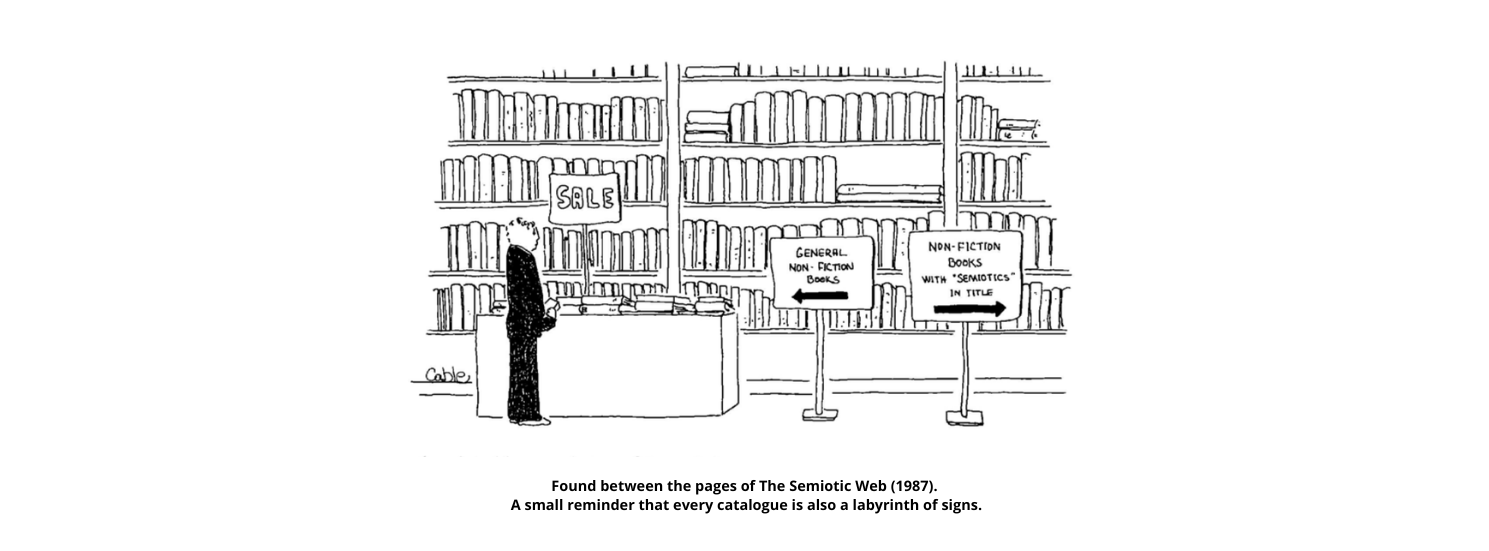
A unified academic catalogue for books, journal articles, book chapters, proceedings papers, conference abstracts and semiotic research materials.
A unified academic catalogue for books, journal articles, proceedings papers, collection articles and semiotic research materials. Search across the full database; results are shown with pagination.
Thesaurus
Browse authorized terms and raw keywords indexed across books, journals, articles, collections and proceedings. Authorized terms search variants and related concepts.
From Body Fuel to Universal Poison
Francesco Buscemi
- Edition
- 1 edition
Culture Springer Cham 9783319720852 Available
View details
Other title information: Cultural History of Meat: 1900-The Present
Annotation: This book explores our changing relationship with meat as food. Half storytelling and half historic work, it analyzes the way in which humans have dealt with the idea of eating animals in the Western world, from 1900 to the present.
Identifier: 9783319720852
Status: Available
Lexikon der Mensch-Tier-Beziehungen
Arianna Ferrari | Klaus Petrus (Hg.)
Biology / Biosemiotics Transcript Verlag 9783837622324 Available
View details
Annotation: Our relationship with "other" animals is not only becoming socially ever more significant, it has also been rediscovered as a topic for the humanities and sciences. This volume is the first encyclopedia to devote itself comprehensively to the relationship between humans and animals. In contrast to traditional introductions into animal ethics, the large-scale work does not limit itself to issues of moral philosophy but also explores the human-animal relationship from a historical, sociological, ethological and cultural perspective
Identifier: 9783837622324
Status: Available
Semiosis and Catastrophes
edited by Wolfgang Wildgen and Paer Aage Brandt
- Edition
- 1 edition
Linguistics Peter Lang Publishing 9783034304672 Available
View details
Other title information: René Thom’s Semiotic Heritage
Annotation: The central concern of this volume is semiogenesis, i.e. the evolution and differentiation of meaningful («pregnant») forms in the field of symbolic systems – from bio-communication to language and cultural forms like music, art, architecture or urban forms. The basic questions are: How are meanings created and further differentiated? Where do they come from? What kind of forces drive their unfolding? How can complex cultural forms be understood based on simple morphodynamic principles? Applications concern the perception of forms by animals and humans, the categorization of forms e.g. in a lexicon, and predication or other complex symbolic behaviors which show up in grammar or in cultural artifacts like the unfolding of urban centers.
Identifier: 9783034304672
Status: Available
Animals and music: Between cultural definitions and sensory evidence
Gisela Kaplan
In: Sign System Studies 2009, Volume 37, Issue 3/4: Zoosemiotics
- Pages
- 423-453
Sign Systems Studies 10.12697/SSS.2009.37.3-4.02
View details
Identifier: 10.12697/SSS.2009.37.3-4.02
Studying the cognitive states of animals: Epistemology, ethology and ethics
Otto Lehto
In: Sign System Studies 2009, Volume 37, Issue 3/4: Zoosemiotics
- Pages
- 369-422
Sign Systems Studies 10.12697/SSS.2009.37.3-4.01
View details
Identifier: 10.12697/SSS.2009.37.3-4.01
The origins of meaning
James R. Hurford
- Dependent title
- Vol. 1
Linguistics Oxford University Press 9780199207855 Available
View details
Other title information: Language in the Light of Evolution
Annotation: Hurford integrates findings from ethology and neuroscience with concepts from philosophy and linguistics to make an explicit and convincing case that animals have rich concepts, and thus that meaning predated language
Identifier: 9780199207855
Status: Available
Defining the semiotic animal
John Deely
General Semiotics Tip-Top Press 9548964678 Available
View details
Other title information: A postmodern definiton of "human being" to supersede the modern definition as "res cogitans"
Notes: Fourth and last publication in the 2005 Semiotics Seminar series
Annotation: The book starts with a historical overview of general semiotics and then transitions into zoosemiotics and biosemiotics, focusing on perception in animals and humans with a goal of defining what it means to be human
Identifier: 9548964678
Status: Available
Thinking with animals
Andreas Roepstorff
In: Sign System Studies 2001, Volume 29, Issue 1: Semiotics of nature
- Pages
- 203-218
Sign Systems Studies 10.12697/SSS.2001.29.1.12
View details
Identifier: 10.12697/SSS.2001.29.1.12
La Traduzione
edited by Susan Petrilli
General Semiotics Meltemi editore 8883530349 Available
View details
Annotation: This issue of Athanor is a collection of contributions by specialists from different disciplinary fields - semiotics, linguistics, literary criticism, philosophy, and biology - on the problems of translation. We can distinguish them on the basis of two orientations. One consists in limiting the question of translation to the realm of verbal language or, more specifically, to the relationship between historical-natural languages, or, again, to the more restricted realm of literary and poetic translation. The other, instead, aims to broaden the field of investigation to intersemiotic translation, between different non-verbal languages and even outside of human languages, to the point of including translations of a specifically biological nature that are the object of study of biosemiotics - such as for example, the three different types of translation in the nutritional system that constitute the difference between plants, animals and mushrooms - or the cyborg translation between organic and inorganic made possible by current technological development. (Translated with Google Translate)
Identifier: 8883530349
Status: Available
Language and Human Behaviour
Derek Bickerton
Linguistics UCL Press Limited 1857285417 Available
View details
Annotation: Bickerton argues that each of the properties distinguishing human intelligence and consciousness from that of other animals can be shown to derive straightforwardly from properties of language. In essence, language arose as a representational system, not a means of communication or a skill, and not a product of culture but an evolutionary adaptation.
Identifier: 1857285417
Status: Available
The Socialness of Things
edited by Stephen Harold Riggins
Social Mouton de Gruyter 3110141337 Available
View details
Other title information: Essays on the Socio-Semiotics of Objects
Notes: This book is based on the proceedings of an international conference which took place at the University of Toronto in 1990.
Annotation: The term "socialness" is a neologism that is used in this volume to call attention to the integration of objects in the social fabric of everyday life. Specialists in material culture studies have understood for some time, that societies consist of both people and artifacts. It is not only with people and animals that we interact but also with objects. The chapters in the first part of the volume deal with artefacts such as furniture, mementoes, and knickknacks, which can be manipulated as social "others" – entities with which one can socialize or make a part in socialisation processes such as establishing a bond, conveying a message, etc. The second section of articles concerns artefacts whose dimensions take such proportions that humans become dwarfed with respect to them, such as tourists travelling to visit them or shoppers being herded through their artificial geography as if flowing within an oversized organism. In the concluding section, the artefacts examined are by contrast so adjusted to the proportion of the human body, so close to it that they become an indissociable part of the social persona sticking to the skin, expressing better than any other means of the socialness - fashion.
Identifier: 3110141337
Status: Available
A stroll through the worlds of animals and men: A picture book of invisible worlds
JAKOB VON UEXKÜLL
In: Semiotica 1992, Issue 4
Semiotica DOI: 10.1515/semi.1992.89.4.319
View details
Identifier: DOI: 10.1515/semi.1992.89.4.319
From calculus to language: The case of circus equine displays
PAUL BOUISSAC
In: Semiotica 1991, Issue 2024-03-04 00:00:00
Semiotica DOI: 10.1515/semi.1991.85.3-4.291
View details
Identifier: DOI: 10.1515/semi.1991.85.3-4.291
Introduction: The circus — a semiotic spectroscopy
PAUL BOUISSAC
In: Semiotica 1991, Issue 2024-03-04 00:00:00
Semiotica DOI: 10.1515/semi.1991.85.3-4.189
View details
Identifier: DOI: 10.1515/semi.1991.85.3-4.189
My circus fieldwork
MARY DOUGLAS
In: Semiotica 1991, Issue 2024-03-04 00:00:00
Semiotica DOI: 10.1515/semi.1991.85.3-4.201
View details
Identifier: DOI: 10.1515/semi.1991.85.3-4.201
Old Regnas et le droit chemin: Analyse sémiotique et opérateurs topologiques
ANDREA SEMPRINI
In: Semiotica 1991, Issue 2024-03-04 00:00:00
Semiotica DOI: 10.1515/semi.1991.85.3-4.319
View details
Identifier: DOI: 10.1515/semi.1991.85.3-4.319
Performance and family in the world of British circus
YORAM S. CARMELI
In: Semiotica 1991, Issue 2024-03-04 00:00:00
Semiotica DOI: 10.1515/semi.1991.85.3-4.257
View details
Identifier: DOI: 10.1515/semi.1991.85.3-4.257
Sonstiges
In: Semiotica 1991, Issue 2024-03-04 00:00:00
Semiotica DOI: 10.1515/semi.1991.85.3-4.u
View details
Identifier: DOI: 10.1515/semi.1991.85.3-4.u
Symbolic types, the body, and circus
DON HANDELMAN
In: Semiotica 1991, Issue 2024-03-04 00:00:00
Semiotica DOI: 10.1515/semi.1991.85.3-4.205
View details
Identifier: DOI: 10.1515/semi.1991.85.3-4.205
The rhetoric of romance and the simulation of tradition in circus clown performance
W. KENNETH LITTLE
In: Semiotica 1991, Issue 2024-03-04 00:00:00
Semiotica DOI: 10.1515/semi.1991.85.3-4.227
View details
Identifier: DOI: 10.1515/semi.1991.85.3-4.227
A Cape Breton System of personal names: Pragmatic and semantic change
ELIZABETH MERTZ
In: Semiotica 1983, Issue 2024-01-02 00:00:00
Semiotica DOI: 10.1515/semi.1983.44.1-2.55
View details
Identifier: DOI: 10.1515/semi.1983.44.1-2.55
Cinema and semiosis
F. W. GALAN
In: Semiotica 1983, Issue 2024-01-02 00:00:00
Semiotica DOI: 10.1515/semi.1983.44.1-2.21
View details
Identifier: DOI: 10.1515/semi.1983.44.1-2.21
Commemorative essay. Roman Jakobson
EDWARD STANKIEWICZ
In: Semiotica 1983, Issue 2024-01-02 00:00:00
- Pages
- 1-20
Semiotica DOI: 10.1515/semi.1983.44.1-2.1
View details
Identifier: DOI: 10.1515/semi.1983.44.1-2.1
Ecriture, peinture: Des calligrammes aux pictogrammes
GENEVlÈVE CORNU
In: Semiotica 1983, Issue 2024-01-02 00:00:00
Semiotica DOI: 10.1515/semi.1983.44.1-2.123
View details
Identifier: DOI: 10.1515/semi.1983.44.1-2.123
La structure de la description réaliste dans la littérature européenne
PATRICK IMBERT
In: Semiotica 1983, Issue 2024-01-02 00:00:00
- Pages
- 95-122
Semiotica DOI: 10.1515/semi.1983.44.1-2.95
View details
Identifier: DOI: 10.1515/semi.1983.44.1-2.95
Publications received
In: Semiotica 1983, Issue 2024-01-02 00:00:00
Semiotica DOI: 10.1515/semi.1983.44.1-2.199
View details
Identifier: DOI: 10.1515/semi.1983.44.1-2.199
Review article
In: Semiotica 1983, Issue 2024-01-02 00:00:00
Semiotica DOI: 10.1515/semi.1983.44.1-2.137
View details
Identifier: DOI: 10.1515/semi.1983.44.1-2.137
Sonstiges
In: Semiotica 1983, Issue 2024-01-02 00:00:00
Semiotica DOI: 10.1515/semi.1983.44.1-2.u
View details
Identifier: DOI: 10.1515/semi.1983.44.1-2.u
What became of Eliza Doolittle? A case study of the sign in fiction
PETER CASSIRER
In: Semiotica 1983, Issue 2024-01-02 00:00:00
Semiotica DOI: 10.1515/semi.1983.44.1-2.75
View details
Identifier: DOI: 10.1515/semi.1983.44.1-2.75