
A unified academic catalogue for books, journal articles, book chapters, proceedings papers, conference abstracts and semiotic research materials.
A unified academic catalogue for books, journal articles, proceedings papers, collection articles and semiotic research materials. Search across the full database; results are shown with pagination.
Culture and Communication
- Dependent title
- An Anthology of Major and Lesser-Known Works by Yuri Lotman
- Edition
- 1 edition
View details
Other title information: Signs in Flux
Notes: Translated from Russian by Benjamin Paloff
Annotation: This collection provides a stand-alone primer to his intellectual legacy in both semiotics and cultural history. It includes new translations of some of his major pieces as well as works that have never been published in English. The collection brings Lotman into the orbit of contemporary concerns such as gender, memory, performance, world literature, and urban life. It is aimed at students from various disciplines and is augmented by an introduction and notes that elucidate the relevant contexts.
Identifier: 9781644693872
Status: Available
Passions of Our Time
View details
Notes: edited with foreword by Lawrence D. Kritzman. Printed version in two notebooks
Annotation: Julia Kristeva is a true polymath, an intellectual of astonishingly wide range whose erudition and insight have been brought to bear on psychoanalysis, literary criticism, gender and sex, and cultural critique. Passions of Our Time showcases recent essays of Kristeva’s that demonstrate the scope of her capacious intellect, her gifts as a stylist, and the profound contribution of her thought to the challenges of the present. The collection begins with а vivid recollection of celebrating, as a child in Bulgaria, Alphabet Day, the holiday honoring the Cyrillic letters, which proceeds outward into a contemplation of the writer as translator. Kristeva considers literature with Barthes, freedom through Rousseau, Teresa of Avila and mystical experience, Simone de Beauvoir’s dream life, and Antigone and the psychic life of women. A group of essays drawing on her psychoanalytic work delve into Freud, Lacan, maternal eroticism, and the continued importance of psychoanalysis today. In a series of striking investigations, she thinks through disability and normativity, monotheism and secularization, the need to believe and the desire to know. Calling for the courage to renew and reinvent humanism, she outlines the principles of a stance founded on the importance of respecting human life. Finally, Kristeva discusses French culture and diversity, rethinking universalism and interrogating the potential for Islam and psychoanalysis to meet, and pays homage to Beauvoir by rephrasing her dictum into the provocative “One is born woman, but I become one.”
Identifier: 9780231171441
Status: Available
Grand Hotel Abyss
View details
Other title information: The Lives of the Frankfurt School
Annotation: Who were the Frankfurt School — Benjamin, Adorno, Marcuse, Horkheimer — and why do they matter today? In 1923, a group of young radical German thinkers and intellectuals came together to at Victoria Alle 7, Frankfurt, determined to explain the workings of the modern world. Among the most prominent members of what became the Frankfurt School were the philosophers Walter Benjamin, Theodor Adorno, Max Horkheimer, and Herbert Marcuse. Not only would they change the way we think, but also the subjects we deem worthy of intellectual investigation.Grand Hotel Abyss combines biography, philosophy, and storytelling to reveal how the Frankfurt thinkers gathered in hopes of understanding the politics of culture during the rise of fascism. Some of them, forced to escape the horrors of Nazi Germany, later found exile in the United States. By taking popular culture seriously as an object of study—whether it was film, music, ideas, or consumerism—the Frankfurt School elaborated upon the nature and crisis of our mass-produced, mechanised society. Grand Hotel Abyss shows how much these ideas still tell us about our age of social media and runaway consumption.
Identifier: 9781784785697
Status: Available
The problem of the modern and tradition
View details
Other title information: early Soviet musical culture and the musicological theory of Boris Asafiev (1884–1949)
Annotation: This is the first English language analytical and critical monograph to examine Asafiev's literary output during 1916-1930. The author explores Asafiev's critical and musicological works both against the backfrop of Russian cultural history, an within the Western Europen intellectual historical context. She demonstrates how Asafiev became an established Soviet cultural theorietician of music, a celebrated but also a persecuted Soviet musicologist.
Identifier: 9789526825779
Status: Available
Greimas close and far
View details
Parallel title: Parallel title: Greimas arti ir toli
Annotation: Algirdas Julien Greimas (born Algirdas Julius Greimas) is one the most prominent creators of semiotics who laid the foundations of the Paris School of Semiotics known all over the world. He was also a famous linguist who researched Lithuanian mythology. Algirdas Julien Greimas is one of the most prominent Lithuanians in the international world of science, in many aspects compared to Mikalojus Konstantinas Čiurlionis. The greatest influence on the life and works of Greimas came from French culture renowned for its science, literature and art. Nevertheless, the time spent in Lithuania was also significant. Greimas himself viewed Lithuanian and western (French) periods of his life as correlation between two cultures. Therefore, every moment of his life is important to us, each moment contributing to the whole picture and enriching his life. Neither Greimas' childhood nor his youth which is the genesis of intellectual and aesthetic signs is reviewed in literature. Various authors tend to start writing Greimas'biography starting from his years in Vytautas Magnus University. Professor Eero Tarasti, the president of the International Association for Semiotic Studies, offered me to prepare a work about Greimas' life in Lithuania. As I myself studied in Kupiškis and knew a lot of things about the Greimas family, I decided to look at Greimas'childhood period in Kupiškis. The sources I used in this work are as follows: Greimas' words about his childhood, national and personal archives, press of those days and stories told by those who knew the Greimas family.My experience with exceptionally gifted children in National M. K. Čiurlionis School of Art in Vilnius and consulting with famous scientist has helped me to discuss the genesis of intellectual and aesthetic signs in Greimas' biography. As for the form of the work, I have chosen to use the form of an exposition with elements of a poster presentation, which allowed me to participate in significant scientific forums in France, Finland, Russia and China. In Lithuania, in those places where Greimas lived, my exposition contributed to the studies of his biography, organisation of conferences and dedication to Greimas. As it turned out, the prestigious gymnasiums where Greimas studied in Šiauliai and Marijampolė established in 1851 and 1867 have raised about half (9 out of 20) of those who signed the Act of Independence of Lithuania on 16 February 1918 and 12 out of 100 most outstanding persons in Lithuania in a millennium. In this respect these two gymnasiums are the only ones in Lithuania. It should also be mentioned that Greimas attended lectures in Vytautas Magnus University by famous Lithuanian scientists Mykolas Romeris, Vladas Jurgutis, Vosylius Sezemanas and Jonas Bučas who later contributed to laying the foundation for the science of semiotics.
Identifier: 9789955038702
Status: Available
Mathematics as a Modeling System
- Edition
- 1 edition
View details
Other title information: a Semiotic Approach
Notes: Editors of the series: Kalevi Kull, Silvi Salupere, Peeter Torop
Annotation: Mathematics and semiotics share many intellectual features and interests, from the study of how representations stand for specific kinds of referents to philosophical considerations of how these interrelate with reality. Nonetheless, in-depth studies of this intrinsic relation between the two have rarely been undertaken, with a few notable exceptions (as will be discussed in the book). Especially relevant to the study of the nature of mathematics is the concept of model – a term and notion that is used widely in both disciplines. However, to the best of our knowledge the theory of models in semiotics, known as Modeling Systems Theory, has rarely, if ever, been applied to the study of mathematical modeling. The purpose of this book is to do exactly that since it is our view that mathematics is a de facto modelling system in the semiotic sense and it is our hope that from this it will be possible to gain considerable insights into how mathematics works and achieves the discoveries and forms of knowledge that it has since the dawn of antiquity. Hopefully, this will allow both mathematicians and semioticians to pursue similar or analogous research objectives with regard to understanding the biological and cognitive etiology of sign systems and their connection to reality.
Identifier: 9789949326105
Status: Available
Are You Stupid?
- Edition
- 1 edition
View details
Other title information: A Second Revolution Might Save America From Herself
Annotation: In the most dynamic and prosperous country on Earth-the USA-stupidity overshadows the intellectual and technical accomplishments that other nations envy. If Americans continue to delude themselves about their country, the USA will end up like the USSR: imploding from within. This work analyzes the systemic aspects of America's current condition: across-the-board-dumbing down through media and in education; growing dependence on and demand for entitlements; corruption in the private and political domains; chronic cronyism; the opportunistic engineering of reality. Consequently, individual and collective stupidity not only leads to crises, it renders the USA impotent in dealing with the challenges of the fast dynamics characteristic of our time of post-industrial capitalism oriented towards consumption. The causes for this state of stupidity are examined: the people's willful ignorance of the nation's true history and development; an economic system that does not foster a sense of citizenry; cultivated mediocrity in education and entertainment; corruption of justice; rampant consumerism; a state of prosperity that lulls the people into complacency. Taking the rewards of change for granted, Americans no longer understand what change entails. Gazing into the rear-view mirror of history in search of answers, they forget that the USA was founded in a world more similar to the 1st century than the 21st. Americans will have to start fighting their own stupidity instead of further exhausting the country's (and the world's) resources in wars and entitlement measures. America has to "reset" herself, within an authentic democratic process, on a foundation appropriate to the integrated world of the global information age.
Identifier: 9781490525655
Status: Available
From semantics to semiotics: A page of early Soviet intellectual history
In: Sign System Studies 2011, Volume 39, Issue 1
- Pages
- 224-235
View details
Identifier: 10.12697/SSS.2011.39.1.08
Universals in the Context of Juri Lotman's Semiotics
- Edition
- 1 edition
View details
Notes: Appendix: Three lectures by Juri Lotman
Annotation: This book looks afresh at the heritage of cultural semiotician Juri Lotman - the founder of the Tartu-Moscow school of semiotics. The author proceeds from the idea that 'intellect' is one of the central categories of Juri Lotman's semiotics. Intellect becomes an important concept in Lotman's heritage - starting with the series of lectures given by him in the autumn and winter of 1967 at the University of Tartu (the lectures are published for the first time as an appendix to the book).
Identifier: 9789949118311
Status: Available
Muotokuvia
View details
Other title information: Tulkintoja, Muistelmia, Tarnoita
Annotation: Portraits is a work in which culture, art and science are approached through the persons who practice them. Some are famous men and women in the Finnish context, from Mannerheim to Ville Vallgren and Anna Sahlstén, while others are international celebrities from Ludvig II and George Sand to Umberto Eco. Memoirs, documents, letters and anecdotes about the lives of the lesser-known are passed on to those who have not known them. Various life works attract the author to intellectual reflections and analyses. But through them the author also draws his own profile as a semiotician, musician and scholar.
Identifier: 9525431142
Status: Available
Intellectual Effort and Linguistic Work
- Dependent title
- Semiotic and Hermeneutic Aspects of the Philosophy of Bergson
View details
Annotation: Bergson discusses the questions of philosophic truth in a way that allows an interpretation in terms of contemporary semiotics and hermeneutics. In his famous "Philosophical intuition" he defines this kind of truth as "something simple, infinitely simple, so extraordinarily simple that the philosopher has never succeded in saying it". This dialectic between intuition and its 'saying' is examined as the hermeneutics of understanding and interpretation. At the same time, this study attempts to open new insights in Bergson's philosophy, and especially in his notion of Intellectual Effort. Kristian Bankov, in his essay, considers this concept not only central to Bergson's philosophy, but also a key to the sign-nature of our whole being and existence in the world.
Identifier: 9519865403
Status: Available
Semiotic Grammar
- Edition
- 1 edition
View details
Annotation: The label `semiotic grammar' captures a fundamental property of the grammars of human languages: not only is language a semiotic system in the familiar Saussurean sense, but its organizing system, its grammar, is also a semiotic system. This proposition, explicated in detail by William McGregor in this book, constitutes a new theory of grammar. Semiotic Grammar is `functional' rather than `formal' in its intellectual origins, approaches, and methods. It demonstrates, however, that neither a purely functional nor a purely formal account of language is adequate, given the centrality of the sign as the fundamental unit of grammatical analysis. The author distinguishes four types of grammatical signs: experiential, logical, interpersonal, and textural. The signifiers of these signs are syntagmatic relationships of the following types, respectively: constituency, dependency, conjugational and linking. McGregor illustrates and exemplifies the theory with data from a variety of languages including English, Acehnese, Polish, Finnish, Japanese, Chinese, and Mohawk; and from his pioneering research on Gooniyandi and Nyulnyul, two languages of the Kimberleys region of Western Australia.
Identifier: 0198236883
Status: Available
The Making of Avant-Garde
View details
Other title information: Tel Quel
Annotation: The present work will examine the constitution of Tel Quel's multipositionality (Boltanski 1973: 3-26), or funtion as a geometric locus, as the social creation of a symbolic good that combined all signs of intellectual radicality characteristic of the period. My aim is to analyze Tel Quel as a relatively heterogenous and changing object by exploring in a specific context its constitution, ascension, and decline as an intellectual avant-garde.
Identifier: 3110139529
Status: Available
The historian in the labyrinth of signs: Reconstructing cultures and reading texts in the practice of intellectual history
In: Semiotica 1991, Issue 2024-03-04 00:00:00
- Pages
- 351-384
View details
Identifier: DOI: 10.1515/semi.1991.83.3-4.351
The thought of Mikhail Bakhtin
- Edition
- 1 edition
View details
Other title information: from word to culture
Annotation: Occupying a still evolving but clearly established place in 20th-century intellectual history, Mikhail Bakhtin is best characterized as a philosopher of dialogue or human communication. The book approaches its subject by concentrating on problems of language and literature
Identifier: 0333556321
Status: Available
Beyond Goffman
View details
Other title information: Studies on Communication, Institution, and Social Interaction
Notes: Based on a conference held Dec. 1987 at the Central Institute of Indian Languages in Mysore, India.
Annotation: This book is a collection of original articles which endeavours to expand the scope of the theoretical views and empirical research Erving Goffman contributed to the social sciences. Most chapters take a critical stand toward his ideas while still recognizing his fundamental contribution to the field. Hence, the title Beyond Goffman. The book is divided into two parts. The first concentrates upon theory and explores Goffman's intellectual heritage (symbolic interactionism, phenomenology, the notion of social situation, the relation between micro and macro levels of analysis) and also examines the way his work relates to contemporary theoretical movements (semiotics, postmodernism, deconstructionism, and feminism). The second part of the book probes the insights found in his diverse empirical studies and expands the domain of their applications.
Identifier: 3110122081
Status: Available
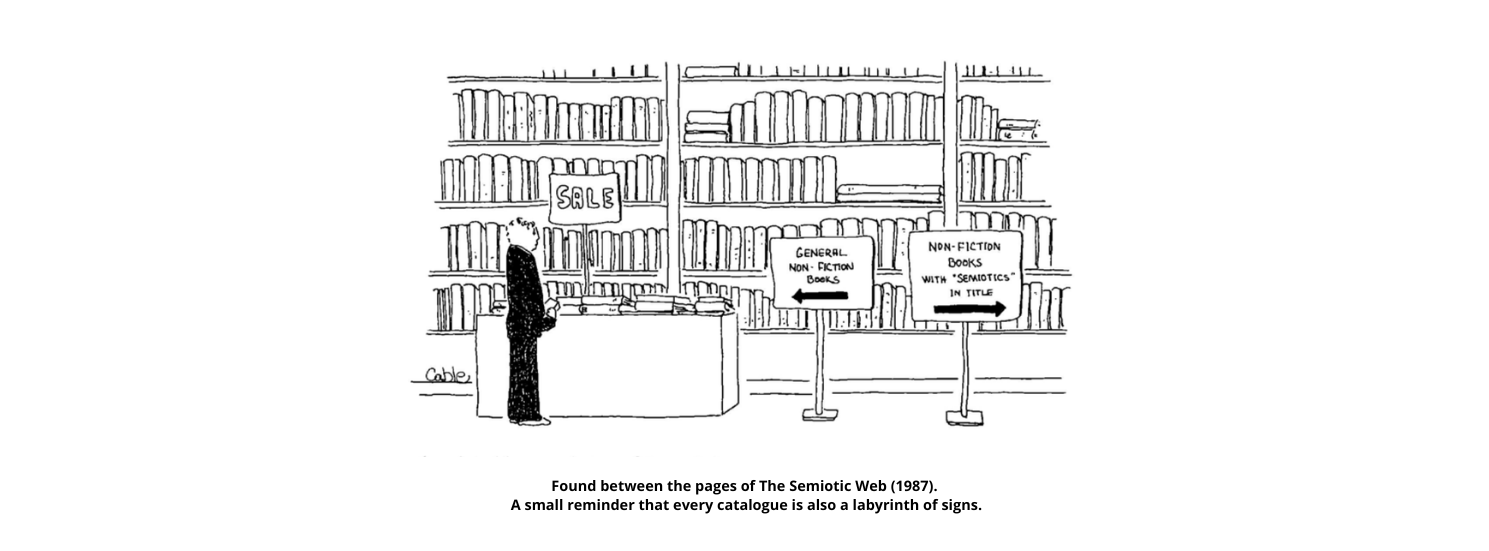
Algirdas J. Greimas: An Intellectual Biography
In: The Semiotic Web 1987
- Pages
- 23-36
View details
Umberto Eco: An Intellectual Biography
In: The Semiotic Web 1987
- Pages
- 3-22
View details
Writings of Charles S. Peirce
View details
Other title information: a chronological edition. Volume 3
Annotation: For anyone seriously interested in Peirce, or in nineteenth-century American philosophy, or in American intellectual history, or in philosophy in general, or in semiotics and its philosophical import, these volumes should be required reading.""--Murray G. Murphey, Semiotica
Identifier: 0253372038
Status: Available
Saussure and the intellectual traditions of the twentieth century
In: Semiotica 1985, Issue 2024-01-02 00:00:00
View details
Identifier: DOI: 10.1515/semi.1985.57.1-2.33
Semiotics and legal theory
View details
Annotation: Semiotics and Legal Theory is an exercise in exposition, comparison, criticism, and construction. Jackson takes two very different intellectual traditions - structuralist semiotics as represented by A.J. Greimas and modern (mainly positivist) legal theory as represented by Hart, MacCormick, Dworkin, and Kelsen and by juxtaposing them seeks to clarify and assess their respective semiotic presuppositions, in order to lay some foundations for a semiotically sensitive theory of law. This book is designed for both jurists and semioticians. To facilitate access across the disciplinary divide, Jackson provides an abstract at the head of each chapter, which serves as both a summary and a conclusion to each section.
Identifier: 0952893819
Status: Available
A Brief Intellectual Autobiography by Charles Sanders Peirce
In: The American Journal of Semiotics 1983, Volume 2, Issue 1/2
- Pages
- 61-83
View details
The Subject of Semiotics
View details
Annotation: Through the writings of Ferdinand de Saussure, Roland Barthes, Jacques Lacan and others, the kindred disciplines of semiotics and structuralism have stirred enormous interest within European and American intellectual circles in recent years. With their focus on the ways in which signs, symbols, and cultural phenomena of all kinds convey meaning, these burgeoning theoretcial fields have had a special impact on the analysis of fil and literature. In this provocative book Kaja Silverman undertakes a new and challenging reading of recent semiotic and structuralist theory, arguing that films, novels, and poems cannot be studied in isolation from their viewers and readers.
Identifier: 9780195031782
Status: Available
L'obvie et l'obtus
- Dependent title
- Essais critiques III
- Edition
- 2nd
View details
Annotation: The symbolic meaning imposes itself on me by a double determination: it is intentional (this is what the author meant) and it is taken from a sort of general, common lexicon of symbols: it is a meaning that goes to meet me. I propose to call this complete sign the obvious meaning. As for the other meaning, the third, the one that comes 'in excess', like a supplement that my intellect cannot quite absorb, at once stubborn and fleeting, smooth and eluding, I propose to call it 'the obtuse meaning.' --Roland Barthes
Identifier: 2020146096
Status: Available