
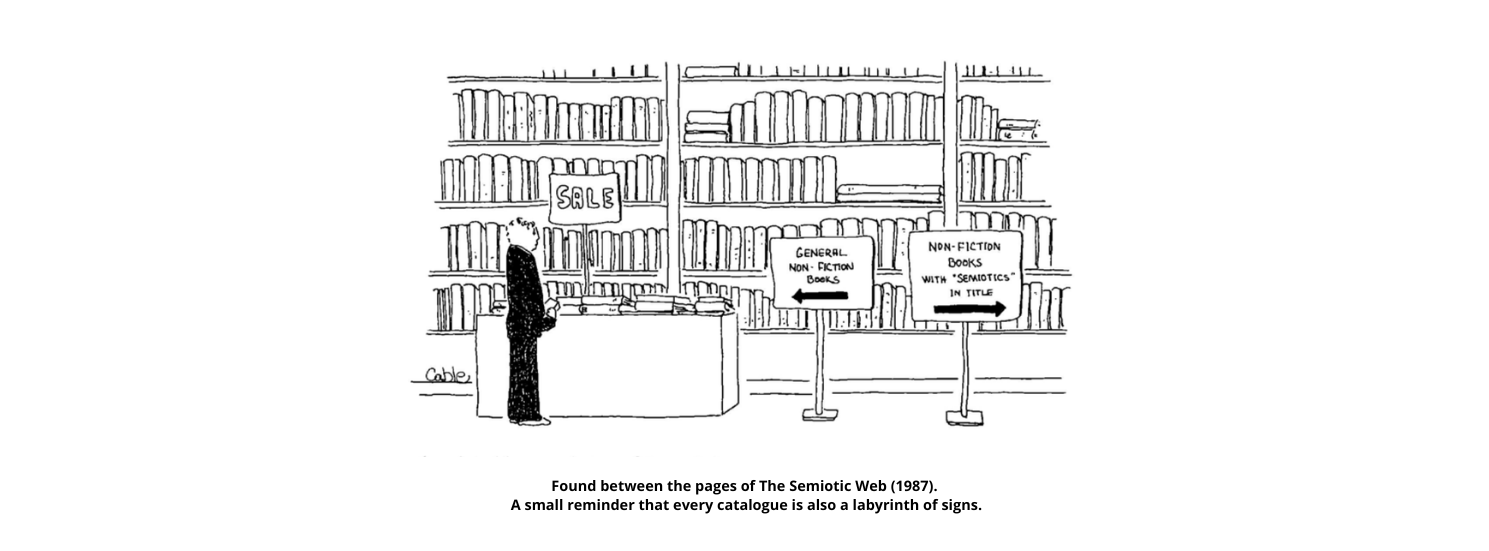
A unified academic catalogue for books, journal articles, book chapters, proceedings papers, conference abstracts and semiotic research materials.
A unified academic catalogue for books, journal articles, proceedings papers, collection articles and semiotic research materials. Search across the full database; results are shown with pagination.
Thesaurus
Browse authorized terms and raw keywords indexed across books, journals, articles, collections and proceedings. Authorized terms search variants and related concepts.
On the logical form and ontology of inferences in conversational implicatures
Denis Perrin
In: Semiotica 2021, Issue 240
- Pages
- 285-315
Semiotica DOI: 10.1515/sem-2021-0027
View details
Identifier: DOI: 10.1515/sem-2021-0027
Structural Units of Mass Culture Mythology
Lyudmyla Zaporozhtseva
- Edition
- 1 edition
Social Tartu University Press 9789949032150 Available
View details
Other title information: A Cultural Semiotic Approach
Annotation: My dissertation focuses on the study of myths and their semiotic mechanisms that appear in contemporary mass culture texts. Although myths and mass culture as a whole have been widely discussed from the perspectives of various disciplines, there are no studies that deal with the systematization of mass culture mythology and the semiotic definition of mythic markers. The topic of this dissertation is interesting not only from a general theoretical, philosophical, anthropological and semiotic perspective, but also for practical reasons. I believe that I can convincingly show in my work that the study and identification of semiotic mechanisms of mass culture myths is applicable in the field of marketing semiotics and social communication. In my dissertation, I first compare mass culture mythology from a sociological, philosophical-anthropological and semiotic perspective. This allows me to combine the two main epistemological approaches to myth research and treat myth as a holistic meta-concept on the one hand, and approach myth as a cultural text on the other. Based on the framework I have created, I will analyze various texts of mass culture in my work and focus on identifying the most common and enduring structural units of mass culture mythology. How do I define a smaller unit of myth? In defining it, I will rely on two structural principles of myth: the emic unit, which I denote by the concept of mythologeme, and the hybrid unit, which I denote by the concept of mytheme. In the course of the analysis, I will highlight the following mythologemes: Fate, Journey, Universality, Catastrophe, Golden Age and Mother Nature, and the mythemes: Transformation and Return. In addition to distinguishing the aforementioned mythologemes and mythemes, I will highlight their value and function in mythological discourse. Fate and Journey help to integrate the life of the individual into the whole. The mythologeme of Mother Nature is associated with the existential need of a person to search for authenticity and identity. The mythologemes of the Universe, Catastrophe and Golden Age constitute the human time-spatial past-present-future triad. The latter are related to human questions about the origin of the world, nostalgia for the past and fears about the future. The mythologeme of Transformation points to the idea of miracle and the mythologeme of Return to the time-spatial axis of the human semiosphere, to orderliness. The last chapter of the work applies the theoretical framework developed in the dissertation to specific case studies. The first of them is dedicated to the analysis of the TV political marketing of the Ukrainian politician Darth Vader, and there I show how archetypal mythological meanings were included in the structure of the political narrative. The second case study focuses on the development of a specific brand, which I did in collaboration with the well-known Russian pop artist Manizha, and where I apply the mythologeme of Mother Nature.Further research into mythologemes and mythemes could open up new semiotic markers and thereby expand the field of application of semiotics, as well as help to better understand the mythological basis of culture. This dissertation presents a semiotic study of myth revealing in contemporary mass cultural texts and exploration of its inner semiotic machinery. Although a variety of studies have been devoted to myth, and quite a few studies have tackled mass culture issues, less attention has been given to the systematic articulation of mass cultural mythology and its markers, which reveal its inner semiotic machinery. Those issues are relevant not only from a general theoretical philosophical, anthropological, and semiotic point of view, but also have concrete applicability in marketing semiotics and social communications. Firstly, I discuss mass culture under an emancipatory umbrella approach and explore mass culture mythology from the sociological, philosophical-anthropological and semiotic perspectives. Secondly, I combine two main epistemological attitudes of myth and integrate a holistic object of research – which appears as a meta-concept – from one side, and a text of culture – mass cultural narratives around brands conveying their main values – from the other side . Thirdly, I discuss the smallest units of mass culture mythology and explore its most widespread structural units. I classify the smallest units of myth by their structural principles: the emic units (mythologemes) and the hybrid ones (mythemes). There are the mythologemes of Fate, Course, Universe, Catastrophe, Golden Age, and Mother Nature, and the mythemes of Transformation and Backtracking considered in detail. The main existential values of those smallest mythological units are discussed. The mythologemes of Fate and Course help to understand individual life as a part of an integral whole. The mythologeme of Mother Nature relates to the existential search for inner authenticity and identity. The mythologemes of Universe, Catastrophe, and Golden Age constitute an integral triadic idea about time and space (past-present-future) and reflect the human existential quest for an explanation of the world origin, nostalgia for the past and fears about the future. The mytheme of Transformation represents the idea of mythological miracle, and the mytheme of Backtracking appeals to the idea of a mastered time and space. Fourthly, I extend the process to find more minimal units of myth in cultural texts of different genres. The first case is dedicated to close analysis of the television communication of the Ukrainian politician Darth Vader. This case demonstrates the combination of archaic meanings and contemporary forms of myth within a narrative, producing new powerful connotations. The second case applies the Mother Nature mythologeme as a branding tool for building a coherent image of a musical artist. The further exploration of the mythologemes and mythemes and articulation of other semiotic markers of myth systematically enriches a profound understanding of human mind and culture.
Identifier: 9789949032150
Status: Available
Przestrzeń i muzyka
Leszek Polony
Music Akademia Muzyczna w Krakowie 9788387182731 Available
View details
Annotation: This essay is the third in a series of works devoted to musical hermeneutics. In the first, I dealt with the basic concepts of music ontology: movement, play, being and time, drawing inspiration from the hermeneutical philosophy of Schleiermacher, Diltey, Heidegger and Gadamer. Then, inspired by the thought of Paul Ricoeur, I analysed the conceptual category of musical narrative. Even then, in these considerations, the category of space appeared many times, inseparable from human experience in its temporal and spatial structure and, as it turns out, inextricably linked to the experience of music. In the reception of music, we are undoubtedly given a certain "temporal" sound-musical space.
Identifier: 9788387182731
Status: Available
Movement and Poetic Rhythm
Drina Hocevar
- Dependent title
- Uncovering the Musical Signification of Poetic Discourse via The Temporal Dimension of the Sign
Music International Semiotics Institute 9525431063 Available
View details
Annotation: The musical sense in both poetry and music is fundamentally temporal. The question is not whether music is a language or whether language is music, but rather how the 'musicality' of language signifies. The musical sense of poetry is not only heard but it is also felt. In order to deal with these problems the author, Drina Hocevar, from Venezuela, has elaborated a highly original model. She tries to understand the temporal movement as a generative process, deeply rooted in the ontology of our being.
Identifier: 9525431063
Status: Available
The ontology of espionage in reality and fiction: A case study on iconicity
Frederik Stjernfelt
In: Sign System Studies 2003, Volume 31, Issue 1
- Pages
- 133-162
Sign Systems Studies 10.12697/SSS.2003.31.1.05
View details
Identifier: 10.12697/SSS.2003.31.1.05
Biosemiotics and formal ontology
Frederik Stjernfelt
In: Semiotica 1999, Issue 2024-01-04 00:00:00
- Pages
- 537-566
Semiotica DOI: 10.1515/semi.1999.127.1-4.537
View details
Identifier: DOI: 10.1515/semi.1999.127.1-4.537
Ontology and Teleology
Peter H. Salus
In: The American Journal of Semiotics 1991, Volume 8, Issue 3
- Pages
- 107-115
The American Journal of Semiotics
View details
A problem of genre: Two theories of autobiography
JANE HEATH
In: Semiotica 1987, Issue 2024-03-04 00:00:00
Semiotica DOI: 10.1515/semi.1987.64.3-4.307
View details
Identifier: DOI: 10.1515/semi.1987.64.3-4.307
A semiotic approach to prospection in Shelley
JONATHAN BALDO
In: Semiotica 1987, Issue 2024-03-04 00:00:00
Semiotica DOI: 10.1515/semi.1987.64.3-4.279
View details
Identifier: DOI: 10.1515/semi.1987.64.3-4.279
Dress right, dress: The Boy Scout uniform as a folk costume
JAY MECHLING
In: Semiotica 1987, Issue 2024-03-04 00:00:00
Semiotica DOI: 10.1515/semi.1987.64.3-4.319
View details
Identifier: DOI: 10.1515/semi.1987.64.3-4.319
Field dependence and sensitivity to facial affect cues
GARY H. JEFFERY; DONNA L. PATTERSON
In: Semiotica 1987, Issue 2024-03-04 00:00:00
Semiotica DOI: 10.1515/semi.1987.64.3-4.335
View details
Identifier: DOI: 10.1515/semi.1987.64.3-4.335
Métaphore, repères et phonétique
CHRISTIANE MORINET
In: Semiotica 1987, Issue 2024-03-04 00:00:00
Semiotica DOI: 10.1515/semi.1987.64.3-4.249
View details
Identifier: DOI: 10.1515/semi.1987.64.3-4.249
Negotiating the mimetic contract in film
PAUL S. LICKER
In: Semiotica 1987, Issue 2024-03-04 00:00:00
Semiotica DOI: 10.1515/semi.1987.64.3-4.213
View details
Identifier: DOI: 10.1515/semi.1987.64.3-4.213
Power-and-difference: An essay in semiotic ontology
J. FISHER SOLOMON
In: Semiotica 1987, Issue 2024-03-04 00:00:00
Semiotica DOI: 10.1515/semi.1987.64.3-4.259
View details
Identifier: DOI: 10.1515/semi.1987.64.3-4.259
Q-analysis and literary structure: A multi-dimensional representation of poetic relations
DAVID R. McCONNAUGHEY
In: Semiotica 1987, Issue 2024-03-04 00:00:00
Semiotica DOI: 10.1515/semi.1987.64.3-4.229
View details
Identifier: DOI: 10.1515/semi.1987.64.3-4.229
Review article
In: Semiotica 1987, Issue 2024-03-04 00:00:00
Semiotica DOI: 10.1515/semi.1987.64.3-4.343
View details
Identifier: DOI: 10.1515/semi.1987.64.3-4.343
The performance as an ’interpretant’ of the drama
ERIKA FISCHER-LICHTE
In: Semiotica 1987, Issue 2024-03-04 00:00:00
Semiotica DOI: 10.1515/semi.1987.64.3-4.197
View details
Identifier: DOI: 10.1515/semi.1987.64.3-4.197
The poet’s body: Toward a semiotic of Whitman and Rimbaud
PETER BAKER
In: Semiotica 1987, Issue 2024-03-04 00:00:00
Semiotica DOI: 10.1515/semi.1987.64.3-4.297
View details
Identifier: DOI: 10.1515/semi.1987.64.3-4.297
Esthétique comparée et sémiologie: Questions de méthodologie
MONIQUE BRUNET-WEINMANN
In: Semiotica 1977, Issue 2024-03-04 00:00:00
Semiotica DOI: 10.1515/semi.1977.21.3-4.257
View details
Identifier: DOI: 10.1515/semi.1977.21.3-4.257
Forms and Functions of Nonverbal Communication in the Novel: A New Perspective of the Author-Character-Reader Relationship
FERNANDO POYATOS
In: Semiotica 1977, Issue 2024-03-04 00:00:00
Semiotica DOI: 10.1515/semi.1977.21.3-4.295
View details
Identifier: DOI: 10.1515/semi.1977.21.3-4.295
Publications Received
In: Semiotica 1977, Issue 2024-03-04 00:00:00
Semiotica DOI: 10.1515/semi.1977.21.3-4.381
View details
Identifier: DOI: 10.1515/semi.1977.21.3-4.381
Review Article
In: Semiotica 1977, Issue 2024-03-04 00:00:00
Semiotica DOI: 10.1515/semi.1977.21.3-4.339
View details
Identifier: DOI: 10.1515/semi.1977.21.3-4.339
Scientific Theories as Meta-Semiotic Systems
MYRNA GOPNIK
In: Semiotica 1977, Issue 2024-03-04 00:00:00
Semiotica DOI: 10.1515/semi.1977.21.3-4.211
View details
Identifier: DOI: 10.1515/semi.1977.21.3-4.211
Sir Gawain and the Green Knight and the Semiotics of Ontology
WILLIAM BENZON
In: Semiotica 1977, Issue 2024-03-04 00:00:00
Semiotica DOI: 10.1515/semi.1977.21.3-4.267
View details
Identifier: DOI: 10.1515/semi.1977.21.3-4.267
Socio-sémiotique du roman courtois
KARIN BOKLUND
In: Semiotica 1977, Issue 2024-03-04 00:00:00
Semiotica DOI: 10.1515/semi.1977.21.3-4.227
View details
Identifier: DOI: 10.1515/semi.1977.21.3-4.227
The Dynamic Model of a Semiotic System
JU. M. LOTMAN
In: Semiotica 1977, Issue 2024-03-04 00:00:00
Semiotica DOI: 10.1515/semi.1977.21.3-4.193
View details
Identifier: DOI: 10.1515/semi.1977.21.3-4.193