
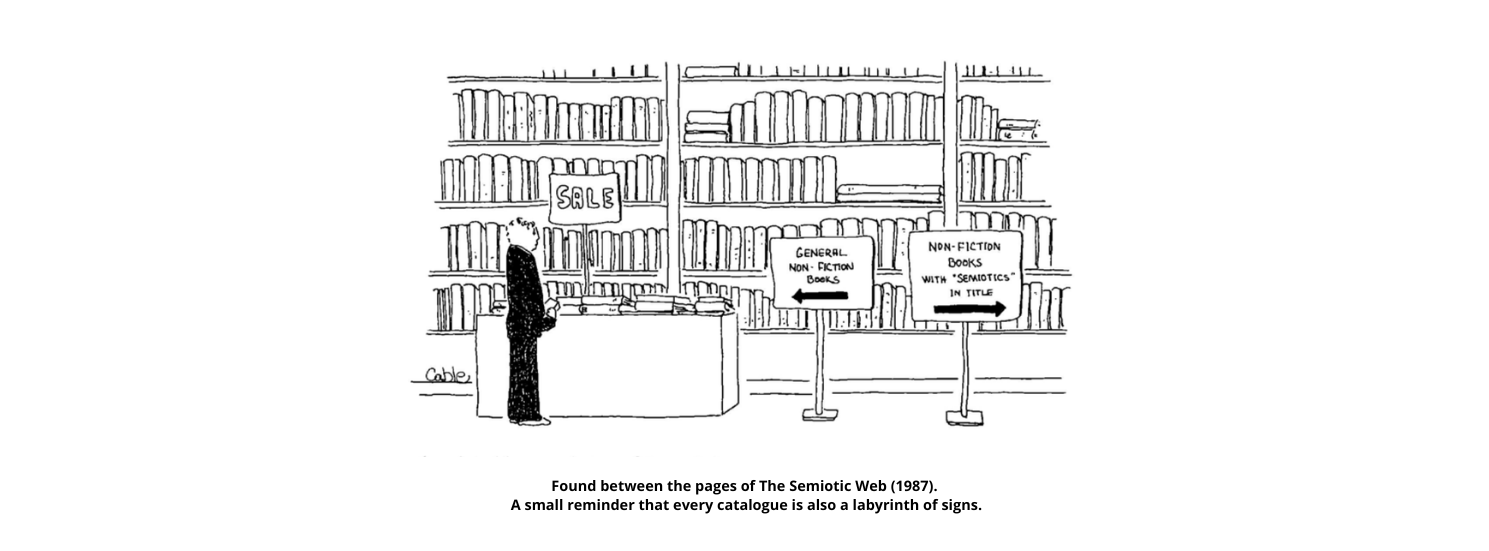
A unified academic catalogue for books, journal articles, book chapters, proceedings papers, conference abstracts and semiotic research materials.
A unified academic catalogue for books, journal articles, proceedings papers, collection articles and semiotic research materials. Search across the full database; results are shown with pagination.
Thesaurus
Browse authorized terms and raw keywords indexed across books, journals, articles, collections and proceedings. Authorized terms search variants and related concepts.
Multiculturalism as Multimodal Communication
Alin Olteanu
- Edition
- 1 edition
Culture Springer Cham 9783030178826 Available
View details
Other title information: A Semiotic Perspective
Annotation: This highly readable book develops a numanistic, and specifically semiotic approach to multiculturalism. It reveals how semiotics provides fresh and valuable insights into multiculturalism: in contrast to the binary logic of dualistic philosophy, semiotic logic does not understand the value of truth in rigid terms of ‘true’ or ‘false’, ‘right’ or ‘wrong’ only. The value of truth resides in meaning, which is a dynamic, evolutionary phenomenon, rooted, nevertheless, in factuality. Drawing on recent developments in biosemiotics, the book presents a theoretical approach to multiculturalism, regarding the lives of people living in multicultural environments. Rather than analyzing political or economic phenomena, it offers a semiotic analysis of multiculturalism and discusses its educational implications. It also invites readers to regard learning as a phenomenon of ecological sign growth and to understand multiculturalism along the same lines. As such, it brings together the life and social sciences and the humanities in a unified perspective, in an approach fitting postmodernism.
Identifier: 9783030178826
Status: Available
Rights, responsibilities, and resistance: Legal discourse and intervention legislation in the Northern Territory in Australia
Peter Gale
In: Semiotica 2016, Issue 209
- Pages
- 167-185
Semiotica DOI: 10.1515/sem-2016-0010
View details
Identifier: DOI: 10.1515/sem-2016-0010
The hidden meanings in the case law of the European Court for Human Rights
Laura Ervo
In: Semiotica 2016, Issue 209
- Pages
- 209-230
Semiotica DOI: 10.1515/sem-2016-0009
View details
Identifier: DOI: 10.1515/sem-2016-0009
Europos sąjungos piliečių teisės
Aistė Balžekienė | Algis Krupavičius | Algis Junevičius | Eglė Butkevičienė | Justina Ražanauskaitė
Social Technologija 9786090211427 Available
View details
Other title information: požiūriai ir patirtys
Annotation: This is a handbook of human rights in European Union, the experiences and opinions
Identifier: 9786090211427
Status: Available
Moral Systems and the Evolution of Human Rights
Bruce K. Friesen
- Edition
- 1 edition
Social Springer Dordrecht 9789401795500 Available
View details
Annotation: This volume offers a comprehensible account of the development and evolution of moral systems. It seeks to answer the following questions: If morals are eternal and unchanging, why have the world’s dominant religious moral systems been around for no more than a mere six thousand of the two hundred thousand years of modern human existence? What explains the many and varied moral systems across the globe today? How can we account for the significant change in moral values in one place in less than 100 years’ time? Using examples from classical civilizations, the book demonstrates how increasing diversity compromises a moral system’s ability to account for and integrate larger populations into a single social unit. This environmental stress is not relieved until a broader, more abstract moral system is adopted by a social system. This new system provides a sense of belonging and purpose for more people, motivating them to engage in prosocial (or moral) acts and refrain from socially disruptive selfish acts. The current human rights paradigm is the world’s first universal, indigenous moral system. Because moral systems can be expected to continue to evolve, this book points to current boundaries of the human rights paradigm and where the next major moral revolution might emerge.
Identifier: 9789401795500
Status: Available
Jakob von Uexküll and Right Livelihood — the current actuality of his Weltanschauung1
Jakob von Uexküll, jr
In: Sign System Studies 2004, Volume 32, Issue 1/2
- Pages
- 363-371
Sign Systems Studies 10.12697/SSS.2004.32.1-2.16
View details
Identifier: 10.12697/SSS.2004.32.1-2.16
Signs of firstness: A journey into brightest semiotica
Cecilia Almeida Salles
In: Synthesis in Diversity, Volume 2
- Pages
- 1039-1042
Semiotics Around the World
View details
The semiotics of ethnicity: Using consumption imagery to decode Spike Lee's Do the Right Thing
Elizabeth C. Hirschman
In: Semiotica 1994, Issue 2024-01-02 00:00:00
- Pages
- 109-138
Semiotica DOI: 10.1515/semi-1994-981-206
View details
Identifier: DOI: 10.1515/semi-1994-981-206
The semiotics of ethnicity: Using consumption imagery to decode Spike Lee’s Do the Right Thing
ELIZABETH C. HIRSCHMAN
In: Semiotica 1994, Issue 2024-01-02 00:00:00
Semiotica DOI: 10.1515/semi.1994.98.1-2.109
View details
Identifier: DOI: 10.1515/semi.1994.98.1-2.109
Social psychology in the '90s
Kay Deaux | Francis C. Dane | Lawrence S. Wrightsman | in association with Carol K. Siegelman
- Edition
- 6 edition
Social Brooks/Cole Pub. Co. 0534103987 Available
View details
Annotation: A detailed overview of different concepts in social psychology
Identifier: 0534103987
Status: Available
Charles S. Peirce meets Douglas Hofstadter: Pragmatism and the language of modern science
ROBERT WRIGHT
In: Semiotica 1989, Issue 2024-03-04 00:00:00
Semiotica DOI: 10.1515/semi.1989.73.3-4.191
View details
Identifier: DOI: 10.1515/semi.1989.73.3-4.191
Dress right, dress: The Boy Scout uniform as a folk costume
JAY MECHLING
In: Semiotica 1987, Issue 2024-03-04 00:00:00
Semiotica DOI: 10.1515/semi.1987.64.3-4.319
View details
Identifier: DOI: 10.1515/semi.1987.64.3-4.319
Laterality in negation: Are Jakobson and Vavra right?
PETER COLLETT; JOSEPHINE CHILTON
In: Semiotica 1981, Issue 2024-01-02 00:00:00
Semiotica DOI: 10.1515/semi.1981.35.1-2.57
View details
Identifier: DOI: 10.1515/semi.1981.35.1-2.57
Facial Emblems of ‘Right’ and ‘Wrong’: Topographical Analysis and Derivation of a Recognition Test
HOWARD M. ROSENFELD; MARILYN SHEA; PAUL GREENBAUM
In: Semiotica 1979, Issue 2024-01-02 00:00:00
Semiotica DOI: 10.1515/semi.1979.26.1-2.15
View details
Identifier: DOI: 10.1515/semi.1979.26.1-2.15
THE RIGHT TO MAKE INTERPRETATIONS ABOUT PROFESSIONAL STRATIFICATION
ROLAND WULBERT
In: Semiotica 1976, Issue 3
Semiotica DOI: 10.1515/semi.1976.16.3.223
View details
Identifier: DOI: 10.1515/semi.1976.16.3.223
A Componential Analysis of the Architectural Sign /Column/
UMBERTO ECO
In: Semiotica 1972, Issue 2
Semiotica DOI: 10.1515/semi.1972.5.2.97
View details
Identifier: DOI: 10.1515/semi.1972.5.2.97
Linguistic Correlates of Scientific Prediction
V.A. ZVEGINCEV
In: Semiotica 1972, Issue 2
Semiotica DOI: 10.1515/semi.1972.5.2.162
View details
Identifier: DOI: 10.1515/semi.1972.5.2.162
Review article
In: Semiotica 1972, Issue 2
Semiotica DOI: 10.1515/semi.1972.5.2.184
View details
Identifier: DOI: 10.1515/semi.1972.5.2.184
The Role of Deictic Elements in Linguistic Evolution
JERZY KURYŁOWICZ
In: Semiotica 1972, Issue 2
Semiotica DOI: 10.1515/semi.1972.5.2.174
View details
Identifier: DOI: 10.1515/semi.1972.5.2.174
What is Right is Right
SANDA GOLOPENŢIA-ERETESCU
In: Semiotica 1972, Issue 2
Semiotica DOI: 10.1515/semi.1972.5.2.118
View details
Identifier: DOI: 10.1515/semi.1972.5.2.118