
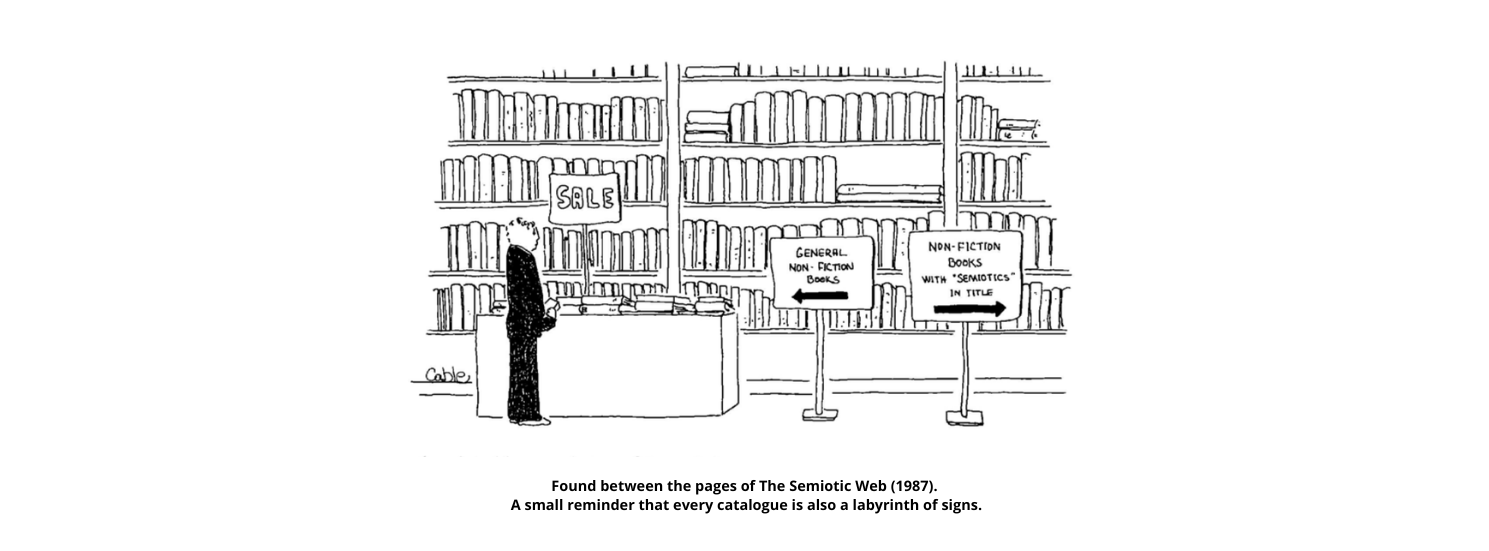
A unified academic catalogue for books, journal articles, book chapters, proceedings papers, conference abstracts and semiotic research materials.
A unified academic catalogue for books, journal articles, proceedings papers, collection articles and semiotic research materials. Search across the full database; results are shown with pagination.
Thesaurus
Browse authorized terms and raw keywords indexed across books, journals, articles, collections and proceedings. Authorized terms search variants and related concepts.
Greimas close and far
Karolis Rimtautas Kašponis
General Semiotics Naujasis Lankas 9789955038702 Available
View details
Parallel title: Parallel title: Greimas arti ir toli
Annotation: Algirdas Julien Greimas (born Algirdas Julius Greimas) is one the most prominent creators of semiotics who laid the foundations of the Paris School of Semiotics known all over the world. He was also a famous linguist who researched Lithuanian mythology. Algirdas Julien Greimas is one of the most prominent Lithuanians in the international world of science, in many aspects compared to Mikalojus Konstantinas Čiurlionis. The greatest influence on the life and works of Greimas came from French culture renowned for its science, literature and art. Nevertheless, the time spent in Lithuania was also significant. Greimas himself viewed Lithuanian and western (French) periods of his life as correlation between two cultures. Therefore, every moment of his life is important to us, each moment contributing to the whole picture and enriching his life. Neither Greimas' childhood nor his youth which is the genesis of intellectual and aesthetic signs is reviewed in literature. Various authors tend to start writing Greimas'biography starting from his years in Vytautas Magnus University. Professor Eero Tarasti, the president of the International Association for Semiotic Studies, offered me to prepare a work about Greimas' life in Lithuania. As I myself studied in Kupiškis and knew a lot of things about the Greimas family, I decided to look at Greimas'childhood period in Kupiškis. The sources I used in this work are as follows: Greimas' words about his childhood, national and personal archives, press of those days and stories told by those who knew the Greimas family.My experience with exceptionally gifted children in National M. K. Čiurlionis School of Art in Vilnius and consulting with famous scientist has helped me to discuss the genesis of intellectual and aesthetic signs in Greimas' biography. As for the form of the work, I have chosen to use the form of an exposition with elements of a poster presentation, which allowed me to participate in significant scientific forums in France, Finland, Russia and China. In Lithuania, in those places where Greimas lived, my exposition contributed to the studies of his biography, organisation of conferences and dedication to Greimas. As it turned out, the prestigious gymnasiums where Greimas studied in Šiauliai and Marijampolė established in 1851 and 1867 have raised about half (9 out of 20) of those who signed the Act of Independence of Lithuania on 16 February 1918 and 12 out of 100 most outstanding persons in Lithuania in a millennium. In this respect these two gymnasiums are the only ones in Lithuania. It should also be mentioned that Greimas attended lectures in Vytautas Magnus University by famous Lithuanian scientists Mykolas Romeris, Vladas Jurgutis, Vosylius Sezemanas and Jonas Bučas who later contributed to laying the foundation for the science of semiotics.
Identifier: 9789955038702
Status: Available
A History of Psycholinguistics
Willem J. M. Levelt
- Edition
- 1 edition
Linguistics Oxford University Press 9780199653669 Available
View details
Other title information: The Pre-Chomskyan Era
Annotation: How do we manage to speak and understand language? How do children acquire these skills and how does the brain support them? These psycholinguistic issues have been studied for more than two centuries. Though many Psycholinguists tend to consider their history as beginning with the Chomskyan "cognitive revolution" of the late 1950s/1960s, the history of empirical psycholinguistics actually goes back to the end of the 18th century. This is the first book to comprehensively treat this "pre-Chomskyan" history. It tells the fascinating history of the doctors, pedagogues, linguists and psychologists who created this discipline, looking at how they made their important discoveries about the language regions in the brain, about the high-speed accessing of words in speaking and listening, on the child's invention of syntax, on the disruption of language in aphasic patients and so much more. The book is both a history of ideas as well of the men and women whose intelligence, brilliant insights, fads, fallacies, cooperations, and rivalries created this discipline. Psycholinguistics has four historical roots, which, by the end of the 19th century, had merged. By then, the discipline, usually called the psychology of language, was established. The first root was comparative linguistics, which raised the issue of the psychological origins of language. The second root was the study of language in the brain, with Franz Gall as the pioneer and the Broca and Wernicke discoveries as major landmarks. The third root was the diary approach to child development, which emerged from Rousseau's Émile. The fourth root was the experimental laboratory approach to speech and language processing, which originated from Franciscus Donders' mental chronometry. Wilhelm Wundt unified these four approaches in his monumental Die Sprache of 1900. These four perspectives of psycholinguistics continued into the 20th century but in quite divergent frameworks. There was German consciousness and thought psychology, Swiss/French and Prague/Viennese structuralism, Russian and American behaviorism, and almost aggressive holism in aphasiology. As well as reviewing all these perspectives, the book looks at the deep disruption of the field during the Third Reich and its optimistic, multidisciplinary re-emergence during the 1950s with the mathematical theory of communication as a major impetus. A tour de force from one of the seminal figures in the field, this book will be essential reading for all linguists, psycholinguists, neuroscientists, and psychologists with an interest in language.
Identifier: 9780199653669
Status: Available
Accomplishing Permanency
Elizabeth Fernandez
- Edition
- 1 edition
Social Springer Dordrecht 9789400750913 Available
View details
Other title information: Reunification Pathways and Outcomes for Foster Children
Annotation: Reunification is a primary goal of foster care systems and the most common permanency planning decision. It is defined as the return of children placed in protective care to the home of their birth family and used to describe the act of restoring a child in out-of-home care back to the biological family. Yet reunification decision-making and the process of reintegrating children into birth families remains under researched. This Brief takes a look at family reunification knowledge and research in Australia where there is evidence that most children placed in protective care are eventually reunited with their birth parents. It explores how a knowledge of reunification decision making and outcomes can contribute to strengthening practice and informing policy formulation and program planning in Child Welfare.
Identifier: 9789400750913
Status: Available
Fence sitters: Parents’ reactions to sexual ambiguities in their newborn children
MEIRA WEISS
In: Semiotica 1995, Issue 2024-01-02 00:00:00
Semiotica DOI: 10.1515/semi.1995.107.1-2.33
View details
Identifier: DOI: 10.1515/semi.1995.107.1-2.33
The Narrative Symbol in Childhood Literature
Joanne M. Golden
Literature Mouton de Gruyter 3110122898 Available
View details
Other title information: Explorations in the Contruction of Text
Annotation: This book offers an analysis of narrative of children's literature by using discourse analysis.
Identifier: 3110122898
Status: Available
Circumspection in psychotherapy: Structures and strategies of counselor-client interaction
MARK PEYROT
In: Semiotica 1987, Issue 2024-03-04 00:00:00
Semiotica DOI: 10.1515/semi.1987.65.3-4.249
View details
Identifier: DOI: 10.1515/semi.1987.65.3-4.249
Duel de significations dans les soleils des indépendances d’Ahmadou Kourouma
PETER IGBONEKWU OKEH
In: Semiotica 1987, Issue 2024-03-04 00:00:00
Semiotica DOI: 10.1515/semi.1987.65.3-4.295
View details
Identifier: DOI: 10.1515/semi.1987.65.3-4.295
Kriemhilt’s face work: A sociolinguistic analysis of social behavior in the Nibelungenlied
LANA RINGS
In: Semiotica 1987, Issue 2024-03-04 00:00:00
Semiotica DOI: 10.1515/semi.1987.65.3-4.317
View details
Identifier: DOI: 10.1515/semi.1987.65.3-4.317
Limits of Innovation in dance and mime
ANYA PETERSON ROYCE
In: Semiotica 1987, Issue 2024-03-04 00:00:00
Semiotica DOI: 10.1515/semi.1987.65.3-4.269
View details
Identifier: DOI: 10.1515/semi.1987.65.3-4.269
Of position papers, paradigms, and paradoxes
FLOYD MERRELL
In: Semiotica 1987, Issue 2024-03-04 00:00:00
Semiotica DOI: 10.1515/semi.1987.65.3-4.191
View details
Identifier: DOI: 10.1515/semi.1987.65.3-4.191
Proxemic patterns, social structures, and world view
MIHÁLY HOPPÁL
In: Semiotica 1987, Issue 2024-03-04 00:00:00
Semiotica DOI: 10.1515/semi.1987.65.3-4.225
View details
Identifier: DOI: 10.1515/semi.1987.65.3-4.225
Review article
In: Semiotica 1987, Issue 2024-03-04 00:00:00
Semiotica DOI: 10.1515/semi.1987.65.3-4.327
View details
Identifier: DOI: 10.1515/semi.1987.65.3-4.327
The effects of play contexts on the development of preschool children’s verbalized fantasy
ANTHONY D. PELLEGRINI
In: Semiotica 1987, Issue 2024-03-04 00:00:00
Semiotica DOI: 10.1515/semi.1987.65.3-4.285
View details
Identifier: DOI: 10.1515/semi.1987.65.3-4.285
Iconic gestures of children and adults
DAVID MCNEILL
In: Semiotica 1986, Issue 2024-01-02 00:00:00
Semiotica DOI: 10.1515/semi.1986.62.1-2.107
View details
Identifier: DOI: 10.1515/semi.1986.62.1-2.107
Evaluation of postures
BENEDICT PERRINO
In: Semiotica 1981, Issue 2024-01-02 00:00:00
Semiotica DOI: 10.1515/semi.1981.37.1-2.27
View details
Identifier: DOI: 10.1515/semi.1981.37.1-2.27
Hello–Goodbye: An analysis of children′s telephone conversations
JANET HOLMES
In: Semiotica 1981, Issue 2024-01-02 00:00:00
Semiotica DOI: 10.1515/semi.1981.37.1-2.91
View details
Identifier: DOI: 10.1515/semi.1981.37.1-2.91
Identifying and counting utterances
ALICE M. ROY
In: Semiotica 1981, Issue 2024-01-02 00:00:00
Semiotica DOI: 10.1515/semi.1981.37.1-2.15
View details
Identifier: DOI: 10.1515/semi.1981.37.1-2.15
Pooh talk: Formulating children’s conversational troubles
ARTHUR W. FRANK, III
In: Semiotica 1981, Issue 2024-01-02 00:00:00
Semiotica DOI: 10.1515/semi.1981.37.1-2.109
View details
Identifier: DOI: 10.1515/semi.1981.37.1-2.109
Review article
In: Semiotica 1981, Issue 2024-01-02 00:00:00
Semiotica DOI: 10.1515/semi.1981.37.1-2.121
View details
Identifier: DOI: 10.1515/semi.1981.37.1-2.121
Sonstiges
In: Semiotica 1981, Issue 2024-01-02 00:00:00
Semiotica DOI: 10.1515/semi.1981.37.1-2.u
View details
Identifier: DOI: 10.1515/semi.1981.37.1-2.u
The management of grantings and rejections by parents in request sequences
A. J. WOOTTON
In: Semiotica 1981, Issue 2024-01-02 00:00:00
Semiotica DOI: 10.1515/semi.1981.37.1-2.59
View details
Identifier: DOI: 10.1515/semi.1981.37.1-2.59
The relative contribution of verbal, vocal, and visual channels to person perception: Experiment and critique
ADRIAN FURNHAM; ROBERT TREVETHAN; GEORGE GASKELL
In: Semiotica 1981, Issue 2024-01-02 00:00:00
Semiotica DOI: 10.1515/semi.1981.37.1-2.39
View details
Identifier: DOI: 10.1515/semi.1981.37.1-2.39
Unresolved theoretical issues in nonverbal communication
MELE KONEYA
In: Semiotica 1981, Issue 2024-01-02 00:00:00
- Pages
- 1-14
Semiotica DOI: 10.1515/semi.1981.37.1-2.1
View details
Identifier: DOI: 10.1515/semi.1981.37.1-2.1