
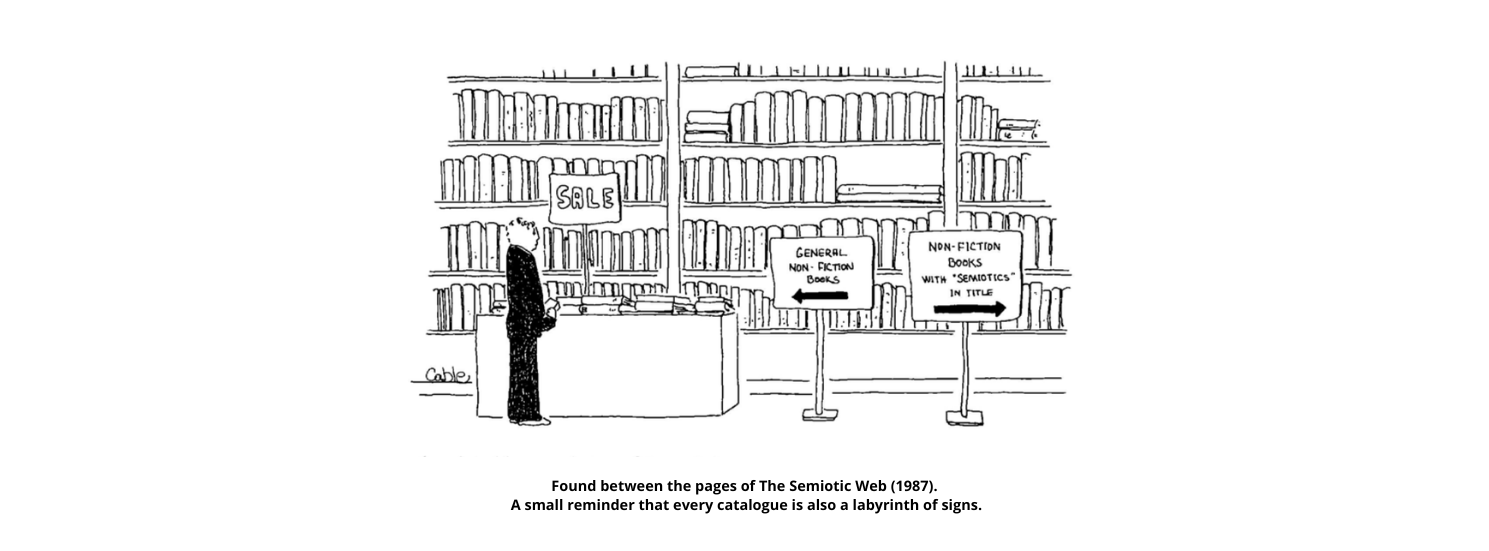
A unified academic catalogue for books, journal articles, book chapters, proceedings papers, conference abstracts and semiotic research materials.
A unified academic catalogue for books, journal articles, proceedings papers, collection articles and semiotic research materials. Search across the full database; results are shown with pagination.
Thesaurus
Browse authorized terms and raw keywords indexed across books, journals, articles, collections and proceedings. Authorized terms search variants and related concepts.
From Body Fuel to Universal Poison
Francesco Buscemi
- Edition
- 1 edition
Culture Springer Cham 9783319720852 Available
View details
Other title information: Cultural History of Meat: 1900-The Present
Annotation: This book explores our changing relationship with meat as food. Half storytelling and half historic work, it analyzes the way in which humans have dealt with the idea of eating animals in the Western world, from 1900 to the present.
Identifier: 9783319720852
Status: Available
Estudo Interpretativo da Técnica Composicional Melodia das Montanhas
Rodrigo Passos Felicissimo
- Dependent title
- Utilizada nas peças orquestrais
Music Novas Edições Acadêmicas 9783330765054 Available
View details
Other title information: New York Sky-Line Melody e Sinfonia No. 6 de Heitor Villa-Lobos
Annotation: The 20th century produced a significant number of geniuses. In music, we had Strawinsky, Debussy, Puccini, Strauss, to name just a few from different countries, and our own Villa-Lobos. His presence in the music scene is of great importance. Villa-Lobos, a profound observer of life, never missed an opportunity to invent new processes of musical creation for himself and for the teachers of Orpheonic Singing. Thus, in 1934, a method of creating melodies coming from nature itself emerged: the Chart to record the Melody of the Mountains of Brazil. "The maestro sought a kind of representation of Brazil based on these geographical symbols", as Dr. Rodrigo Felicíssimo points out in his doctoral thesis, which was promptly transformed into a book.
Identifier: 9783330765054
Status: Available
Reflections on Creating a Reality: The American Society for Cybernetics in the 1980s
William J. Reckmeyer
In: Cybernetics & Human Knowing 2016, Volume 23, Issue 1: 50th Anniversary Retrospective of the ASC
- Pages
- 28
Cybernetics & Human Knowing
View details
Heroizability
Ibrahim Taha
General Semiotics De Gruyter 9781501510816 Available
View details
Other title information: An anthroposemiotic theory of Literary characters
Annotation: It is commonly believed that some approaches of structural semiotics, narratology and cognitive science have not yet succeeded in constructing a complete and coherent theory of literary character. The author argues that the primary explanation of the failure is the artificial separation between characters and their actions. One of the chief implications of such separation is treating characters in terms of structures, agents, actants, functions, roles, and signs, which obviously mean that actions can hardly be explained as intended, motivated, performed and experienced. Survival, as a motivation-based concept, is one of the key concepts making the separation between character and action something impossible. Humans in literary narratives search for survival as an aware process of knowing and meaning making. Meaning in literary narratives can be produced by heroizability, which treats literary characters as living anthroposemiotic entities aware of their natural motivation to achieve in order to survive and produce meanings of their survival. As such, characters in literary narratives have active cognitions, and their cognitive activities remain meaningless without a process of semiosis. Applying Anthroposemiotic theory with Modeling System Theory, heroizability provides methodical tools to explain how the narrative text is represented and, thus, how it is to be interpreted properly by the reader not only to find, but also to make meaning in narrative world.
Identifier: 9781501510816
Status: Available
Do iconic gestures have a functional role in lexical access? An experimental study of the effects of repeating a verbal message on gesture production
Geoffrey Beattie; Jane Coughlan
In: Semiotica 1998, Issue 2024-03-04 00:00:00
- Pages
- 221-250
Semiotica DOI: 10.1515/semi.1998.119.3-4.221
View details
Identifier: DOI: 10.1515/semi.1998.119.3-4.221
Creating signs, building bridges
José María Ortiz Martínez
In: Synthesis in Diversity, Volume 1
- Pages
- 231-234
Semiotics Around the World
View details
The Constitution of Han-Academic Ideology
You-Zheng Li
- Edition
- 1 edition
Culture Peter Lang Publishing 3631313853 Available
View details
Parallel title: Parallel title: An Archetype of Chinese Ethics and Academic Ideology
Other title information: A Hermeneutico-Semiotic Study
Annotation: Intercultural philosophy does not take its starting point from the comparison of different cultures from a neutral point of view, it instead arises through the confrontation with certain features of another culture which distance the philosopher from his or her own tradition, compelling it to be regarded in a new way. In dealing with the origins of Confucian ethics, You-Zheng Li does exactly this. His extensive training in Western Hermeneutics and semiotics enables him to reformulate the set of ethical customs, rituals, rules and strategies formulated 2500 years ago in ancient China. In contrast to Western ethics, which are thoroughly penetrated by the divine commands of the Judeo-Christian tradition and mainly characterized by the search for the practical good and one's own happiness begun in Greek and Roman philosophy, Chinese ethics originated and developed largely outside the domains of religion and philosophy. In attempting to elaborate on the specific nature of these ethics, the author navigates between Scylla and Charybdis. He seeks to avoid the one extreme of merely repeating from the inside what has already been said, with its effective reduction of ethical theory to certain reflexes of practical life. Just as well, however, he tries to avoid the other extreme of measuring ancient traditions by external standards and therewith exchanging old prejudices for new ones. He much rather tries to elucidate the foundation of Chinese ethics by using a certain language and a certain method which, as only one language and one method among others, does not aver to exhaust the inherent sense and the efficacious demand of what has been or is still being lived out and practised.
Identifier: 3631313853
Status: Available
The Structure of the Chinese Ethical Archetype
You-Zheng Li
- Edition
- 1 edition
Culture Peter Lang Publishing 3631313861 Available
View details
Parallel title: Parallel title: An Archetype of Chinese Ethics and Academic Ideology
Other title information: A Hermeneutico-Semiotic Study
Annotation: Intercultural philosophy does not take its starting point from the comparison of different cultures from a neutral point of view, it instead arises through the confrontation with certain features of another culture which distance the philosopher from his or her own tradition, compelling it to be regarded in a new way. In dealing with the origins of Confucian ethics, You-Zheng Li does exactly this. His extensive training in Western Hermeneutics and semiotics enables him to reformulate the set of ethical customs, rituals, rules and strategies formulated 2500 years ago in ancient China. In contrast to Western ethics, which are thoroughly penetrated by the divine commands of the Judeo-Christian tradition and mainly characterized by the search for the practical good and one's own happiness begun in Greek and Roman philosophy, Chinese ethics originated and developed largely outside the domains of religion and philosophy. In attempting to elaborate on the specific nature of these ethics, the author navigates between Scylla and Charybdis. He seeks to avoid the one extreme of merely repeating from the inside what has already been said, with its effective reduction of ethical theory to certain reflexes of practical life. Just as well, however, he tries to avoid the other extreme of measuring ancient traditions by external standards and therewith exchanging old prejudices for new ones. He much rather tries to elucidate the foundation of Chinese ethics by using a certain language and a certain method which, as only one language and one method among others, does not aver to exhaust the inherent sense and the efficacious demand of what has been or is still being lived out and practised.
Identifier: 3631313861
Status: Available
Interface design: A semiotic paradigm
MIHAI NADIN
In: Semiotica 1988, Issue 2024-03-04 00:00:00
Semiotica DOI: 10.1515/semi.1988.69.3-4.269
View details
Identifier: DOI: 10.1515/semi.1988.69.3-4.269
Material bases of signification
GIORGIO PRODI
In: Semiotica 1988, Issue 2024-03-04 00:00:00
Semiotica DOI: 10.1515/semi.1988.69.3-4.191
View details
Identifier: DOI: 10.1515/semi.1988.69.3-4.191
Object as memory: The material foundations of human semiosis
KENNETH E. FOOTE
In: Semiotica 1988, Issue 2024-03-04 00:00:00
Semiotica DOI: 10.1515/semi.1988.69.3-4.243
View details
Identifier: DOI: 10.1515/semi.1988.69.3-4.243
Peirce’s teleological signs
WILLIAM E. SEAGER
In: Semiotica 1988, Issue 2024-03-04 00:00:00
Semiotica DOI: 10.1515/semi.1988.69.3-4.303
View details
Identifier: DOI: 10.1515/semi.1988.69.3-4.303
Review article
In: Semiotica 1988, Issue 2024-03-04 00:00:00
Semiotica DOI: 10.1515/semi.1988.69.3-4.331
View details
Identifier: DOI: 10.1515/semi.1988.69.3-4.331
Verbal icons and self-reference
ANNA WHITESIDE
In: Semiotica 1988, Issue 2024-03-04 00:00:00
Semiotica DOI: 10.1515/semi.1988.69.3-4.315
View details
Identifier: DOI: 10.1515/semi.1988.69.3-4.315