
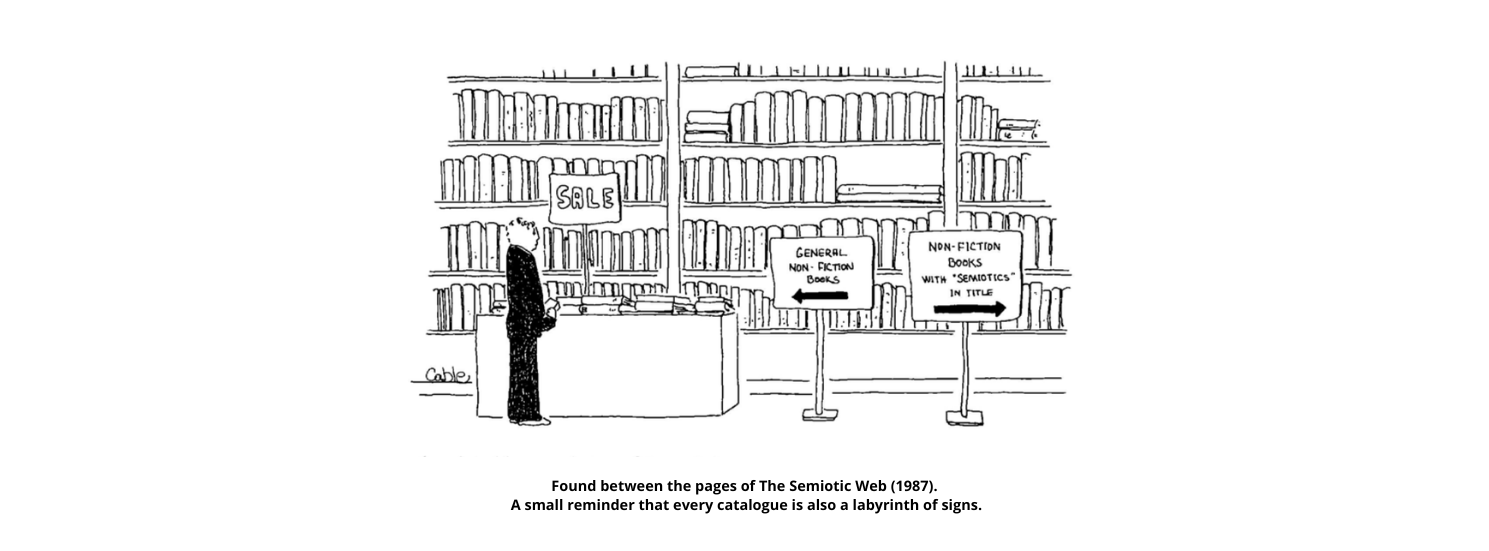
A unified academic catalogue for books, journal articles, book chapters, proceedings papers, conference abstracts and semiotic research materials.
A unified academic catalogue for books, journal articles, proceedings papers, collection articles and semiotic research materials. Search across the full database; results are shown with pagination.
Thesaurus
Browse authorized terms and raw keywords indexed across books, journals, articles, collections and proceedings. Authorized terms search variants and related concepts.
Sounds, Societies, Significations
edited by Rima Povilionienė
- Edition
- 1 edition
Music Springer Cham 9783319470597 Available
View details
Other title information: Numanistic Approaches to Music
Annotation: This edited book covers many topics in musicological literature, gathering various approaches to music studies that encapsulate the vivid relation music has to society. It focusses on repertoires and geographical areas that have not previously been well frequented in musicology. As readers will see, music has many roles to play in society. Music can be a generator of social phenomena, or a result of them; it can enhance or activate social actions, or simply co-habit with them. Above all, music has a stable position within society, in that it actively participates in it. Music can either describe or prescribe social aspects; musicians may have a certain position/role in society (e.g., the “popstar” as fashion leader, spokesman for political issues, etc.). Depending on the type of society, music may have a certain “meaning” or “function” (music does not mean the same thing everywhere in the world). Lastly, music can define a society, and it is not uncommon for it to best define a particular historical moment.
Identifier: 9783319470597
Status: Available
Heroizability
Ibrahim Taha
General Semiotics De Gruyter 9781501510816 Available
View details
Other title information: An anthroposemiotic theory of Literary characters
Annotation: It is commonly believed that some approaches of structural semiotics, narratology and cognitive science have not yet succeeded in constructing a complete and coherent theory of literary character. The author argues that the primary explanation of the failure is the artificial separation between characters and their actions. One of the chief implications of such separation is treating characters in terms of structures, agents, actants, functions, roles, and signs, which obviously mean that actions can hardly be explained as intended, motivated, performed and experienced. Survival, as a motivation-based concept, is one of the key concepts making the separation between character and action something impossible. Humans in literary narratives search for survival as an aware process of knowing and meaning making. Meaning in literary narratives can be produced by heroizability, which treats literary characters as living anthroposemiotic entities aware of their natural motivation to achieve in order to survive and produce meanings of their survival. As such, characters in literary narratives have active cognitions, and their cognitive activities remain meaningless without a process of semiosis. Applying Anthroposemiotic theory with Modeling System Theory, heroizability provides methodical tools to explain how the narrative text is represented and, thus, how it is to be interpreted properly by the reader not only to find, but also to make meaning in narrative world.
Identifier: 9781501510816
Status: Available
Sociocultural crossings and borders
edited by Rūta Stanevičiūtė | Rima Povilionienė
Music Lithuanian Academy of Music and Theatre | International Musicological Society 9786098071290 Available
View details
Other title information: musical microhistories
Annotation: In the current global world the interaction between cultures penetrates into musical practices and discourses, radically affecting the sociocultural imagination and altering the established shapes of cultural territories. Yet the history of music demonstrates that the dynamics of cultural encounters and segregations has always been a key factor in the formation of individual and collective identities and in the understanding of other cultures. Cultural expansions and, conversely, the trajectories of displacement of cultural expression are to a varied extent affected by the political, economic, technological and other dimensions of dissemination of musical practices and traditions. In the modern age, the extramusical factors are of equal significance to textual (creation) and contextual (dissemination and reception) configurations of sociocultural interactions. The understanding of sociocultural interactions and borders plays an important role in the appropriation of the musical past and the revival of cultural memory.
Identifier: 9786098071290
Status: Available
The Logos of the Bios 2
Günther Witzany
- Dependent title
- Bio-Communication
Biology / Biosemiotics Umweb publications Available
View details
Annotation: In Volume 2 the practical application of the early developed pragmatic philosophy of body follows. Articles from 1 to 5 are reviews which cover all organismic kingdoms in special examples, except that of Archaea. The aim was to demonstrate Bio-communication in all domains of life as rule-governed sign-mediated interactions.
Status: Available
The Logos of the Bios 1
Günther Witzany
- Dependent title
- Contributions to the Foundation of a three-leveled Biosemiotics
Biology / Biosemiotics Umweb publications 9525576019 Available
View details
Annotation: This book opens a new perspective on living nature through the philosophical foundation of biology as an understanding social science. The contributions integrate the pragmatic turn of the theory of science discussion, replacing the solus ipse subject of knowledge of objectivism by the intersubjective - communicative character of thought, experience and research. A three-leveled biosemiotics investigates rule-governed sign-mediated interactions within and between organisms of all organismic kingdoms. This approach underlines the complementarity of syntactic, pragmatic and semantic rules as a precondition for adequately investigating the languagelike structure of the genetic code and the communicative organization of interacting living nature.
Identifier: 9525576019
Status: Available
From questions to stimuli, from answers to reactions: The case of Clever Hans
EILEEN CRIST
In: Semiotica 1997, Issue 2024-01-02 00:00:00
- Pages
- 1-42
Semiotica DOI: 10.1515/semi.1997.113.1-2.1
View details
Identifier: DOI: 10.1515/semi.1997.113.1-2.1
Fence sitters: Parents’ reactions to sexual ambiguities in their newborn children
MEIRA WEISS
In: Semiotica 1995, Issue 2024-01-02 00:00:00
Semiotica DOI: 10.1515/semi.1995.107.1-2.33
View details
Identifier: DOI: 10.1515/semi.1995.107.1-2.33
The Socialness of Things
edited by Stephen Harold Riggins
Social Mouton de Gruyter 3110141337 Available
View details
Other title information: Essays on the Socio-Semiotics of Objects
Notes: This book is based on the proceedings of an international conference which took place at the University of Toronto in 1990.
Annotation: The term "socialness" is a neologism that is used in this volume to call attention to the integration of objects in the social fabric of everyday life. Specialists in material culture studies have understood for some time, that societies consist of both people and artifacts. It is not only with people and animals that we interact but also with objects. The chapters in the first part of the volume deal with artefacts such as furniture, mementoes, and knickknacks, which can be manipulated as social "others" – entities with which one can socialize or make a part in socialisation processes such as establishing a bond, conveying a message, etc. The second section of articles concerns artefacts whose dimensions take such proportions that humans become dwarfed with respect to them, such as tourists travelling to visit them or shoppers being herded through their artificial geography as if flowing within an oversized organism. In the concluding section, the artefacts examined are by contrast so adjusted to the proportion of the human body, so close to it that they become an indissociable part of the social persona sticking to the skin, expressing better than any other means of the socialness - fashion.
Identifier: 3110141337
Status: Available
Intermittences du sens
Henri Quéré
- Dependent title
- études sémiotiques
General Semiotics Presses universitaires de France 2130445225 Available
View details
Annotation: Les intermittences du sens, c'est ici, tout d'abord, une pluralité d'pbjects en tous genres (romans, nouvelles ou poèmes, en françauis ou en anglais; discours littéraires, échanges de lettres, bribes de conversation courante; pratiques quotidienne ou objets esthétiques) que traverse et que scande le retour d'une même question: celle de la signification de son surgissement, de ses modes de manifestation et même, peut-on dire, de ses agissements. C'est aussi de point en point et de part en part, le jeu réglé des singularités et des récurrences, l'alternance des espèces constituées et des morphologies en devenir, l'entrejeu des discontinuités et des enchaînements, sur le support, el la dynamique des places et des forces. C'est, dans l'épaisseur des textes, l'échange réversible entre l'espace vectorisé oû les figures se déploient et le substrat figural que y imprime sa prosodie et ses contours. C'est enfin et surtout à la caçon de l'accompagnement qui lie la partition, l'interrogation sur le ses du sens: non pas tant sa saisie que sa poursuite et plutôt que sa fuite, sa fugue. The intermittences of meaning are here, first of all, a plurality of objects of all kinds (novels, short stories or poems, in French or in English; literary discourses, exchanges of letters, snippets of everyday conversation; daily practices or aesthetic objects) that cross and that are punctuated by the return of the same question: that of the meaning of its emergence, of its modes of manifestation and even, one might say, of its actions. It is also from point to point and from one end to the other, the regulated play of singularities and recurrences, the alternation of constituted species and morphologies in the making, the interplay of discontinuities and sequences, on the support, and the dynamics of places and forces. It is, in the thickness of the texts, the reversible exchange between the vectorized space where the figures are deployed and the figural substrate that its prosody and its contours imprint there. It is finally and above all the way of accompaniment which links the score, the questioning of the meaning: not so much its grasp as its pursuit and rather than its escape, its fugue. (Translated with Google Translate)
Identifier: 2130445225
Status: Available
A critique of the ’post-structuralist’ conception of language
ESA ITKONEN
In: Semiotica 1988, Issue 2024-03-04 00:00:00
Semiotica DOI: 10.1515/semi.1988.71.3-4.305
View details
Identifier: DOI: 10.1515/semi.1988.71.3-4.305
Discourse of blame: Courtroom construction of social identity from the perspective of the defendant
VIVEKA ADELSWÄRD; KARIN ARONSSON; PER LINELL
In: Semiotica 1988, Issue 2024-03-04 00:00:00
Semiotica DOI: 10.1515/semi.1988.71.3-4.261
View details
Identifier: DOI: 10.1515/semi.1988.71.3-4.261
Gender and culture as determinants of the ’ideal voice’
CAROL ANN VALENTINE; BANISA SAINT DAMIAN
In: Semiotica 1988, Issue 2024-03-04 00:00:00
Semiotica DOI: 10.1515/semi.1988.71.3-4.285
View details
Identifier: DOI: 10.1515/semi.1988.71.3-4.285
Iconisme ou mimétisme?
TADEUSZ KOWZAN
In: Semiotica 1988, Issue 2024-03-04 00:00:00
Semiotica DOI: 10.1515/semi.1988.71.3-4.213
View details
Identifier: DOI: 10.1515/semi.1988.71.3-4.213
Le signe et ses sémiotiques: Une réflexion fondamentale sur les moutons de Saussure
PER AAGE BRANDT
In: Semiotica 1988, Issue 2024-03-04 00:00:00
Semiotica DOI: 10.1515/semi.1988.71.3-4.321
View details
Identifier: DOI: 10.1515/semi.1988.71.3-4.321
Polysemy and authority in the late Roman Empire
R. F. NEWBOLD
In: Semiotica 1988, Issue 2024-03-04 00:00:00
Semiotica DOI: 10.1515/semi.1988.71.3-4.227
View details
Identifier: DOI: 10.1515/semi.1988.71.3-4.227
Review article
In: Semiotica 1988, Issue 2024-03-04 00:00:00
Semiotica DOI: 10.1515/semi.1988.71.3-4.339
View details
Identifier: DOI: 10.1515/semi.1988.71.3-4.339
Social meaning in the observation of goal directed action
LADISLAV VALACH; MARIO von CRANACH; URS KALBERMATTEN
In: Semiotica 1988, Issue 2024-03-04 00:00:00
Semiotica DOI: 10.1515/semi.1988.71.3-4.243
View details
Identifier: DOI: 10.1515/semi.1988.71.3-4.243
The Old Vic: A semiotic analysis
MARVIN CARLSON
In: Semiotica 1988, Issue 2024-03-04 00:00:00
Semiotica DOI: 10.1515/semi.1988.71.3-4.187
View details
Identifier: DOI: 10.1515/semi.1988.71.3-4.187
‘Figures’ and Semiotic Relations: A Rhetoric of Syntax in Balzac’s Sarrasine. An Analysis of the Fictive Text Based on Genette’s Figures III (1972)
ROBERTA KEVELSON
In: Semiotica 1978, Issue 2024-01-02 00:00:00
Semiotica DOI: 10.1515/semi.1978.24.1-2.113
View details
Identifier: DOI: 10.1515/semi.1978.24.1-2.113
Communicative Acts: A Semiological Approach to the Empirical Analysis of Filmed Interaction
MARGA KRECKEL
In: Semiotica 1978, Issue 2024-01-02 00:00:00
Semiotica DOI: 10.1515/semi.1978.24.1-2.87
View details
Identifier: DOI: 10.1515/semi.1978.24.1-2.87
Contrasting Nonverbal Styles in Mother-Child Interaction: Examples from a Study of Child Abuse
DAVID B. GIVENS
In: Semiotica 1978, Issue 2024-01-02 00:00:00
Semiotica DOI: 10.1515/semi.1978.24.1-2.33
View details
Identifier: DOI: 10.1515/semi.1978.24.1-2.33
Contrastive-Identificational Features of Persian Gesture
CAROL M. SPARHAWK
In: Semiotica 1978, Issue 2024-01-02 00:00:00
Semiotica DOI: 10.1515/semi.1978.24.1-2.49
View details
Identifier: DOI: 10.1515/semi.1978.24.1-2.49
Maximizing Replicability in Describing Facial Behavior
HENRY W. JR. SEAFORD
In: Semiotica 1978, Issue 2024-01-02 00:00:00
- Pages
- 1-32
Semiotica DOI: 10.1515/semi.1978.24.1-2.1
View details
Identifier: DOI: 10.1515/semi.1978.24.1-2.1
Publications Received
In: Semiotica 1978, Issue 2024-01-02 00:00:00
Semiotica DOI: 10.1515/semi.1978.24.1-2.195
View details
Identifier: DOI: 10.1515/semi.1978.24.1-2.195
Review Article
In: Semiotica 1978, Issue 2024-01-02 00:00:00
Semiotica DOI: 10.1515/semi.1978.24.1-2.149
View details
Identifier: DOI: 10.1515/semi.1978.24.1-2.149