
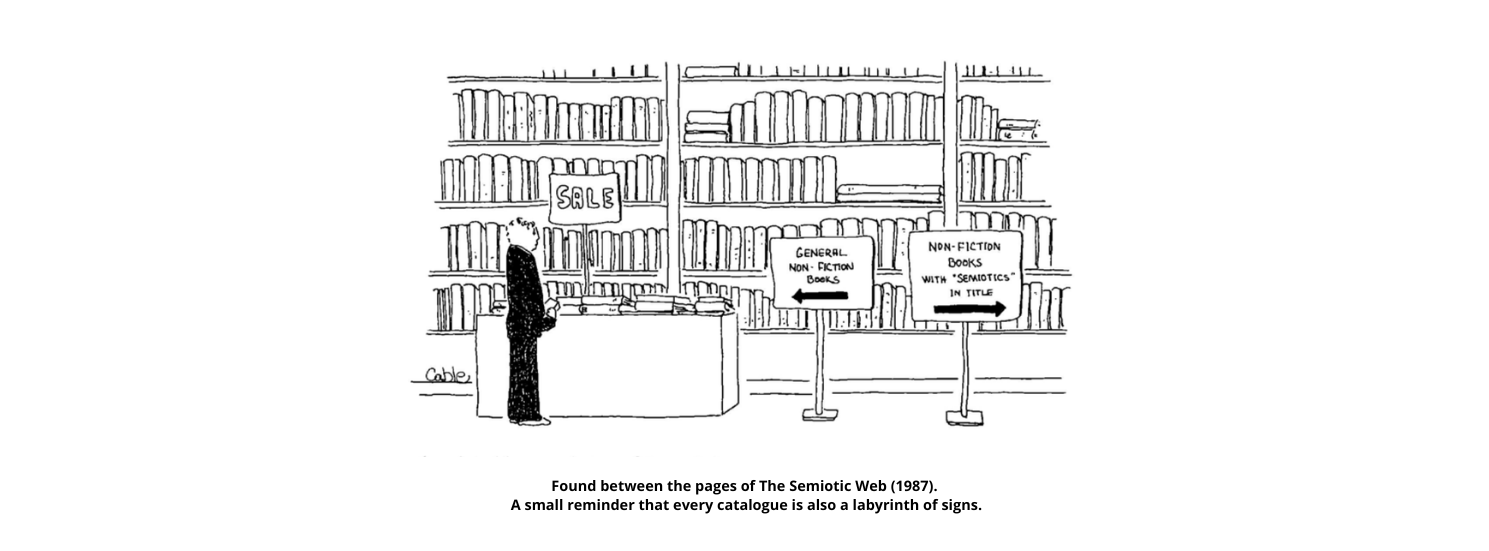
A unified academic catalogue for books, journal articles, book chapters, proceedings papers, conference abstracts and semiotic research materials.
A unified academic catalogue for books, journal articles, proceedings papers, collection articles and semiotic research materials. Search across the full database; results are shown with pagination.
Thesaurus
Browse authorized terms and raw keywords indexed across books, journals, articles, collections and proceedings. Authorized terms search variants and related concepts.
The Constitution of Han-Academic Ideology
You-Zheng Li
- Edition
- 1 edition
Culture Peter Lang Publishing 3631313853 Available
View details
Parallel title: Parallel title: An Archetype of Chinese Ethics and Academic Ideology
Other title information: A Hermeneutico-Semiotic Study
Annotation: Intercultural philosophy does not take its starting point from the comparison of different cultures from a neutral point of view, it instead arises through the confrontation with certain features of another culture which distance the philosopher from his or her own tradition, compelling it to be regarded in a new way. In dealing with the origins of Confucian ethics, You-Zheng Li does exactly this. His extensive training in Western Hermeneutics and semiotics enables him to reformulate the set of ethical customs, rituals, rules and strategies formulated 2500 years ago in ancient China. In contrast to Western ethics, which are thoroughly penetrated by the divine commands of the Judeo-Christian tradition and mainly characterized by the search for the practical good and one's own happiness begun in Greek and Roman philosophy, Chinese ethics originated and developed largely outside the domains of religion and philosophy. In attempting to elaborate on the specific nature of these ethics, the author navigates between Scylla and Charybdis. He seeks to avoid the one extreme of merely repeating from the inside what has already been said, with its effective reduction of ethical theory to certain reflexes of practical life. Just as well, however, he tries to avoid the other extreme of measuring ancient traditions by external standards and therewith exchanging old prejudices for new ones. He much rather tries to elucidate the foundation of Chinese ethics by using a certain language and a certain method which, as only one language and one method among others, does not aver to exhaust the inherent sense and the efficacious demand of what has been or is still being lived out and practised.
Identifier: 3631313853
Status: Available
The Structure of the Chinese Ethical Archetype
You-Zheng Li
- Edition
- 1 edition
Culture Peter Lang Publishing 3631313861 Available
View details
Parallel title: Parallel title: An Archetype of Chinese Ethics and Academic Ideology
Other title information: A Hermeneutico-Semiotic Study
Annotation: Intercultural philosophy does not take its starting point from the comparison of different cultures from a neutral point of view, it instead arises through the confrontation with certain features of another culture which distance the philosopher from his or her own tradition, compelling it to be regarded in a new way. In dealing with the origins of Confucian ethics, You-Zheng Li does exactly this. His extensive training in Western Hermeneutics and semiotics enables him to reformulate the set of ethical customs, rituals, rules and strategies formulated 2500 years ago in ancient China. In contrast to Western ethics, which are thoroughly penetrated by the divine commands of the Judeo-Christian tradition and mainly characterized by the search for the practical good and one's own happiness begun in Greek and Roman philosophy, Chinese ethics originated and developed largely outside the domains of religion and philosophy. In attempting to elaborate on the specific nature of these ethics, the author navigates between Scylla and Charybdis. He seeks to avoid the one extreme of merely repeating from the inside what has already been said, with its effective reduction of ethical theory to certain reflexes of practical life. Just as well, however, he tries to avoid the other extreme of measuring ancient traditions by external standards and therewith exchanging old prejudices for new ones. He much rather tries to elucidate the foundation of Chinese ethics by using a certain language and a certain method which, as only one language and one method among others, does not aver to exhaust the inherent sense and the efficacious demand of what has been or is still being lived out and practised.
Identifier: 3631313861
Status: Available