
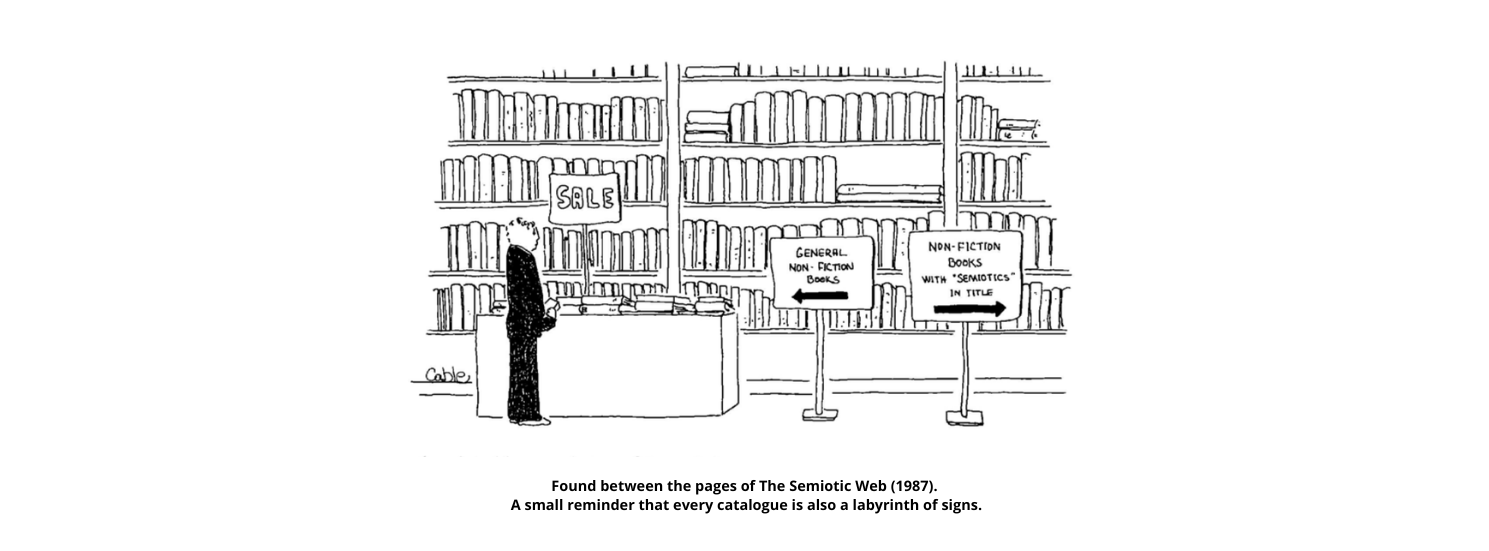
A unified academic catalogue for books, journal articles, book chapters, proceedings papers, conference abstracts and semiotic research materials.
A unified academic catalogue for books, journal articles, proceedings papers, collection articles and semiotic research materials. Search across the full database; results are shown with pagination.
A Reader on Both Cybernetics and Systems Theory
In: Cybernetics & Human Knowing 2016, Volume 23, Issue 2: Challenges of, and to, Pragmatics
View details
Can Pragmatists Believe in Qualia?
In: Cybernetics & Human Knowing 2016, Volume 23, Issue 2: Challenges of, and to, Pragmatics
View details
Challenges of, and to, Pragmatics
In: Cybernetics & Human Knowing 2016, Volume 23, Issue 2: Challenges of, and to, Pragmatics
View details
Column on Transdisciplinary Realism
In: Cybernetics & Human Knowing 2016, Volume 23, Issue 2: Challenges of, and to, Pragmatics
View details
Helpful Feedback
In: Cybernetics & Human Knowing 2016, Volume 23, Issue 2: Challenges of, and to, Pragmatics
View details
New Visual Hermeneutics
In: Cybernetics & Human Knowing 2016, Volume 23, Issue 2: Challenges of, and to, Pragmatics
View details
Three Levels of Semiosis: Three Kinds of Kinds
In: Cybernetics & Human Knowing 2016, Volume 23, Issue 2: Challenges of, and to, Pragmatics
View details
Why Do We Want To Live In Cybernetics?
In: Cybernetics & Human Knowing 2016, Volume 23, Issue 2: Challenges of, and to, Pragmatics
View details
Przestrzeń i muzyka
View details
Annotation: This essay is the third in a series of works devoted to musical hermeneutics. In the first, I dealt with the basic concepts of music ontology: movement, play, being and time, drawing inspiration from the hermeneutical philosophy of Schleiermacher, Diltey, Heidegger and Gadamer. Then, inspired by the thought of Paul Ricoeur, I analysed the conceptual category of musical narrative. Even then, in these considerations, the category of space appeared many times, inseparable from human experience in its temporal and spatial structure and, as it turns out, inextricably linked to the experience of music. In the reception of music, we are undoubtedly given a certain "temporal" sound-musical space.
Identifier: 9788387182731
Status: Available
Music and the Arts
- Edition
- 1 edition
View details
Other title information: Volume II
Annotation: Music, in some forms, declares itself autonomous and absolute. But semiotics has taught us that no sign system can function alone, isolated from other texts. Correspondences and interrelationships of arts have always been fertile soil from which musical meanings to grow. Thus, among the topics of these proceedings, one finds music and painting, ekphrasis, interpretation, semiotic theory of music, pragmatism, aesthetics, topics, narrativity, music and media, opera, cinema, literature, music history, hermeneutics, dance and music psychology. Musical Signification is a world-wide research project that tries to open new avenues for an innovative science of music as a meaningful practice throughout the ages.
Identifier: 9525431096
Status: Available
Systems of musical sense
- Dependent title
- essays on the analysis, semiotics, and hermeneutics of music
View details
Annotation: Systems of Musical Sense breathes new life into the field of music semiotics in its intuitive mix of logical rigor and hermeneutical interpretation and unique approach to paradigmatic analysis (Ruwet, Nattiez) and established theories of tinal music (Schoenberg). More significantly, te authors lay out an entirely new and innovative theory in their concept of musical homestasis, a phenomenon closely related to the fundamental law of physics which states that all things set in motion, organic and inorganic, tend to return to their initial point of rest. In tonal music, which also incorporates teology, this can take place at different levels, embodied by various parameters. The sensitive analyses here demonstrate ramifications of this axiom and cast new light on the structuring and effects de sens of tinal genres ranging in diversity from Bach chorales to Wagnerian opera. The culmination of mera tha a decade of research by this tea of widely published music scholars, the book is also a starting point: cognitivists, theorists, musicologists, and others can use the analytic methos "as is", develop it further, or transform it.The systems unvailed here need not be confined to tonal, "common-practice" art music. As universal axiom at least as dependable as the gestaltists "law of good continuation", the theory of homeostasis reveals new dimensions in earlier musical style and thos of more contemporary vintage.
Identifier: 9525431061
Status: Available
M. K. Čiurlionio
- Dependent title
- fortepijoninės muzikos tekstas
View details
Other title information: Other title information (genezės aspektas)
Annotation: The purpose of this book is to reveal the genesis of Čiurlionis's piano music trxt. To that end, the general issues of text theory and the very concept of text in the paradigms of structuralism, hermeneutics, phenomenology and reception are discussed at the beginning. Next, the book defines the concept of a musical text, one of the forms of existence of a text, and reveals the essential features of a musical text, consistently revealing the genesis of the piano music text of Čiurlionis.
Status: Available
Readers of the book of life
- Dependent title
- contextualizing developmental evolutionary biology
View details
Annotation: The "chicken-and-egg" enigma of how genetic information and the body intermingle in "performing life" is a fascinating challenge for biology. The "Jurassic Park Fallacy" is a more traditional interpretation, stating that all the information necessary to build a body is present in DNA; the cell is but a "juke box" playing unambiguously what is in its genetic text and tuning the performance to the environment. Anton Markos suggests a complementary approach: to assume that living beings are endowed with a capacity analogous to a human reader, who is able to extract meaning from a given text, according to her or his personal experience and cultural background. Hermeneutics was developed in the humanities as a method to achieve understanding, in a given context, of texts, history, and artwork. The author takes living beings as hermeneutical interpreters of "texts" encoded in DNA." "This book should interest scholars in both biology and the humanities. To bring both kinds of reader to a common platform, the first part compares two problem-solving strategies: the "objectivist" approach common in natural sciences and hermeneutics as used in the humanities. The second part surveys aspects of the development of twentieth-century biology, also accentuating branches that never became part of today's mainstream. The third part reviews a large body of recent evidence, which can be interpreted in favor of the author's arguments."
Identifier: 0195149483
Status: Available
Intellectual Effort and Linguistic Work
- Dependent title
- Semiotic and Hermeneutic Aspects of the Philosophy of Bergson
View details
Annotation: Bergson discusses the questions of philosophic truth in a way that allows an interpretation in terms of contemporary semiotics and hermeneutics. In his famous "Philosophical intuition" he defines this kind of truth as "something simple, infinitely simple, so extraordinarily simple that the philosopher has never succeded in saying it". This dialectic between intuition and its 'saying' is examined as the hermeneutics of understanding and interpretation. At the same time, this study attempts to open new insights in Bergson's philosophy, and especially in his notion of Intellectual Effort. Kristian Bankov, in his essay, considers this concept not only central to Bergson's philosophy, but also a key to the sign-nature of our whole being and existence in the world.
Identifier: 9519865403
Status: Available
Biohermeneutics and hermeneutics of biology
In: Semiotica 1999, Issue 2024-01-04 00:00:00
- Pages
- 215-226
View details
Identifier: DOI: 10.1515/semi.1999.127.1-4.215
A general theory of semiotics in Jaspers’ critical hermeneutics
In: Synthesis in Diversity, Volume 2
- Pages
- 1019-1022
View details
Hermeneutics, semiotics and architecture: Timaeus revisited
In: Synthesis in Diversity, Volume 1
- Pages
- 573-576
View details
The Constitution of Han-Academic Ideology
- Edition
- 1 edition
View details
Parallel title: Parallel title: An Archetype of Chinese Ethics and Academic Ideology
Other title information: A Hermeneutico-Semiotic Study
Annotation: Intercultural philosophy does not take its starting point from the comparison of different cultures from a neutral point of view, it instead arises through the confrontation with certain features of another culture which distance the philosopher from his or her own tradition, compelling it to be regarded in a new way. In dealing with the origins of Confucian ethics, You-Zheng Li does exactly this. His extensive training in Western Hermeneutics and semiotics enables him to reformulate the set of ethical customs, rituals, rules and strategies formulated 2500 years ago in ancient China. In contrast to Western ethics, which are thoroughly penetrated by the divine commands of the Judeo-Christian tradition and mainly characterized by the search for the practical good and one's own happiness begun in Greek and Roman philosophy, Chinese ethics originated and developed largely outside the domains of religion and philosophy. In attempting to elaborate on the specific nature of these ethics, the author navigates between Scylla and Charybdis. He seeks to avoid the one extreme of merely repeating from the inside what has already been said, with its effective reduction of ethical theory to certain reflexes of practical life. Just as well, however, he tries to avoid the other extreme of measuring ancient traditions by external standards and therewith exchanging old prejudices for new ones. He much rather tries to elucidate the foundation of Chinese ethics by using a certain language and a certain method which, as only one language and one method among others, does not aver to exhaust the inherent sense and the efficacious demand of what has been or is still being lived out and practised.
Identifier: 3631313853
Status: Available
The Structure of the Chinese Ethical Archetype
- Edition
- 1 edition
View details
Parallel title: Parallel title: An Archetype of Chinese Ethics and Academic Ideology
Other title information: A Hermeneutico-Semiotic Study
Annotation: Intercultural philosophy does not take its starting point from the comparison of different cultures from a neutral point of view, it instead arises through the confrontation with certain features of another culture which distance the philosopher from his or her own tradition, compelling it to be regarded in a new way. In dealing with the origins of Confucian ethics, You-Zheng Li does exactly this. His extensive training in Western Hermeneutics and semiotics enables him to reformulate the set of ethical customs, rituals, rules and strategies formulated 2500 years ago in ancient China. In contrast to Western ethics, which are thoroughly penetrated by the divine commands of the Judeo-Christian tradition and mainly characterized by the search for the practical good and one's own happiness begun in Greek and Roman philosophy, Chinese ethics originated and developed largely outside the domains of religion and philosophy. In attempting to elaborate on the specific nature of these ethics, the author navigates between Scylla and Charybdis. He seeks to avoid the one extreme of merely repeating from the inside what has already been said, with its effective reduction of ethical theory to certain reflexes of practical life. Just as well, however, he tries to avoid the other extreme of measuring ancient traditions by external standards and therewith exchanging old prejudices for new ones. He much rather tries to elucidate the foundation of Chinese ethics by using a certain language and a certain method which, as only one language and one method among others, does not aver to exhaust the inherent sense and the efficacious demand of what has been or is still being lived out and practised.
Identifier: 3631313861
Status: Available
The uniqueness of ontological hermeneutics among contemporary semiotic theories of interpretation
In: Synthesis in Diversity, Volume 1
- Pages
- 461-464
View details
Discourses about terrorism
In: Semiotica 1990, Issue 2024-03-04 00:00:00
View details
Identifier: DOI: 10.1515/semi.1990.81.3-4.211
Enunciation and narration: World and text
In: Semiotica 1990, Issue 2024-03-04 00:00:00
View details
Identifier: DOI: 10.1515/semi.1990.81.3-4.357
Focalization and point of view in fiction film
In: Semiotica 1990, Issue 2024-03-04 00:00:00
View details
Identifier: DOI: 10.1515/semi.1990.81.3-4.305
Interpretant and subject: Semiotics or hermeneutics?
In: Semiotica 1990, Issue 2024-03-04 00:00:00
View details
Identifier: DOI: 10.1515/semi.1990.81.3-4.193
Jeux figuratifs et récit fantastique
In: Semiotica 1990, Issue 2024-03-04 00:00:00
View details
Identifier: DOI: 10.1515/semi.1990.81.3-4.393
Literary semiotics in Spain: Bibliography
In: Semiotica 1990, Issue 2024-03-04 00:00:00
View details
Identifier: DOI: 10.1515/semi.1990.81.3-4.323
Montage and spectator: Eisenstein and the avant-garde
In: Semiotica 1990, Issue 2024-03-04 00:00:00
View details
Identifier: DOI: 10.1515/semi.1990.81.3-4.277
Pour une sémiotique du discours social
In: Semiotica 1990, Issue 2024-03-04 00:00:00
View details
Identifier: DOI: 10.1515/semi.1990.81.3-4.203
Semiotics and architecture: Theater and reality in Spain, 1968-1988
In: Semiotica 1990, Issue 2024-03-04 00:00:00
View details
Identifier: DOI: 10.1515/semi.1990.81.3-4.237
Semiotics and Hermeneutics
In: The Semiotic Web 1990: Recent Developments in Theory and History
- Pages
- 267-284
View details
Semiotics and the history of social communication
In: Semiotica 1990, Issue 2024-03-04 00:00:00
View details
Identifier: DOI: 10.1515/semi.1990.81.3-4.221
Sonstiges
In: Semiotica 1990, Issue 2024-03-04 00:00:00
View details
Identifier: DOI: 10.1515/semi.1990.81.3-4.u
The pedagogic subject
In: Semiotica 1990, Issue 2024-03-04 00:00:00
View details
Identifier: DOI: 10.1515/semi.1990.81.3-4.227
The pragmatics of comico-facetious texts
In: Semiotica 1990, Issue 2024-03-04 00:00:00
View details
Identifier: DOI: 10.1515/semi.1990.81.3-4.315
The signifier in painting, shit
In: Semiotica 1990, Issue 2024-03-04 00:00:00
View details
Identifier: DOI: 10.1515/semi.1990.81.3-4.345
To look, to see, to utter
In: Semiotica 1990, Issue 2024-03-04 00:00:00
View details
Identifier: DOI: 10.1515/semi.1990.81.3-4.291
Toward an integrated definition of the literary phenomenon
In: Semiotica 1990, Issue 2024-03-04 00:00:00
View details
Identifier: DOI: 10.1515/semi.1990.81.3-4.385
Visual illusions and intratextuality in Picasso's Picassos
In: Semiotica 1990, Issue 2024-03-04 00:00:00
View details
Identifier: DOI: 10.1515/semi.1990.81.3-4.259
Visual semiotics and the sociology of communication
In: Semiotica 1990, Issue 2024-03-04 00:00:00
View details
Identifier: DOI: 10.1515/semi.1990.81.3-4.243
Hypothesis, reconstruction, analogy: On hermeneutics and the Interpretation of literature
In: Semiotica 1989, Issue 2024-03-04 00:00:00
View details
Identifier: DOI: 10.1515/semi.1989.74.3-4.235
LITERARY SEMIOTICS AND HERMENEUTICS: TOWARDS A TAXONOMY OF THE INTERPRETANT
In: The American Journal of Semiotics 1985, Volume 3, Issue 3
- Pages
- 109-119
View details
T. K. Seung: Structuralism and Hermeneutics
In: The American Journal of Semiotics 1984, Volume 2, Issue 4
- Pages
- 166-169
View details
A system for word senses
In: Semiotica 1983, Issue 2024-03-04 00:00:00
View details
Identifier: DOI: 10.1515/semi.1983.44.3-4.307
Le sens figuré et ses rapports avec la syntaxe
In: Semiotica 1983, Issue 2024-03-04 00:00:00
View details
Identifier: DOI: 10.1515/semi.1983.44.3-4.331
Le spectacle théâtral, lieu de rencontre privilégié entre la littérature, les arts plastiques et la musique
In: Semiotica 1983, Issue 2024-03-04 00:00:00
View details
Identifier: DOI: 10.1515/semi.1983.44.3-4.297
Pragmatic theory of meaning: A note on Peirce's 'last' formulation of the pragmatic maxim and its Interpretation
In: Semiotica 1983, Issue 2024-03-04 00:00:00
View details
Identifier: DOI: 10.1515/semi.1983.44.3-4.203
Review article
In: Semiotica 1983, Issue 2024-03-04 00:00:00
View details
Identifier: DOI: 10.1515/semi.1983.44.3-4.371
Review article
In: Semiotica 1983, Issue 2024-03-04 00:00:00
View details
Identifier: DOI: 10.1515/semi.1983.44.3-4.363
Signs and Systems in Condillac and Saussure
In: Semiotica 1983, Issue 2024-03-04 00:00:00
View details
Identifier: DOI: 10.1515/semi.1983.44.3-4.259
The semiotics of character names in the drama
In: Semiotica 1983, Issue 2024-03-04 00:00:00
View details
Identifier: DOI: 10.1515/semi.1983.44.3-4.283