
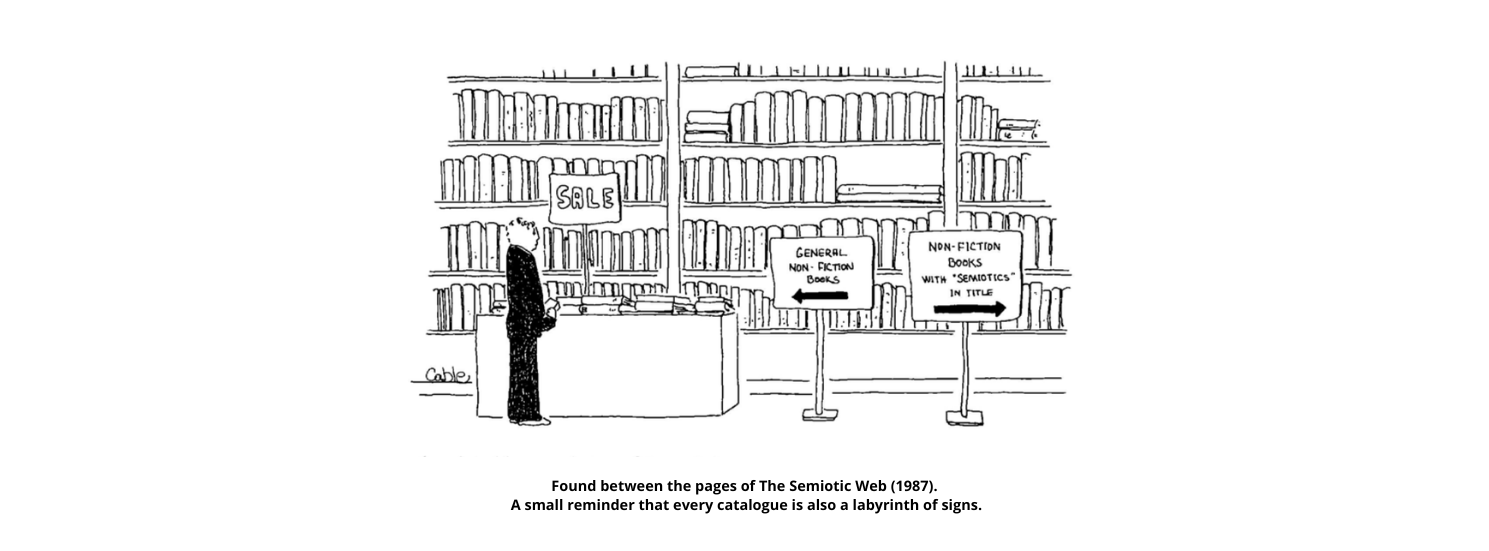
A unified academic catalogue for books, journal articles, book chapters, proceedings papers, conference abstracts and semiotic research materials.
A unified academic catalogue for books, journal articles, proceedings papers, collection articles and semiotic research materials. Search across the full database; results are shown with pagination.
Signic knowledge: its niche in semiotics and its various aspects
In: Semiotica 2021, Issue 239
- Pages
- 225-242
View details
Identifier: DOI: 10.1515/sem-2018-0070
Spaces and Meanings
- Edition
- 1 edition
View details
Other title information: Semantics of the Cultural Landscape
Annotation: This book examines the problem of relationships between culture and space. Highlighting the use of semiotics of culture as a basic concept of research, it describes the power of the cultural landscape in the context of culture philosophical research. Opening with a discussion of the existence of culture in space, it establishes basic concepts such as noosphere and pneumatosphere. The author acknowledges the early contributions of thinkers like Vladimir Vernadsky and Pierre Teilhard de Chardin, who first observed that human activity has become a geological force.
Identifier: 9783030151676
Status: Available
Telos and Object
- Edition
- 1 edition
View details
Other title information: The relation between sign and object as a teleological relation in the semiotics of Charles S. Peirce
Notes: This is Luca Rosso's thesis
Annotation: The semiotics of Charles S. Peirce is conceived as an essential part of a comprehensive philosophical outlook. The study of signs is carried on for its bearing on the knowledge of reality; therefore the relation of signs to objects is the core concern of Peirce’s semiotics. This study looks at this question on the background of Peirce’s philosophical system, individuating in the theories of reality and of knowledge the key issues which allow a philosophically grounded definition of the sign-object relation. The concepts of teleology and of final cause reveal themselves to be the essential conception which emerges from these two issues. The underlying teleological tendencies in the use of signs justify their gnoseological reliableness.
Identifier: 9783034320887
Status: Available
Bioinformatic Egg, Biosemiotic Hen
In: Cybernetics & Human Knowing 2016, Volume 23, Issue 3: Batesonian Facets
View details
Cultural Implications of Biosemiotics
- Edition
- 1 edition
View details
Annotation: This is the first book to consider the major implications for culture of the new science of biosemiotics. The volume is mainly aimed at an audience outside biosemiotics and semiotics, in the humanities and social sciences principally, who will welcome elucidation of the possible benefits to their subject area from a relatively new field. The book is therefore devoted to illuminating the extent to which biosemiotics constitutes an ‘epistemological break’ with ‘modern’ modes of conceptualizing culture. It shows biosemiotics to be a significant departure from those modes of thought that neglect to acknowledge continuity across nature, modes which install culture and the vicissitudes of the polis at the centre of their deliberations. The volume exposes the untenability of the ‘culture/nature’ division, presenting a challenge to the many approaches that can only produce an understanding of culture as a realm autonomous and divorced from nature.
Identifier: 9789402408577
Status: Available
Embracing Cybernetics: Living Legacy of the Bateson Research Team
In: Cybernetics & Human Knowing 2016, Volume 23, Issue 3: Batesonian Facets
View details
Foreword: Bateson Facets
In: Cybernetics & Human Knowing 2016, Volume 23, Issue 3: Batesonian Facets
View details
Knowledge & Complexity International Bateson Institute Column
In: Cybernetics & Human Knowing 2016, Volume 23, Issue 3: Batesonian Facets
View details
Letter: Gregory Bateson to Cecil P. Martin
In: Cybernetics & Human Knowing 2016, Volume 23, Issue 3: Batesonian Facets
View details
Meaning, Narrativity, and the Real
- Edition
- 1 edition
View details
Other title information: The Semiotics of Law in Legal Education IV
Annotation: This book examines the concept of meaning and our general understanding of reality in a legal and philosophical context. Starting from the premise that meaning is a matter of linguistic and other forms of articulation, it considers the inherent philosophical consequences. Part I presents Klages’, Derrida’s, Von Hofmannsthal’s and Wittgenstein’s explorations of silence as a source of articulation and meaning. Debates about 20th century psychologism gave the attitude concept a pivotal role; it illustrates the importance of the discovery that a word is globally qualified as ‘the basic unit of language’. This is mirrored in the fact that we understand reality as a matter of particles and thus interpret the real as a component of an all-embracing ‘particle story’. Each chapter of the book focuses on an aspect of legal semiotics related to the chapter’s theme: for instance on the meaning of a Judge’s ‘Saying for Law’, on law students training in varying attitudes or on the ties between law and language. Part II of the book illustrates our general understanding of reality as a matter of particles and partitioning, and examines texts that prove that particle thinking is basic for our meaning concept. It shows that physics, quantum theory, holism, and modern brain research focusing on human linguistic capabilities, confirm their ties to the particle story. In contrast, the book concludes that partitions and particles are neither a fact in the history of the cosmos nor a determinant of knowledge and the sciences, and that meaning is a process: a constellation rather than a fixation. This is manifest once one understands meaning as the result of continuously changing attitudes, which create our narratives on cosmos and creation. The book proposes a new key for meaning: a linguistic occurrence anchored in dimensions of human narrativity.
Identifier: 9783319281742
Status: Available
Synchronicity as Time: E-Series Time for Living Formations
In: Cybernetics & Human Knowing 2016, Volume 23, Issue 3: Batesonian Facets
View details
The Path to Steps to an Ecology of Mind
In: Cybernetics & Human Knowing 2016, Volume 23, Issue 3: Batesonian Facets
View details
Toward a Recursive Theory of Everyday Double Binds
In: Cybernetics & Human Knowing 2016, Volume 23, Issue 3: Batesonian Facets
View details
Virtual Logic—George Spencer-Brown (2 April 1923 – 25 August 2016)
In: Cybernetics & Human Knowing 2016, Volume 23, Issue 3: Batesonian Facets
View details
A methodological framework for projecting brand equity: Putting back the imaginary into brand knowledge structures
In: Sign System Studies 2014, Volume 42, Issue 1
- Pages
- 98-136
View details
Identifier: 10.12697/SSS.2014.42.1.05
Mathematics as a Modeling System
- Edition
- 1 edition
View details
Other title information: a Semiotic Approach
Notes: Editors of the series: Kalevi Kull, Silvi Salupere, Peeter Torop
Annotation: Mathematics and semiotics share many intellectual features and interests, from the study of how representations stand for specific kinds of referents to philosophical considerations of how these interrelate with reality. Nonetheless, in-depth studies of this intrinsic relation between the two have rarely been undertaken, with a few notable exceptions (as will be discussed in the book). Especially relevant to the study of the nature of mathematics is the concept of model – a term and notion that is used widely in both disciplines. However, to the best of our knowledge the theory of models in semiotics, known as Modeling Systems Theory, has rarely, if ever, been applied to the study of mathematical modeling. The purpose of this book is to do exactly that since it is our view that mathematics is a de facto modelling system in the semiotic sense and it is our hope that from this it will be possible to gain considerable insights into how mathematics works and achieves the discoveries and forms of knowledge that it has since the dawn of antiquity. Hopefully, this will allow both mathematicians and semioticians to pursue similar or analogous research objectives with regard to understanding the biological and cognitive etiology of sign systems and their connection to reality.
Identifier: 9789949326105
Status: Available
Accomplishing Permanency
- Edition
- 1 edition
View details
Other title information: Reunification Pathways and Outcomes for Foster Children
Annotation: Reunification is a primary goal of foster care systems and the most common permanency planning decision. It is defined as the return of children placed in protective care to the home of their birth family and used to describe the act of restoring a child in out-of-home care back to the biological family. Yet reunification decision-making and the process of reintegrating children into birth families remains under researched. This Brief takes a look at family reunification knowledge and research in Australia where there is evidence that most children placed in protective care are eventually reunited with their birth parents. It explores how a knowledge of reunification decision making and outcomes can contribute to strengthening practice and informing policy formulation and program planning in Child Welfare.
Identifier: 9789400750913
Status: Available
Tuning the Self
- Edition
- 1 edition
View details
Other title information: George Herbert’s Poetry as Cognitive Behaviour
Annotation: This book provides a cognitive analysis of the poetry of George Herbert (1593- 1633). From Herbert’s own thinking, recorded in his prose treatises, can be deduced that his poems should serve a specific function: teaching self-knowledge to his readers. Self-knowledge is a necessary skill, to be applied in one’s strife for ‘temperance’: the regulation of body, house, church, mind, and community. To Herbert, the meaning of his poems is subservient to this function: poetry should aid his readers to temper their lives. The cognitive framework applied here can serve to explain this function. Following Merlin Donald’s theory of cognitive evolution, art serves the purpose of mimetic meta-cognition: a specific cognitive strategy at the disposal of a county priest. Moreover, a cognitive framework can serve to explain why the Herbert-tradition has paid so little attention to this artistic function; this tradition operates within specific confines, the same confines that Herbert sought to compensate with his poetry and his thinking.
Identifier: 9783034313780
Status: Available
Young People's Quality of Life and Construction of Citizenship
- Edition
- 1 edition
View details
Annotation: This brief book is dedicated to analyze the relations between quality of life and construction of citizenship of young people in Argentina, considering two specific social scenarios: the community and the university. In the case of community it is important to note that it not imply uniformity, as community means the inclusion of diversity and the achievement of sharing within it, and in the case of university it will be necessary to recognize that as an educational institution the university has expanded his traditional role of production of knowledge, to be an institution of social reference and social support for students. To do this the author will show some of the results of a decade of research in quality of life and young people, using quantitative and qualitative methods.
Identifier: 9789400729957
Status: Available
Understanding Morphology
- Edition
- 2 edition
View details
Annotation: Understanding Morphology offers students an introduction to the study of word structure that starts at the very beginning. Assuming no knowledge of the field of morphology, the book presents a broad range of morphological phenomena from a variety of languages.
Identifier: 9780340950012
Status: Available
Пространства и смыслы
View details
Other title information: Семантика культурного ландшафта
Notes: This book has a table of contents and annotation in English.
Annotation: This book examines the problem of relationships between culture and space. Highlighting the use of semiotics of culture as a basic concept of research, it describes the power of the cultural landscape in the context of culture philosophical research. Opening with a discussion of the existence of culture in space, it establishes basic concepts such as noosphere and pneumatosphere. The author acknowledges the early contributions of thinkers like Vladimir Vernadsky and Pierre Teilhard de Chardin, who first observed that human activity has become a geological force.
Identifier: 9785864431627
Status: Available
The Logos of the Bios 1
- Dependent title
- Contributions to the Foundation of a three-leveled Biosemiotics
View details
Annotation: This book opens a new perspective on living nature through the philosophical foundation of biology as an understanding social science. The contributions integrate the pragmatic turn of the theory of science discussion, replacing the solus ipse subject of knowledge of objectivism by the intersubjective - communicative character of thought, experience and research. A three-leveled biosemiotics investigates rule-governed sign-mediated interactions within and between organisms of all organismic kingdoms. This approach underlines the complementarity of syntactic, pragmatic and semantic rules as a precondition for adequately investigating the languagelike structure of the genetic code and the communicative organization of interacting living nature.
Identifier: 9525576019
Status: Available
What relations are: A case study on conceptual relations, displacement of meaning and knowledge profiling
In: Sign System Studies 2003, Volume 31, Issue 1
- Pages
- 109-132
View details
Identifier: 10.12697/SSS.2003.31.1.04
Biosemiotic knowledge — a prerequisite for valid explorations of extraterrestrial intelligent life
In: Sign System Studies 2002, Volume 30, Issue 1
- Pages
- 283-292
View details
Identifier: 10.12697/SSS.2002.30.1.17
New science
- Edition
- 3 edition
View details
Other title information: Principles of the new science concerning the common nature of nations
Annotation: Barely acknowledged in his lifetime, the New Science of Giambattista Vico (1668-1744) is an astonishingly perceptive and ambitious attempt to decipher the history, mythology and laws of the ancient world. Discarding the Renaissance notion of the classical as an idealised model for the modern, it argues that the key to true understanding of the past lies in accepting that the customs and emotional lives of ancient Greeks and Romans, Egyptians, Jews and Babylonians were radically different from our own. Along the way, Vico explores a huge variety of topics, ranging from physics to poetics, money to monsters, and family structures to the Flood. Marking a crucial turning-point in humanist thinking, New Science has remained deeply influential since the dawn of Romanticism, inspiring the work of Karl Marx and even influencing the framework for Joyce's Finnegan's Wake.
Identifier: 0140435697
Status: Available
Hi-fives
View details
Other title information: a trip to semiotics
Annotation: The newcomer to semiotics is the primary intended reader of this book. Each of the authors of the various branches of semiotics open this perspective to all who want to know about semiotics, as well as to those who want to add to their knowledge of semiotics. The topics cover the major areas of semiotics and the human sciences: linguistics, theater, psychology, religion, anthropology, history, law, graphics, music, media, poetics, architecture, and a capsule overview of Charles Sanders Peirce. The individual essays develop each specialist's approach to semiotics, with full bibliography for follow-through. The introductory chapter points out the unifying themes that tie the special topics together
Identifier: 0820438421
Status: Available
Deixis and background knowledge in the humor of car bumper stickers
In: Semiotica 1997, Issue 2024-03-04 00:00:00
View details
Identifier: DOI: 10.1515/semi.1997.113.3-4.347
From the fantasia through metaphor to knowledge: A Vichian perspective of conceptualization
In: Synthesis in Diversity, Volume 1
- Pages
- 17-44
View details
How do sex, age, settlement type, education and parental background influence the knowledge of proverbs in Hungary?
In: Synthesis in Diversity, Volume 2
- Pages
- 1147-1150
View details
Is nature a language? J. W. Goethe on scientific knowledge
In: Synthesis in Diversity, Volume 1
- Pages
- 175-178
View details
Project: Knowledge and invention. Comprehension of the architectural process
In: Synthesis in Diversity, Volume 1
- Pages
- 549-552
View details
Signs of meaning in the universe
View details
Notes: Translated by Barbara J. Haveland
Annotation: This book examines the radical premise that the sign, not the molecule, is the crucial, underlying factor in the study of life
Identifier: 0253332338
Status: Available
Compte rendu
In: Semiotica 1992, Issue 2024-03-04 00:00:00
View details
Identifier: DOI: 10.1515/semi.1992.91.3-4.341
Distant genetic relationship and Edward Sapir
In: Semiotica 1992, Issue 2024-03-04 00:00:00
View details
Identifier: DOI: 10.1515/semi.1992.91.3-4.273
Guest editorial. Present image, past text, post word: Educating the late modern citizen
In: Semiotica 1992, Issue 2024-03-04 00:00:00
View details
Identifier: DOI: 10.1515/semi.1992.91.3-4.195
Ideal speech situation vs. particular pragmatics of situation: The microcosm of psychoanalytic discourse
In: Semiotica 1992, Issue 2024-03-04 00:00:00
View details
Identifier: DOI: 10.1515/semi.1992.91.3-4.199
La sémiotique des gestes centrés sur le corps et leurs implications langagières dans le site medical
In: Semiotica 1992, Issue 2024-03-04 00:00:00
View details
Identifier: DOI: 10.1515/semi.1992.91.3-4.319
Professor Tarski, ‘The Liar’, and the true
In: Semiotica 1992, Issue 2024-03-04 00:00:00
View details
Identifier: DOI: 10.1515/semi.1992.91.3-4.301
Sonstiges
In: Semiotica 1992, Issue 2024-03-04 00:00:00
View details
Identifier: DOI: 10.1515/semi.1992.91.3-4.u
Crosscurrents in Second Language Acquisition and Linguistic Theories
View details
Notes: series edited by Harald Clahsen and William Rutherford
Annotation: This state-of-the-art volume presents an outstanding collection of 22 studies on current issues facing research in second-language acquisition (SLA). The editors sought contributions for this volume from seasoned veterans of SLA like Lydia White and Susan Gass, from well-known researchers in linguistics and/or first-language acquisition like Haj Ross and Harald Clahsen, and from relative newcomers to the field like India Plough and Jean-Marc Dewaele. The topics covered range from the role of universals at various levels of second-language (L2) knowledge.
Identifier: 9027224668
Status: Available
Nishi Amane’s efforts to translate Western knowledge: Sound, written character, and meaning
In: Semiotica 1991, Issue 2024-03-04 00:00:00
View details
Identifier: DOI: 10.1515/semi.1991.83.3-4.283
Signs of Knowledge in the Contemporary Academy
In: The American Journal of Semiotics 1990, Volume 7, Issue 4
- Pages
- 149-160
View details
Between definite and indefinite articles: The succinctness of signs (or the material field of dialectic)
In: Semiotica 1989, Issue 2024-03-04 00:00:00
View details
Identifier: DOI: 10.1515/semi.1989.74.3-4.271
Hypothesis, reconstruction, analogy: On hermeneutics and the Interpretation of literature
In: Semiotica 1989, Issue 2024-03-04 00:00:00
View details
Identifier: DOI: 10.1515/semi.1989.74.3-4.235
On a fallacious semantic conception of Gottlob Frege
In: Semiotica 1989, Issue 2024-03-04 00:00:00
View details
Identifier: DOI: 10.1515/semi.1989.74.3-4.211
On the linguistic import of catastrophe theory
In: Semiotica 1989, Issue 2024-03-04 00:00:00
View details
Identifier: DOI: 10.1515/semi.1989.74.3-4.179
Review article
In: Semiotica 1989, Issue 2024-03-04 00:00:00
View details
Identifier: DOI: 10.1515/semi.1989.74.3-4.337
Roland Barthes: Modernity within history
In: Semiotica 1989, Issue 2024-03-04 00:00:00
View details
Identifier: DOI: 10.1515/semi.1989.74.3-4.313
The articulation of gender symmetry in Yuchi culture
In: Semiotica 1989, Issue 2024-03-04 00:00:00
View details
Identifier: DOI: 10.1515/semi.1989.74.3-4.289
The semiotic character of ‛with’
In: Semiotica 1989, Issue 2024-03-04 00:00:00
View details
Identifier: DOI: 10.1515/semi.1989.74.3-4.253