
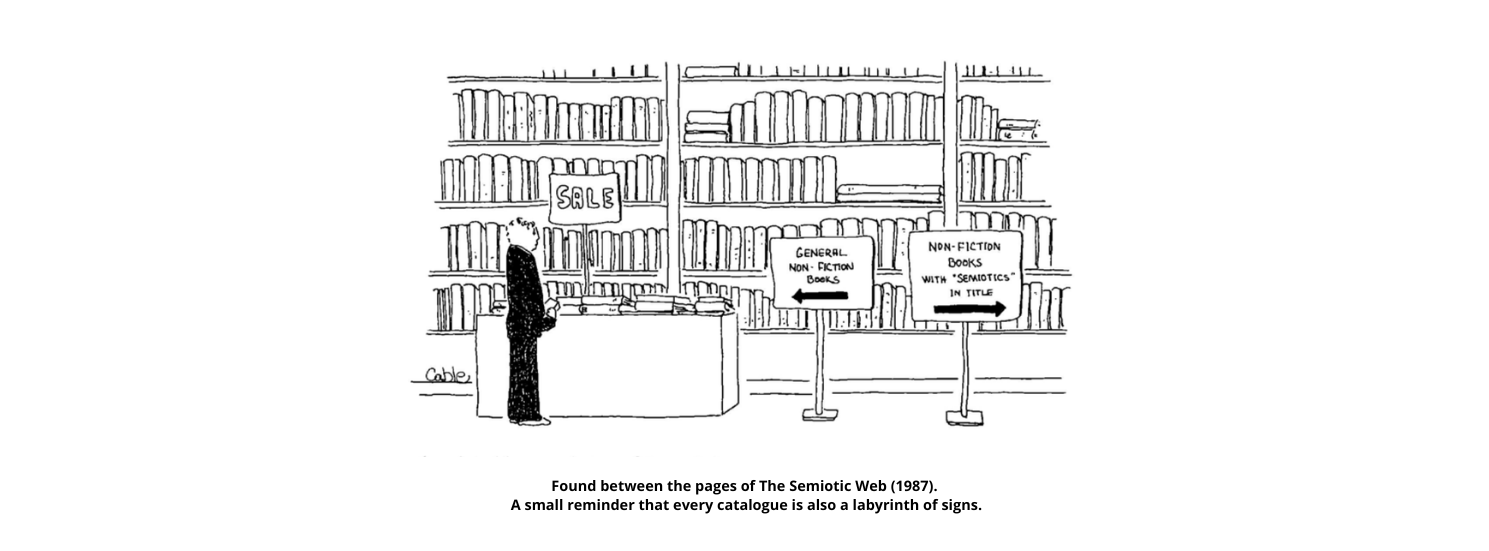
A unified academic catalogue for books, journal articles, book chapters, proceedings papers, conference abstracts and semiotic research materials.
A unified academic catalogue for books, journal articles, proceedings papers, collection articles and semiotic research materials. Search across the full database; results are shown with pagination.
Nishi Amane’s efforts to translate Western knowledge: Sound, written character, and meaning
In: Semiotica 1991, Issue 2024-03-04 00:00:00
View details
Identifier: DOI: 10.1515/semi.1991.83.3-4.283
Nomination originelle et la notion de l’interprétant: Objeux et enjeux de l’écriture pongienne
In: Semiotica 1991, Issue 2024-03-04 00:00:00
View details
Identifier: DOI: 10.1515/semi.1991.84.3-4.285
Postmodernism, or, The cultural logic of late capitalism
- Edition
- 1 edition
View details
Annotation: In his most wide-ranging and accessible work, Fredric Jameson argues that postmodernism is the cultural response to the latest systemic change in world capitalism. He seeks here to crystallize a definition of a term which has taken on so many meanings that it has virtually lost all historical significance. He presents an extensive discussion on the cultural landscape—both ‘high’ and ‘low’—of postmodernity, evaluating the political fortunes of the new term and surveying postmodern developments in a range of different fields—from market ideology to architecture, from painting and instalment art to contemporary punk film, from video art and high literature to deconstruction. Finally, Jameson revaluates the concept of postmodernism in light of postmodern critiques of totalization and historical narratives—from the notion of decadence to the dynamics of small groups, from religious fundamentalism to hi-tech science fiction—while touching on the nature of contemporary cultural critique and the possibilities of cognitive mapping in the present multinational world system. This provocative book will be fundamental to all future discussions of postmodernism.
Identifier: 9780860915379
Status: Available
Review article
In: Semiotica 1991, Issue 2024-03-04 00:00:00
View details
Identifier: DOI: 10.1515/semi.1991.84.3-4.301
Rossi-Landi’s Wittgenstein: ‘A philosopher’s meaning is his use in the culture’
In: Semiotica 1991, Issue 2024-03-04 00:00:00
View details
Identifier: DOI: 10.1515/semi.1991.84.3-4.275
Sonstiges
In: Semiotica 1991, Issue 2024-03-04 00:00:00
View details
Identifier: DOI: 10.1515/semi.1991.84.3-4.u
The Empire of Signs
View details
Other title information: Semiotic Essays on Japanese culture
Annotation: Like Roland Barthe's well-known book, 'The Empire of Signs', from which its title is taken, the present volume contains essays dealing with certain aspects of Japanese culture. Also like those contained in Barthes' book, the essays in the present volume are generally characterized by a mildly semioitc orientation, which means that while the authors may or may not be explicitly conscious of semiotic formulation, they are all (at least in the editor's view) interested in, and concerned with signifying (or meaning-generating) activity.
Identifier: 9027232784
Status: Available
The sun and the moon in Bulgakov’s The Master and Margarita: Life, death, and resurrection
In: Semiotica 1991, Issue 2024-03-04 00:00:00
View details
Identifier: DOI: 10.1515/semi.1991.84.3-4.185
Time-binding and Native people: A semiotic interpretation
In: Semiotica 1991, Issue 2024-03-04 00:00:00
View details
Identifier: DOI: 10.1515/semi.1991.84.3-4.253
Blame–account sequences in therapy: The negotiation of relational meanings
In: Semiotica 1990, Issue 2024-03-04 00:00:00
View details
Identifier: DOI: 10.1515/semi.1990.78.3-4.219
Interactive meaning representation of audiovisual texts: A Peircean approach
In: Semiotica 1990, Issue 2024-01-02 00:00:00
View details
Identifier: DOI: 10.1515/semi.1990.79.1-2.51
Radical translation, actual translation, and the problem of meaning
In: Semiotica 1990, Issue 2024-01-02 00:00:00
View details
Identifier: DOI: 10.1515/semi.1990.80.1-2.81
S/Z
View details
Annotation: S/Z is the linguistic distillation of Barthes's system of semiology, a science of signs and symbols, in which Balzac's novella, Sarrasine, is dissected semantically to uncover layers of hidden meaning.
Identifier: 0631176071
Status: Available
The True Meaning of Christmases Past: Masks of Verisimilitude in Rural Autobiography
In: The American Journal of Semiotics 1990, Volume 7, Issue 4
- Pages
- 29-39
View details
Meaning, Subject, and Reality as Semiotic Foci of Political Research
In: The Semiotic Web 1989
- Pages
- 399-446
View details
Semiotics of Deception: Meaning Deconstruction or Protection?
In: The American Journal of Semiotics 1989, Volume 6, Issue 2/3
- Pages
- 265-275
View details
How to kill jokes cognitively? The meaning structure of jokes
In: Semiotica 1988, Issue 2024-03-04 00:00:00
View details
Identifier: DOI: 10.1515/semi.1988.68.3-4.297
Social meaning in the observation of goal directed action
In: Semiotica 1988, Issue 2024-03-04 00:00:00
View details
Identifier: DOI: 10.1515/semi.1988.71.3-4.243
The iconography of landscape
View details
Annotation: The Iconography of Landscape draws together fourteen scholars from diverse disciplines across the humanities and social sciences to explicate the status of landscape as a cultural image, 'a pictorial way of representing, structuring or symbolising surroundings'. By applying the art-historical method of iconography - interpreting levels of meaning in human artifacts - to landscapes on paper or canvas, in literary form or on its ground, its contributors show how landscape is an important mode of human signification, informed by, and itself informing, social, cultural and political issues. The range of examples is wide in terms of medium, period and place. It covers poetry and promotional literature, architectural design and urban ceremonial, maps and paintings. The historical periods discussed include sixteenth-century Italy, eighteenth-century England, eighteenth- and nineteenth-century Scotland and twentieth-century Canada. The book is introduced by the editors' discussion of the meanings of landscape and of the iconographic method in the context of contemporary theoretical and methodological debates on culture and society
Identifier: 0521324378
Status: Available
The Meaning of Nonsense and the Empirical Turn: The Semiotics of Paul Bouissac
In: The Semiotic Web 1988
- Pages
- 41-52
View details
The meanings of bodily artifacts: Variation in domain structure, communicative functions, and social contexts
In: Semiotica 1987, Issue 2024-01-02 00:00:00
View details
Identifier: DOI: 10.1515/semi.1987.65.1-2.107
MEANING, BEING, AND OSTENSION: SEMIOTICS AND THE ARTS
In: The American Journal of Semiotics 1986, Volume 4, Issue 3/4
- Pages
- 143-156
View details
METER AND MEANING: THE SEMANTIC ’HALO’ OF VERSE FORM IN ENGLISH ROMANTIC LYRICAL POEMS (IAMBIC AND TROCHAIC TETRAMETER)
In: The American Journal of Semiotics 1986, Volume 4, Issue 3/4
- Pages
- 85-106
View details
Conceptual meaning in natural languages
In: Semiotica 1985, Issue 2024-01-02 00:00:00
- Pages
- 1-12
View details
Identifier: DOI: 10.1515/semi.1985.57.1-2.1
Significs and Language
View details
Notes: With an introduction by H. W. Schmitz
Annotation: This is the facsimile 1911 reprint of Victoria Lady Welby’s very last publication Significs and Language. The Articulate form of our Expressive and Interpretative resources. This volume also includes two major essays from the author’s hands, ‘Meaning and Metaphor’ (reprinted from The Monist 3:4, 1893), and ‘Sense, Meaning and Interpretation’ (reprinted from Mind 5:17 and 18, 1896), and a selection of several noteworthy and unpublished essays. In the introduction to this volume the editor H. Walter Schmitz exemplifies how Lady Welby developed her significs in discussion and cooperation with numerous highly divergent scientists and scholars of her times; how her ideas influenced other scholars in Europe and the US; and how significs sank to near oblivion and was finally recovered.
Identifier: 9789027232755
Status: Available
Shades of meaning in President Sadat’s Knesset speech
In: Semiotica 1984, Issue 2024-03-04 00:00:00
View details
Identifier: DOI: 10.1515/semi.1984.48.3-4.229
The Interpretation of pronominal paradigms: Speech situation, pragmatic meaning, and cultural structure
In: Semiotica 1984, Issue 2024-03-04 00:00:00
View details
Identifier: DOI: 10.1515/semi.1984.50.3-4.221
The meaning of the term makara in light of comparative mythology
In: Semiotica 1984, Issue 2024-03-04 00:00:00
View details
Identifier: DOI: 10.1515/semi.1984.49.3-4.191
THE SEARCH MEANING: MATHEMATICS, MUSIC, AND RITUAL
In: The American Journal of Semiotics 1984, Volume 2, Issue 4
- Pages
- 1-57
View details
A mechanism for meaning: A ritual and the photographic process
In: Semiotica 1983, Issue 1
- Pages
- 1-40
View details
Identifier: DOI: 10.1515/semi.1983.46.1.1
MEANING IN MUSIC: IS MUSIC LIKE LANGUAGE AND IF SO, HOW?
In: The American Journal of Semiotics 1983, Volume 2, Issue 3
- Pages
- 1-11
View details
Pragmatic theory of meaning: A note on Peirce's 'last' formulation of the pragmatic maxim and its Interpretation
In: Semiotica 1983, Issue 2024-03-04 00:00:00
View details
Identifier: DOI: 10.1515/semi.1983.44.3-4.203
The Subject of Semiotics
View details
Annotation: Through the writings of Ferdinand de Saussure, Roland Barthes, Jacques Lacan and others, the kindred disciplines of semiotics and structuralism have stirred enormous interest within European and American intellectual circles in recent years. With their focus on the ways in which signs, symbols, and cultural phenomena of all kinds convey meaning, these burgeoning theoretcial fields have had a special impact on the analysis of fil and literature. In this provocative book Kaja Silverman undertakes a new and challenging reading of recent semiotic and structuralist theory, arguing that films, novels, and poems cannot be studied in isolation from their viewers and readers.
Identifier: 9780195031782
Status: Available
What is Meaning?
View details
Other title information: Studies in the Development of Signifcance
Notes: Reprint of the edition London, 1903, with an Introductory essay by Gerrit Mannoury and a Preface by Achim Eschach.
Annotation: In "What is Meaning" (1903) the author elaborates on the fundamental tenets of her theory of sign, to which she gave the overall term significs . One of the main obstacles to an adequate theory of meaning, in Lady Welby s opinion, is the unfounded assumption of fixed sign meaning. "There is, strictly speaking, no such thing as the Sense of a word, but only the sense in which it is used the circumstances, state of mind, reference, universe of discourse belonging to it. The Meaning of a word is the intent which it is desired to convey the intention of the user. The Significance is always manifold, and intensifies its sense as well as its meaning, by expressing its importance, its appeal to us, its moment for us, its emotional force, its ideal value, its moral aspect, its universal or at least social range." This facsimile of the 1903 edition of "What is Meaning" is accompanied by an essay on "Significs as a Fundamental Science" by Achim Eschbach, and "A Concise History of Significs" by G. Mannoury.
Identifier: 9027232725
Status: Available
Introduction: Meaning and science in Jakob von Uexküll’s concept of biology
In: Semiotica 1982, Issue 1
- Pages
- 1-24
View details
Identifier: DOI: 10.1515/semi.1982.42.1.1
Semiotic and Nonsemiotic Concepts of Meaning
In: The American Journal of Semiotics 1982, Volume 1, Issue 4
- Pages
- 1-19
View details
The concretization of meaning: Roman Ingarden
In: Semiotica 1982, Issue 2024-01-04 00:00:00
View details
Identifier: DOI: 10.1515/semi.1982.41.1-4.247
The Theory of Meaning
In: Semiotica 1982, Issue 1
View details
Identifier: DOI: 10.1515/semi.1982.42.1.25
An indigenous theory of meaning and its elicitation in performative context
In: Semiotica 1981, Issue 2024-01-02 00:00:00
View details
Identifier: DOI: 10.1515/semi.1981.34.1-2.113
Many meanings, one formula, and the myth of the Aloades
In: Semiotica 1980, Issue 2024-01-02 00:00:00
View details
Identifier: DOI: 10.1515/semi.1980.29.1-2.39
A Semiotic Metatheory of Human Communication
In: Semiotica 1979, Issue 4
View details
Identifier: DOI: 10.1515/semi.1979.27.4.293
INDEX TO SEMIOTICA 1-25 (1969-1979)
In: Semiotica 1979, Issue 4
View details
Identifier: DOI: 10.1515/semi.1979.27.4.327
On the Nature of Meanings
In: Semiotica 1979, Issue 4
View details
Identifier: DOI: 10.1515/semi.1979.27.4.307
Sonstiges
In: Semiotica 1979, Issue 4
View details
Identifier: DOI: 10.1515/semi.1979.27.4.u
L'obvie et l'obtus
- Dependent title
- Essais critiques III
- Edition
- 2nd
View details
Annotation: The symbolic meaning imposes itself on me by a double determination: it is intentional (this is what the author meant) and it is taken from a sort of general, common lexicon of symbols: it is a meaning that goes to meet me. I propose to call this complete sign the obvious meaning. As for the other meaning, the third, the one that comes 'in excess', like a supplement that my intellect cannot quite absorb, at once stubborn and fleeting, smooth and eluding, I propose to call it 'the obtuse meaning.' --Roland Barthes
Identifier: 2020146096
Status: Available
Linguistic Form and Meaning
In: Semiotica 1977, Issue 2024-01-02 00:00:00
View details
Identifier: DOI: 10.1515/semi.1977.20.1-2.123
Compte rendu
In: Semiotica 1973, Issue 3
View details
Identifier: DOI: 10.1515/semi.1973.8.3.239
PUBLICATIONS REÇUES
In: Semiotica 1973, Issue 3
View details
Identifier: DOI: 10.1515/semi.1973.8.3.287
Semantic and Symbolic Elements in Architecture: Iconology as a First Step Towards an Architectural Semiotic
In: Semiotica 1973, Issue 3
View details
Identifier: DOI: 10.1515/semi.1973.8.3.220
Tactique du sens
In: Semiotica 1973, Issue 3
View details
Identifier: DOI: 10.1515/semi.1973.8.3.193