
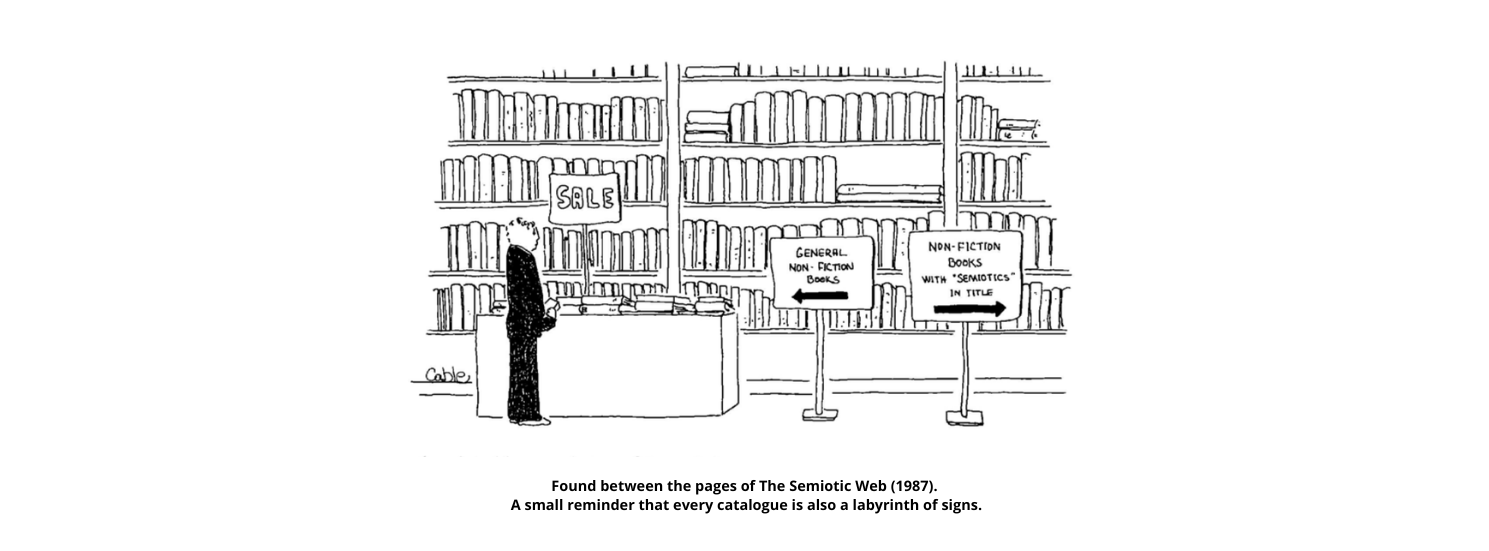
A unified academic catalogue for books, journal articles, book chapters, proceedings papers, conference abstracts and semiotic research materials.
A unified academic catalogue for books, journal articles, proceedings papers, collection articles and semiotic research materials. Search across the full database; results are shown with pagination.
The distribution of handshapes in the established lexicon of Israeli Sign Language (ISL)
In: Semiotica 2021, Issue 242
- Pages
- 101-122
View details
Identifier: DOI: 10.1515/sem-2019-0049
The element of surprise in Peirce’s double consciousness paradigm
In: Semiotica 2021, Issue 243
- Pages
- 11-47
View details
Identifier: DOI: 10.1515/sem-2021-0122
The manner of use, the uses and sub-uses of terms in social sciences: from the functional approach to natural language to applied semiotics and the philosophy of science
In: Semiotica 2021, Issue 240
- Pages
- 23-39
View details
Identifier: DOI: 10.1515/sem-2021-0019
The plastic of clothing and the construction of visual communication and interaction: a semiotic examination of the eighteenth-century French dress
In: Semiotica 2021, Issue 242
- Pages
- 17-37
View details
Identifier: DOI: 10.1515/sem-2020-0050
The representation of gappy sentences in four-valued semantics
In: Semiotica 2021, Issue 240
- Pages
- 145-163
View details
Identifier: DOI: 10.1515/sem-2021-0011
The role of schemas and scripts in pictorial narration
In: Semiotica 2021, Issue 241
- Pages
- 1-27
View details
Identifier: DOI: 10.1515/sem-2019-0071
Token reflexivity and logic
In: Semiotica 2021, Issue 240
- Pages
- 241-259
View details
Identifier: DOI: 10.1515/sem-2021-0009
Toward a Peircean logic of meditation
In: Semiotica 2021, Issue 243
- Pages
- 153-170
View details
Identifier: DOI: 10.1515/sem-2021-0119
Towards a stratified metafunctional model of animation
In: Semiotica 2021, Issue 239
- Pages
- 1-35
View details
Identifier: DOI: 10.1515/sem-2019-0078
Understanding and translating Confucian philosophy in the <i>Analect</i>s: a sociosemiotic perspective
In: Semiotica 2021, Issue 239
- Pages
- 287-306
View details
Identifier: DOI: 10.1515/sem-2017-0144
Vers une sémiotique sadienne
In: Semiotica 2021, Issue 241
- Pages
- 139-158
View details
Identifier: DOI: 10.1515/sem-2017-0115
Visual affect in films: a semiotic approach
In: Semiotica 2021, Issue 239
- Pages
- 99-124
View details
Identifier: DOI: 10.1515/sem-2019-0081
What do hashtags afford in digital fashion communication? An exploratory study on Gucci-related hashtags on Twitter and Instagram
In: Semiotica 2021, Issue 243
- Pages
- 325-351
View details
Identifier: DOI: 10.1515/sem-2019-0114
“In my head, I have a cleaning lady:” Symbol form and symbolic intention in the everyday use of money
In: Semiotica 2020, Issue 235
- Pages
- 119-151
View details
Identifier: DOI: 10.1515/sem-2018-0100
Charles Peirce and firstness: The category of origins
In: Semiotica 2020, Issue 235
- Pages
- 63-73
View details
Identifier: DOI: 10.1515/sem-2018-0038
Collocational semiosis in the academic discourse of the Corpus of Contemporary American English (COCA): The case of AFRICA
In: Semiotica 2020, Issue 235
- Pages
- 185-227
View details
Identifier: DOI: 10.1515/sem-2017-0103
Culture and Communication
- Dependent title
- An Anthology of Major and Lesser-Known Works by Yuri Lotman
- Edition
- 1 edition
View details
Other title information: Signs in Flux
Notes: Translated from Russian by Benjamin Paloff
Annotation: This collection provides a stand-alone primer to his intellectual legacy in both semiotics and cultural history. It includes new translations of some of his major pieces as well as works that have never been published in English. The collection brings Lotman into the orbit of contemporary concerns such as gender, memory, performance, world literature, and urban life. It is aimed at students from various disciplines and is augmented by an introduction and notes that elucidate the relevant contexts.
Identifier: 9781644693872
Status: Available
Embodied ekphrasis of experience: Bodily rhetoric in mediating affect in interaction
In: Semiotica 2020, Issue 235
- Pages
- 91-111
View details
Identifier: DOI: 10.1515/sem-2017-0126
Garroni, the late Peirce, and the issue of creativity
In: Semiotica 2020, Issue 235
- Pages
- 165-184
View details
Identifier: DOI: 10.1515/sem-2018-0128
Image and word as forms of iconic depiction
In: Semiotica 2020, Issue 235
- Pages
- 75-90
View details
Identifier: DOI: 10.1515/sem-2018-0112
In the footsteps of the semiotic school of Moscow-Tartu / Tartu-Moscow: Evaluations and perspectives
In: Semiotica 2020, Issue 235
- Pages
- 229-241
View details
Identifier: DOI: 10.1515/sem-2018-0065
Mapping Musical Signification
- Edition
- 1 edition
View details
Annotation: This book is a unique attempt to systematize the latest research on all that music connotes. Musicological reflections on musically expressive content have been pursued for some decades now, in spite of the formalist prejudices that can still hindermusicians and music lovers. The author organizes this body of research so that both professionals and everyday listeners can benefit from it – in plain English, but without giving up the level of depth required by the subject matter. Two criteria have guided his choice among the many ways to speak about musical meaning: its relevance to performance, and its suitability to the teaching context. The legacy of the so-called art music, without an interpretive approach that links ancient traditions to our present, runs the risk of missing the link to the new generations of musicians and listeners. Complementing the theoretical, systematic content, each chapter includes a wealth of examples, including the so-called popular music.
Identifier: 9783030524951
Status: Available
Peirce, Aristotle, metaphor – and comments to Factor
In: Semiotica 2020, Issue 235
- Pages
- 51-61
View details
Identifier: DOI: 10.1515/sem-2018-0037
Re charged emblems: Hawthorne and semiotic metamorphics
In: Semiotica 2020, Issue 235
- Pages
- 1-26
View details
Identifier: DOI: 10.1515/sem-2017-0119
Semeiotic time
In: Semiotica 2020, Issue 235
- Pages
- 113-117
View details
Identifier: DOI: 10.1515/sem-2018-0108
The spectrum of subjectal forms: Towards an Integral Semiotics
In: Semiotica 2020, Issue 235
- Pages
- 27-49
View details
Identifier: DOI: 10.1515/sem-2018-0022
Multiculturalism as Multimodal Communication
- Edition
- 1 edition
View details
Other title information: A Semiotic Perspective
Annotation: This highly readable book develops a numanistic, and specifically semiotic approach to multiculturalism. It reveals how semiotics provides fresh and valuable insights into multiculturalism: in contrast to the binary logic of dualistic philosophy, semiotic logic does not understand the value of truth in rigid terms of ‘true’ or ‘false’, ‘right’ or ‘wrong’ only. The value of truth resides in meaning, which is a dynamic, evolutionary phenomenon, rooted, nevertheless, in factuality. Drawing on recent developments in biosemiotics, the book presents a theoretical approach to multiculturalism, regarding the lives of people living in multicultural environments. Rather than analyzing political or economic phenomena, it offers a semiotic analysis of multiculturalism and discusses its educational implications. It also invites readers to regard learning as a phenomenon of ecological sign growth and to understand multiculturalism along the same lines. As such, it brings together the life and social sciences and the humanities in a unified perspective, in an approach fitting postmodernism.
Identifier: 9783030178826
Status: Available
New Localism
- Edition
- 1 edition
View details
Other title information: Living in the Here and Now
Annotation: This book examines “New Localism' – exploring how communities have turned towards more local concerns: my street, my town, my state, as an expression of dissatisfaction with globalization. It details the ideas that have created a political force that academics have often misunderstood and provides a template for further investigation with a strong focus on how to harness the motivations behind such changes for the benefit of individuals, communities and the more-than-human environment.
Identifier: 9783030215781
Status: Available
Spaces and Meanings
- Edition
- 1 edition
View details
Other title information: Semantics of the Cultural Landscape
Annotation: This book examines the problem of relationships between culture and space. Highlighting the use of semiotics of culture as a basic concept of research, it describes the power of the cultural landscape in the context of culture philosophical research. Opening with a discussion of the existence of culture in space, it establishes basic concepts such as noosphere and pneumatosphere. The author acknowledges the early contributions of thinkers like Vladimir Vernadsky and Pierre Teilhard de Chardin, who first observed that human activity has become a geological force.
Identifier: 9783030151676
Status: Available
Structural Units of Mass Culture Mythology
- Edition
- 1 edition
View details
Other title information: A Cultural Semiotic Approach
Annotation: My dissertation focuses on the study of myths and their semiotic mechanisms that appear in contemporary mass culture texts. Although myths and mass culture as a whole have been widely discussed from the perspectives of various disciplines, there are no studies that deal with the systematization of mass culture mythology and the semiotic definition of mythic markers. The topic of this dissertation is interesting not only from a general theoretical, philosophical, anthropological and semiotic perspective, but also for practical reasons. I believe that I can convincingly show in my work that the study and identification of semiotic mechanisms of mass culture myths is applicable in the field of marketing semiotics and social communication. In my dissertation, I first compare mass culture mythology from a sociological, philosophical-anthropological and semiotic perspective. This allows me to combine the two main epistemological approaches to myth research and treat myth as a holistic meta-concept on the one hand, and approach myth as a cultural text on the other. Based on the framework I have created, I will analyze various texts of mass culture in my work and focus on identifying the most common and enduring structural units of mass culture mythology. How do I define a smaller unit of myth? In defining it, I will rely on two structural principles of myth: the emic unit, which I denote by the concept of mythologeme, and the hybrid unit, which I denote by the concept of mytheme. In the course of the analysis, I will highlight the following mythologemes: Fate, Journey, Universality, Catastrophe, Golden Age and Mother Nature, and the mythemes: Transformation and Return. In addition to distinguishing the aforementioned mythologemes and mythemes, I will highlight their value and function in mythological discourse. Fate and Journey help to integrate the life of the individual into the whole. The mythologeme of Mother Nature is associated with the existential need of a person to search for authenticity and identity. The mythologemes of the Universe, Catastrophe and Golden Age constitute the human time-spatial past-present-future triad. The latter are related to human questions about the origin of the world, nostalgia for the past and fears about the future. The mythologeme of Transformation points to the idea of miracle and the mythologeme of Return to the time-spatial axis of the human semiosphere, to orderliness. The last chapter of the work applies the theoretical framework developed in the dissertation to specific case studies. The first of them is dedicated to the analysis of the TV political marketing of the Ukrainian politician Darth Vader, and there I show how archetypal mythological meanings were included in the structure of the political narrative. The second case study focuses on the development of a specific brand, which I did in collaboration with the well-known Russian pop artist Manizha, and where I apply the mythologeme of Mother Nature.Further research into mythologemes and mythemes could open up new semiotic markers and thereby expand the field of application of semiotics, as well as help to better understand the mythological basis of culture. This dissertation presents a semiotic study of myth revealing in contemporary mass cultural texts and exploration of its inner semiotic machinery. Although a variety of studies have been devoted to myth, and quite a few studies have tackled mass culture issues, less attention has been given to the systematic articulation of mass cultural mythology and its markers, which reveal its inner semiotic machinery. Those issues are relevant not only from a general theoretical philosophical, anthropological, and semiotic point of view, but also have concrete applicability in marketing semiotics and social communications. Firstly, I discuss mass culture under an emancipatory umbrella approach and explore mass culture mythology from the sociological, philosophical-anthropological and semiotic perspectives. Secondly, I combine two main epistemological attitudes of myth and integrate a holistic object of research – which appears as a meta-concept – from one side, and a text of culture – mass cultural narratives around brands conveying their main values – from the other side . Thirdly, I discuss the smallest units of mass culture mythology and explore its most widespread structural units. I classify the smallest units of myth by their structural principles: the emic units (mythologemes) and the hybrid ones (mythemes). There are the mythologemes of Fate, Course, Universe, Catastrophe, Golden Age, and Mother Nature, and the mythemes of Transformation and Backtracking considered in detail. The main existential values of those smallest mythological units are discussed. The mythologemes of Fate and Course help to understand individual life as a part of an integral whole. The mythologeme of Mother Nature relates to the existential search for inner authenticity and identity. The mythologemes of Universe, Catastrophe, and Golden Age constitute an integral triadic idea about time and space (past-present-future) and reflect the human existential quest for an explanation of the world origin, nostalgia for the past and fears about the future. The mytheme of Transformation represents the idea of mythological miracle, and the mytheme of Backtracking appeals to the idea of a mastered time and space. Fourthly, I extend the process to find more minimal units of myth in cultural texts of different genres. The first case is dedicated to close analysis of the television communication of the Ukrainian politician Darth Vader. This case demonstrates the combination of archaic meanings and contemporary forms of myth within a narrative, producing new powerful connotations. The second case applies the Mother Nature mythologeme as a branding tool for building a coherent image of a musical artist. The further exploration of the mythologemes and mythemes and articulation of other semiotic markers of myth systematically enriches a profound understanding of human mind and culture.
Identifier: 9789949032150
Status: Available
A Peirce for the 21st century
In: Sign Systems Studies 2018, Volume 46, Issue 4: Learning and adaptation: Semiotic perspectives
- Pages
- 590-616
View details
Identifier: 10.12697/SSS.2018.46.4.09
A report on the conference “Ecosemiotic Paradigm for Nature and Culture”
In: Sign Systems Studies 2018, Volume 46, Issue 4: Learning and adaptation: Semiotic perspectives
- Pages
- 617-629
View details
Identifier: 10.12697/SSS.2018.46.4.10
A report on the symposium “Juri Lotman and sociosemiotics” (Elva, Estonia, 19–20 May 2017)
In: Sign Systems Studies 2018, Volume 46, Issue 1
- Pages
- 178-180
View details
Identifier: 10.12697/SSS.2018.46.1.09
A study by Umberto Eco and his colleagues on the history of early zoosemiotics: Commentary and bibliography
In: Sign Systems Studies 2018, Volume 46, Issue 2/3
- Pages
- 383-391
View details
Identifier: 10.12697/SSS.2018.46.2-3.11
About the (semiotic) limits of the human language: Discussing the case of Pirahã
In: Sign Systems Studies 2018, Volume 46, Issue 2/3
- Pages
- 392-397
View details
Identifier: 10.12697/SSS.2018.46.2-3.12
Adaptation, learning, Bildung: Discussion with edu- and biosemiotics
In: Sign Systems Studies 2018, Volume 46, Issue 4: Learning and adaptation: Semiotic perspectives
- Pages
- 435-451
View details
Identifier: 10.12697/SSS.2018.46.4.02
Can semiotics be used to drive paradigm changes in medical education?
In: Sign Systems Studies 2018, Volume 46, Issue 4: Learning and adaptation: Semiotic perspectives
- Pages
- 491-516
View details
Identifier: 10.12697/SSS.2018.46.4.05
Choosing and learning: Semiosis means choice
In: Sign Systems Studies 2018, Volume 46, Issue 4: Learning and adaptation: Semiotic perspectives
- Pages
- 452-466
View details
Identifier: 10.12697/SSS.2018.46.4.03
Differentiation of language functions during language acquisition based on Roman Jakobson’s communication model
In: Sign Systems Studies 2018, Volume 46, Issue 4: Learning and adaptation: Semiotic perspectives
- Pages
- 517-537
View details
Identifier: 10.12697/SSS.2018.46.4.06
Emptiness and desire in the first rule of logic
In: Sign Systems Studies 2018, Volume 46, Issue 4: Learning and adaptation: Semiotic perspectives
- Pages
- 467-490
View details
Identifier: 10.12697/SSS.2018.46.4.04
Founding of the French Zoosemiotics Society
In: Sign Systems Studies 2018, Volume 46, Issue 2/3
- Pages
- 401-402
View details
Identifier: 10.12697/SSS.2018.46.2-3.14
Giorgio Prodi and the lower threshold of semiotics
In: Sign Systems Studies 2018, Volume 46, Issue 2/3
- Pages
- 343-351
View details
Identifier: 10.12697/SSS.2018.46.2-3.07
Learning and adaptation from a semiotic perspective
In: Sign Systems Studies 2018, Volume 46, Issue 4: Learning and adaptation: Semiotic perspectives
- Pages
- 409-434
View details
Identifier: 10.12697/SSS.2018.46.4.01
On the analysis of power and politics from the perspective of Juri Lotman’s semiotics of culture
In: Sign Systems Studies 2018, Volume 46, Issue 1
- Pages
- 168-177
View details
Identifier: 10.12697/SSS.2018.46.1.08
Rethinking literary education in the digital age
In: Sign Systems Studies 2018, Volume 46, Issue 4: Learning and adaptation: Semiotic perspectives
- Pages
- 569-589
View details
Identifier: 10.12697/SSS.2018.46.4.08
Returning ‘learning’ to education: Toward an ecological conception of learning and teaching
In: Sign Systems Studies 2018, Volume 46, Issue 4: Learning and adaptation: Semiotic perspectives
- Pages
- 538-568
View details
Identifier: 10.12697/SSS.2018.46.4.07
Text dynamics: Renewing challenges for semiotics of literature
In: Sign Systems Studies 2018, Volume 46, Issue 1
- Pages
- 143-167
View details
Identifier: 10.12697/SSS.2018.46.1.07
The 38th Albi–Moissac Colloquium of French semioticians: Living beings and their environment
In: Sign Systems Studies 2018, Volume 46, Issue 2/3
- Pages
- 398-400
View details
Identifier: 10.12697/SSS.2018.46.2-3.13
The semiotics of models
In: Sign Systems Studies 2018, Volume 46, Issue 1
- Pages
- 7-43
View details
Identifier: 10.12697/SSS.2018.46.1.01
Two decades of ecosemiotics in Tartu
In: Sign Systems Studies 2018, Volume 46, Issue 4: Learning and adaptation: Semiotic perspectives
- Pages
- 630-639
View details
Identifier: 10.12697/SSS.2018.46.4.11