
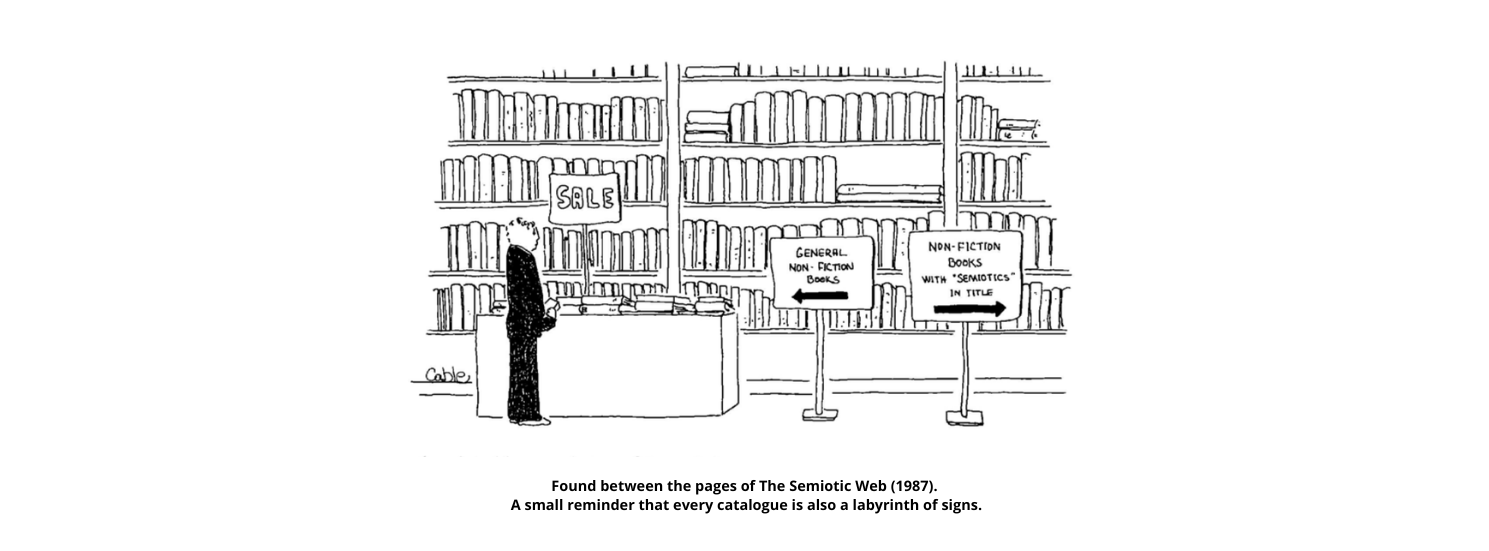
A unified academic catalogue for books, journal articles, book chapters, proceedings papers, conference abstracts and semiotic research materials.
A unified academic catalogue for books, journal articles, proceedings papers, collection articles and semiotic research materials. Search across the full database; results are shown with pagination.
Molecules at High Z
In: Semiotica 1997, Issue 2024-02-04 00:00:00
- Pages
- 317
View details
Multicultural marketing of risk—The meaning of communication policy for insurance companies
In: Synthesis in Diversity, Volume 2
- Pages
- 1259-1262
View details
Murasaki Shikibu vs. Sei Shonagon: A classical case of envy in medi-<i>evil </i>Japan
In: Semiotica 1997, Issue 2024-02-04 00:00:00
- Pages
- 201-226
View details
Identifier: DOI: 10.1515/semi.1997.117.2-4.201
Nothing in the world is single: Metaphorical network in Shelley’s “Love’s Philosophy”
In: Synthesis in Diversity, Volume 1
- Pages
- 425-428
View details
Observing the structures of symbols from Chinese Yijing
In: Synthesis in Diversity, Volume 2
- Pages
- 1247-1250
View details
Pour une sémiotique de l’orgueil
In: Semiotica 1997, Issue 2024-02-04 00:00:00
- Pages
- 345-356
View details
Identifier: DOI: 10.1515/semi.1997.117.2-4.345
Probing the Cosmic "Dark Age"
In: Semiotica 1997, Issue 2024-02-04 00:00:00
- Pages
- 19
View details
Pursomania: The sin-sign of avarice
In: Semiotica 1997, Issue 2024-02-04 00:00:00
- Pages
- 177-200
View details
Identifier: DOI: 10.1515/semi.1997.117.2-4.177
QSO Damped LYα Absorption Systems at Low Redshift and the Giant Hydrogen Cloud Model for Damped LY&alpha
In: Semiotica 1997, Issue 2024-02-04 00:00:00
- Pages
- 263
View details
Seeing Double: Probing the Universe with Quasars Pairs
In: Semiotica 1997, Issue 2024-02-04 00:00:00
- Pages
- 173
View details
Semiotics and temporality facing the art works of El Lissitsky and Helio Oiticica
In: Synthesis in Diversity, Volume 2
- Pages
- 1191-1194
View details
Singularité esthétique et rupture sémiotique
In: Semiotica 1997, Issue 2024-02-04 00:00:00
- Pages
- 275-298
View details
Identifier: DOI: 10.1515/semi.1997.116.2-4.275
Sins and signs: Modern disguises of gluttony
In: Semiotica 1997, Issue 2024-02-04 00:00:00
- Pages
- 231-238
View details
Identifier: DOI: 10.1515/semi.1997.117.2-4.231
Sloth: A paradoxical, intricate sin
In: Semiotica 1997, Issue 2024-02-04 00:00:00
- Pages
- 381-394
View details
Identifier: DOI: 10.1515/semi.1997.117.2-4.381
Sonstiges
In: Semiotica 1997, Issue 2024-02-04 00:00:00
View details
Identifier: DOI: 10.1515/semi.1997.117.2-4.u
Spectroscopy of Damped LYα Systems at Low Redshift
In: Semiotica 1997, Issue 2024-02-04 00:00:00
- Pages
- 257
View details
The charm and seduction of brand names
In: Synthesis in Diversity, Volume 2
- Pages
- 1263-1268
View details
The concept of sin in antiquity, particularly in Homer
In: Semiotica 1997, Issue 2024-02-04 00:00:00
- Pages
- 47-66
View details
Identifier: DOI: 10.1515/semi.1997.117.2-4.47
The concept of sin in modern ethics
In: Semiotica 1997, Issue 2024-02-04 00:00:00
- Pages
- 113-126
View details
Identifier: DOI: 10.1515/semi.1997.117.2-4.113
The Constitution of Han-Academic Ideology
- Edition
- 1 edition
View details
Parallel title: Parallel title: An Archetype of Chinese Ethics and Academic Ideology
Other title information: A Hermeneutico-Semiotic Study
Annotation: Intercultural philosophy does not take its starting point from the comparison of different cultures from a neutral point of view, it instead arises through the confrontation with certain features of another culture which distance the philosopher from his or her own tradition, compelling it to be regarded in a new way. In dealing with the origins of Confucian ethics, You-Zheng Li does exactly this. His extensive training in Western Hermeneutics and semiotics enables him to reformulate the set of ethical customs, rituals, rules and strategies formulated 2500 years ago in ancient China. In contrast to Western ethics, which are thoroughly penetrated by the divine commands of the Judeo-Christian tradition and mainly characterized by the search for the practical good and one's own happiness begun in Greek and Roman philosophy, Chinese ethics originated and developed largely outside the domains of religion and philosophy. In attempting to elaborate on the specific nature of these ethics, the author navigates between Scylla and Charybdis. He seeks to avoid the one extreme of merely repeating from the inside what has already been said, with its effective reduction of ethical theory to certain reflexes of practical life. Just as well, however, he tries to avoid the other extreme of measuring ancient traditions by external standards and therewith exchanging old prejudices for new ones. He much rather tries to elucidate the foundation of Chinese ethics by using a certain language and a certain method which, as only one language and one method among others, does not aver to exhaust the inherent sense and the efficacious demand of what has been or is still being lived out and practised.
Identifier: 3631313853
Status: Available
The Most Metal-Poor Stars
In: Semiotica 1997, Issue 2024-02-04 00:00:00
- Pages
- 197
View details
The mythical time in Scriabin
In: Synthesis in Diversity, Volume 2
- Pages
- 1243-1246
View details
The relationship between texts and their location
In: Synthesis in Diversity, Volume 1
- Pages
- 195-198
View details
The semiotic swarm of cyberspace: Cybergluttony and Internet Addiction in the global village
In: Semiotica 1997, Issue 2024-02-04 00:00:00
- Pages
- 239-298
View details
Identifier: DOI: 10.1515/semi.1997.117.2-4.239
The semiotics of “document” and the antelope of Suzanne Briet
In: Synthesis in Diversity, Volume 2
- Pages
- 1203-1206
View details
The semiotics of the writing systems of Tolkien’s Middle earth
In: Synthesis in Diversity, Volume 2
- Pages
- 1239-1242
View details
The seven deadly sins and the Catholic Church
In: Semiotica 1997, Issue 2024-02-04 00:00:00
- Pages
- 67-102
View details
Identifier: DOI: 10.1515/semi.1997.117.2-4.67
The sign nature of goods and commodities
In: Synthesis in Diversity, Volume 2
- Pages
- 1231-1234
View details
The Structure of the Chinese Ethical Archetype
- Edition
- 1 edition
View details
Parallel title: Parallel title: An Archetype of Chinese Ethics and Academic Ideology
Other title information: A Hermeneutico-Semiotic Study
Annotation: Intercultural philosophy does not take its starting point from the comparison of different cultures from a neutral point of view, it instead arises through the confrontation with certain features of another culture which distance the philosopher from his or her own tradition, compelling it to be regarded in a new way. In dealing with the origins of Confucian ethics, You-Zheng Li does exactly this. His extensive training in Western Hermeneutics and semiotics enables him to reformulate the set of ethical customs, rituals, rules and strategies formulated 2500 years ago in ancient China. In contrast to Western ethics, which are thoroughly penetrated by the divine commands of the Judeo-Christian tradition and mainly characterized by the search for the practical good and one's own happiness begun in Greek and Roman philosophy, Chinese ethics originated and developed largely outside the domains of religion and philosophy. In attempting to elaborate on the specific nature of these ethics, the author navigates between Scylla and Charybdis. He seeks to avoid the one extreme of merely repeating from the inside what has already been said, with its effective reduction of ethical theory to certain reflexes of practical life. Just as well, however, he tries to avoid the other extreme of measuring ancient traditions by external standards and therewith exchanging old prejudices for new ones. He much rather tries to elucidate the foundation of Chinese ethics by using a certain language and a certain method which, as only one language and one method among others, does not aver to exhaust the inherent sense and the efficacious demand of what has been or is still being lived out and practised.
Identifier: 3631313861
Status: Available
The visual representation of the seven deadly sins in a tondo of Hieronymus Bosch
In: Semiotica 1997, Issue 2024-02-04 00:00:00
- Pages
- 103-112
View details
Identifier: DOI: 10.1515/semi.1997.117.2-4.103
Toward a semiotic reading of modern calligraphy
In: Synthesis in Diversity, Volume 2
- Pages
- 1235-1238
View details
Unruly genitals: Psychoanalysis: The disappearance of sin?
In: Semiotica 1997, Issue 2024-02-04 00:00:00
- Pages
- 299-314
View details
Identifier: DOI: 10.1515/semi.1997.117.2-4.299
Writing as a sense of sound
In: Synthesis in Diversity, Volume 2
- Pages
- 1255-1258
View details
Analysing performance
View details
Other title information: a critical reader
Annotation: Each chapter tackles the theory and practice of contemporary performance work, and enables students and teachers to see what is at stake in analysing dance, drama, music and videos
Identifier: 071904250X
Status: Available
Appropriating images
View details
Other title information: The semiotics of visual representation
Annotation: Dr. Tomaselli forcefully underlines the relevance of a semiotic approach to visual representations. Using a large number of film examples the book covers the terrain of semiotic theory, the history of ethnographic film-making and theories of visual anthropology, visual sociology, and documentary film.
Identifier: 8789825055
Status: Available
Semiotics and the modern Quebec novel
- Dependent title
- a Greimassian analysis of Thériault's Agaguk
View details
Annotation: The most popular novel in Quebec since the Second World War, Yves Theriault's Agaguk was published just before the Quiet Revolution, a period of major political and cultural transformation that radically altered Quebec society at the beginning of the 1960s. In this original socio-semiotic reading of the novel in translation, inspired by A.J. Greimas and the Paris School of Semiotics, Paul Perron examines the Inuit setting and characters of Agaguk as metaphors for Quebec society. Semiotics and the Modern Quebec Novel is one of the few semiotic analyses to deal with an entire novel, and illustrates the heuristic value of this complex methodology with respect to long prose texts in English.
Identifier: 0802009263
Status: Available
Estudios para una semiótica del espectáculo
View details
Annotation: Short studies focusing on the semiotics of theatre
Identifier: 9683644139
Status: Available
Faces in the clouds
View details
Other title information: a new theory of religion
Annotation: In this book anthorpologist Steward githrie argues persuasively that religion is anthropomorphism - the attribution of human characteristics to non-human things and events. Guthrie's explanation is radical. Anthropomorphism and hence religion, he says, strem form a stratefy of perception. Mrdhalling a wealth of evidence from etnography, cognitive science, philosophy, theology, advertising, literature, art and animal behavior. Faces in the clouds shows how this perceptual strategy pervades human life and how it underlines religious experience
Identifier: 0195069013
Status: Available
The generation of meanings in liturgical songs
View details
Notes: 1
Annotation: This book is about the meaning of liturgical songs. Everybody who sings liturgical songs knows what liturgical songs is and also what it means. But when we start to talk about them, things become confused. We know too much and there are too many languages in which we can express what we think their meaning is. And what is worse, other people seem no to understand what we say and immediately reply that we may know a lot but not what they know. Then the discussion turns into a quarrel amongst people who know too much and cannot communicate what they know. A wise person may enter into the quarrel and say that communication about liturgical songs can only succeed when we sing together. Then we will sing together, confused and angry, because we now also know that the other people may sings very well, but do not understand what they are doing. This is what has been happening for decades in the Dutch churches. Perhaps we should be silent and start to look and listen very carefully to liturgical songs, while developing a language in which the songs themselves can speak, communicating what they have to say. The looking and listening will take much time and energy: there are no more easy answers. And the language will be so difficult that we are forced to be silent, waiting and hoping for a word to come. -back cover
Identifier: 9039005117
Status: Available
Cultural Artifacts and the production of meaning
- Dependent title
- The Page, the Image, and the Body
View details
Annotation: Diverse essays addressing a variety of subjects, from Renaissance cartography to performance art to rap music, united in their common exploration of material criticism. This recognizes that materialist criticism may embrace techniques borrowed from psychoanalytic, feminist, Marxian, and historicist criticisms. It employs materialist criticism to broaden and strengthen our understanding of what constitutes a 'cultural artifact' and how such artifacts function.
Identifier: 0472082574
Status: Available
Signs of Life in the USA
- Dependent title
- Readings On Popular Culture For Writers
View details
Annotation: The transformation from a text-centred to an image-centred culture presents a certain challenge to writing teachers. How can such a textually based enterprise as writing instruction respond to a video-driven world? How are reading and writing related to seeing and hearing? Can the habits of critical thinking that are so central to the analytical tasks of academic writing be adapted to McLuhan's Brave New World? We have written Signs of Life in the U.S.A. because we believe not only that such bridges can be built but that building them represents our best hope for training a new generation of students in critical thinking and writing. Thus, while the goal of our text remains the traditional one of helping students become strong writers of argument and analysis, our method departs from convention by using printed texts to guide students in the analysis and interpretation of an unwritten world: The world of American popular culture, wherein images, often electronically conveyed, can be more important than words.
Identifier: 031209020X
Status: Available
The semiotics of ethnicity: Using consumption imagery to decode Spike Lee's Do the Right Thing
In: Semiotica 1994, Issue 2024-01-02 00:00:00
- Pages
- 109-138
View details
Identifier: DOI: 10.1515/semi-1994-981-206
The semiotics of ethnicity: Using consumption imagery to decode Spike Lee’s Do the Right Thing
In: Semiotica 1994, Issue 2024-01-02 00:00:00
View details
Identifier: DOI: 10.1515/semi.1994.98.1-2.109
The Socialness of Things
View details
Other title information: Essays on the Socio-Semiotics of Objects
Notes: This book is based on the proceedings of an international conference which took place at the University of Toronto in 1990.
Annotation: The term "socialness" is a neologism that is used in this volume to call attention to the integration of objects in the social fabric of everyday life. Specialists in material culture studies have understood for some time, that societies consist of both people and artifacts. It is not only with people and animals that we interact but also with objects. The chapters in the first part of the volume deal with artefacts such as furniture, mementoes, and knickknacks, which can be manipulated as social "others" – entities with which one can socialize or make a part in socialisation processes such as establishing a bond, conveying a message, etc. The second section of articles concerns artefacts whose dimensions take such proportions that humans become dwarfed with respect to them, such as tourists travelling to visit them or shoppers being herded through their artificial geography as if flowing within an oversized organism. In the concluding section, the artefacts examined are by contrast so adjusted to the proportion of the human body, so close to it that they become an indissociable part of the social persona sticking to the skin, expressing better than any other means of the socialness - fashion.
Identifier: 3110141337
Status: Available
Tracing the Semiotic Boundaries of Politics
View details
Annotation: The first versions of some of the articles in this book were originally presented at the Workshop of Semiotics of the Colloquium on Language and Politics, University of Helsinki, December 12-15, 1988, but most of the articles were begun only after the workshop. The articles are intended to be representative of the current multiplicity of perspectives in the field of language and politics in general and of the boundaries of semiotic studies on language and politics in particular. Here, both "semiotics" and "politics" are used in their broadest sense.
Identifier: 3110135337
Status: Available
Intermittences du sens
- Dependent title
- études sémiotiques
View details
Annotation: Les intermittences du sens, c'est ici, tout d'abord, une pluralité d'pbjects en tous genres (romans, nouvelles ou poèmes, en françauis ou en anglais; discours littéraires, échanges de lettres, bribes de conversation courante; pratiques quotidienne ou objets esthétiques) que traverse et que scande le retour d'une même question: celle de la signification de son surgissement, de ses modes de manifestation et même, peut-on dire, de ses agissements. C'est aussi de point en point et de part en part, le jeu réglé des singularités et des récurrences, l'alternance des espèces constituées et des morphologies en devenir, l'entrejeu des discontinuités et des enchaînements, sur le support, el la dynamique des places et des forces. C'est, dans l'épaisseur des textes, l'échange réversible entre l'espace vectorisé oû les figures se déploient et le substrat figural que y imprime sa prosodie et ses contours. C'est enfin et surtout à la caçon de l'accompagnement qui lie la partition, l'interrogation sur le ses du sens: non pas tant sa saisie que sa poursuite et plutôt que sa fuite, sa fugue. The intermittences of meaning are here, first of all, a plurality of objects of all kinds (novels, short stories or poems, in French or in English; literary discourses, exchanges of letters, snippets of everyday conversation; daily practices or aesthetic objects) that cross and that are punctuated by the return of the same question: that of the meaning of its emergence, of its modes of manifestation and even, one might say, of its actions. It is also from point to point and from one end to the other, the regulated play of singularities and recurrences, the alternation of constituted species and morphologies in the making, the interplay of discontinuities and sequences, on the support, and the dynamics of places and forces. It is, in the thickness of the texts, the reversible exchange between the vectorized space where the figures are deployed and the figural substrate that its prosody and its contours imprint there. It is finally and above all the way of accompaniment which links the score, the questioning of the meaning: not so much its grasp as its pursuit and rather than its escape, its fugue. (Translated with Google Translate)
Identifier: 2130445225
Status: Available
Name, Hero, Icon
View details
Other title information: Semiotics of Nationalism through Heroic Biography
Annotation: The main focus of this project, when it was undertaken in 1987, was on name as sign and hero as icon. Since the completion of the work in 1988, dramatic changes have occurred in the world, particularly in Eastern Europe. Through them, one may observe the unpredictable power of signs and symbols and their profound impact on the collective psyche. Masses of people are involved in the destruction of the old icons and the formation of new ones. Here our semiotic lenses are focused on the role of symbolic, on the power of the name-sign, and on the display of its semiotic constant.
Identifier: 3110130122
Status: Available
Reader Response to Literature
View details
Other title information: To Empirical Dimension
Annotation: The research reported here lays the groundwork for further empirical investigations of reader response. It also provides new insights into how worlds and structures relate to and reproduce our inner and outer space, how the choice of text and critical approach can predetermine responses, and how interpretation depends in part on the cultural forces we reflect and reproduce. This volume does not present a more or less random sample of texts and studies dealing with reader response. Rather, the writers were selected because of their empirical expertise, and because they approached the study of reader response from a perspective which would provide possible answers as to the nature and pattern of reader response to literature.
Identifier: 3110127644
Status: Available
The semiotics of theater
View details
Notes: Originally published in three volumes as Semiotik des Theaters (1983)
Annotation: The theater is a particularly privileged semiotic object. Unlike literature or painting which operate within a single sign-system, theater combines a variety of sign-systems - language and gesture, costume and decoration, music and lighting - each of which generates meaning according to different principles. This complexity creates special challenges for understanding theater as a meaning-generating system. Erika Fischer-Lichte's book examines each of the sign-systems of the theater and investigates the ways they relate to one another. The result is a brilliant articulation of a semiotics of theater
Identifier: 0253322375
Status: Available
Approaching Theatre
View details
Notes: Originally published as Théâtre, modes d'approche (1987)
Annotation: This book is concerned with the analysis of the theatrical event and of all the elements that make up a perdormance – the text, the actor, the space, the spectator, the social circumstances. Here, an international group of scholars approaches theatre – viewed in its traditional guise as a physical entertainment of a text before spectators – from a variety of directions and using different methodologies. While there is a general orientation toward semiotic analysis, historical, sociological, and anthropological approaches are represented as well.
Identifier: 0253327237
Status: Available