
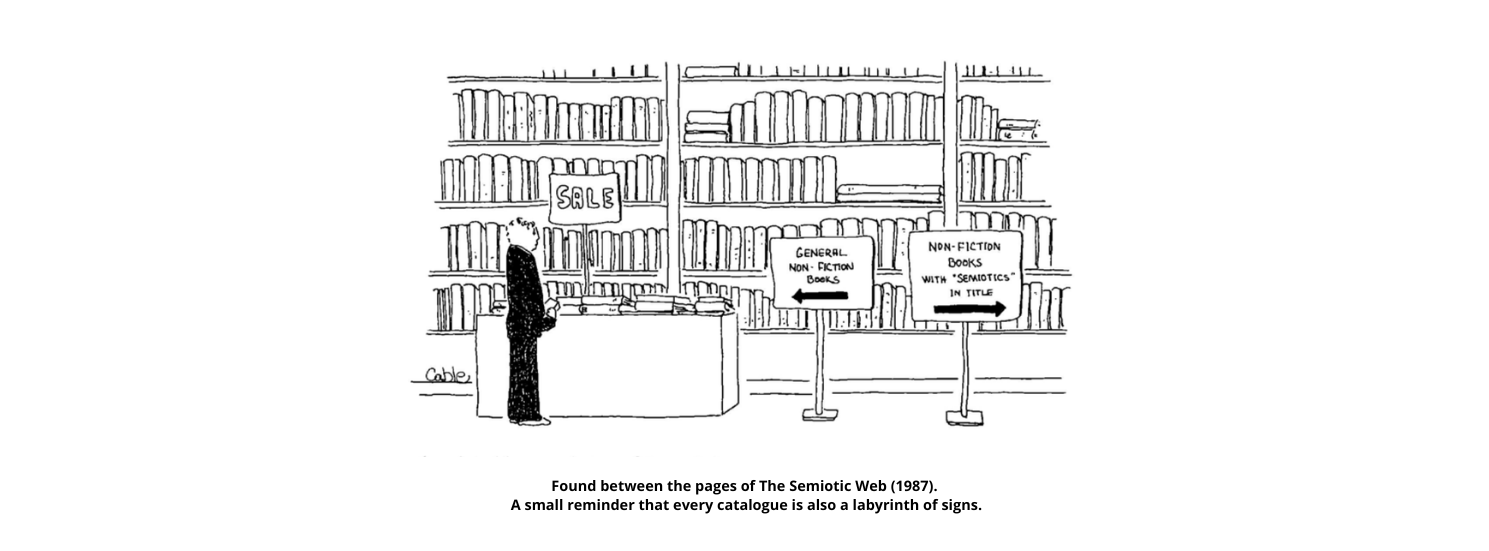
A unified academic catalogue for books, journal articles, book chapters, proceedings papers, conference abstracts and semiotic research materials.
A unified academic catalogue for books, journal articles, proceedings papers, collection articles and semiotic research materials. Search across the full database; results are shown with pagination.
La început a fost semnul
View details
Other title information: o altă introducere în semiotică
Annotation: This book is an alternative approach to the introduction of the meaning of signs and the process of signification. What if first there was a sign?
Identifier: 973799468X
Status: Available
On translating signs
View details
Other title information: exploring text and semio-translation
Annotation: The book sets to answer questions regarding the definitions of text, translation and meaning, presenting a semiotic approach to the matter
Identifier: 9042016426
Status: Available
Symbol formation
In: Sign System Studies 2004, Volume 32, Issue 1/2
- Pages
- 209-227
View details
Identifier: 10.12697/SSS.2004.32.1-2.09
Systems of musical sense
- Dependent title
- essays on the analysis, semiotics, and hermeneutics of music
View details
Annotation: Systems of Musical Sense breathes new life into the field of music semiotics in its intuitive mix of logical rigor and hermeneutical interpretation and unique approach to paradigmatic analysis (Ruwet, Nattiez) and established theories of tinal music (Schoenberg). More significantly, te authors lay out an entirely new and innovative theory in their concept of musical homestasis, a phenomenon closely related to the fundamental law of physics which states that all things set in motion, organic and inorganic, tend to return to their initial point of rest. In tonal music, which also incorporates teology, this can take place at different levels, embodied by various parameters. The sensitive analyses here demonstrate ramifications of this axiom and cast new light on the structuring and effects de sens of tinal genres ranging in diversity from Bach chorales to Wagnerian opera. The culmination of mera tha a decade of research by this tea of widely published music scholars, the book is also a starting point: cognitivists, theorists, musicologists, and others can use the analytic methos "as is", develop it further, or transform it.The systems unvailed here need not be confined to tonal, "common-practice" art music. As universal axiom at least as dependable as the gestaltists "law of good continuation", the theory of homeostasis reveals new dimensions in earlier musical style and thos of more contemporary vintage.
Identifier: 9525431061
Status: Available
The Eternal Question: Biological variations on a Platonic dialogue
In: Sign System Studies 2004, Volume 32, Issue 1/2
- Pages
- 329-362
View details
Identifier: 10.12697/SSS.2004.32.1-2.15
Uexküll and contemporary biology: Some methodological reconsiderations
In: Sign System Studies 2004, Volume 32, Issue 1/2
- Pages
- 169-186
View details
Identifier: 10.12697/SSS.2004.32.1-2.07
Movement and Poetic Rhythm
- Dependent title
- Uncovering the Musical Signification of Poetic Discourse via The Temporal Dimension of the Sign
View details
Annotation: The musical sense in both poetry and music is fundamentally temporal. The question is not whether music is a language or whether language is music, but rather how the 'musicality' of language signifies. The musical sense of poetry is not only heard but it is also felt. In order to deal with these problems the author, Drina Hocevar, from Venezuela, has elaborated a highly original model. She tries to understand the temporal movement as a generative process, deeply rooted in the ontology of our being.
Identifier: 9525431063
Status: Available
Signs of Light
View details
Other title information: A biophotonic approach to human (meta)physical fundamentals
Annotation: We could say that inside the pages of this book we have "holographically" integrated the whole semiosis of the "world genesis by sign". This sign is the "creative sign" by which the light colours were spread throughout the world and the signs of the "creative face and resemblance" by which the human being was granted the gift-power to love his / her fellow beings, the cosmos and God.
Identifier: 9738518040
Status: Available
The ontology of espionage in reality and fiction: A case study on iconicity
In: Sign System Studies 2003, Volume 31, Issue 1
- Pages
- 133-162
View details
Identifier: 10.12697/SSS.2003.31.1.05
Translation translation
View details
Annotation: Translation Translation contributes to current debate on the question of translation dealt with in an interdisciplinary perspective, with implications not only of a theoretical order but also of the didactic and the practical orders. In the context of globalization the question of translation is fundamental for education and responds to new community needs with reference to Europe and more extensively to the international world.In its most obvious sense translation concerns verbal texts and their relations among different languages. However, to remain within the sphere of verbal signs, languages consist of a plurality of different languages that also relate to each other through translation processes. Moreover, translation occurs between verbal languages and nonverbal languages and among nonverbal languages without necessarily involving verbal languages. Thus far the allusion is to translation processes within the sphere of anthroposemiosis.But translation occurs among signs and the signs implicated are those of the semiosic sphere in its totality, which are not exclusively signs of the linguistic-verbal order. Beyond anthroposemiosis, translation is a fact of life and invests the entire biosphere or biosemiosphere, as clearly evidenced by research in “biosemiotics”, for where there is life there are signs, and where there are signs or semiosic processes there is translation, indeed semiosic processes are translation processes. According to this approach reflection on translation obviously cannot be restricted to the domain of linguistics but must necessarily involve semiotics, the general science or theory of signs. In this theoretical framework essays have been included not only from major translation experts, but also from researchers working in different areas, in addition to semiotics and linguistics, also philosophy, literary criticism, cultural studies, gender studies, biology, and the medical sciences. All scholars work on problems of translation in the light of their own special competencies and interests.
Identifier: 9042009470
Status: Available
Augusto Ponzio
- Dependent title
- bibliografia e letture critiche
View details
Annotation: A collection of Augusto Ponzio's bibliography and critical texts
Status: Available
Biological evolution — a semiotically constrained growth of complexity
In: Sign System Studies 2002, Volume 30, Issue 1
- Pages
- 271-282
View details
Identifier: 10.12697/SSS.2002.30.1.16
Does “quorum sensing” imply a new type of biological information?
In: Sign System Studies 2002, Volume 30, Issue 1
- Pages
- 221-243
View details
Identifier: 10.12697/SSS.2002.30.1.13
Feeling the signs: The origins of meaning in the biological philosophy of Susanne K. Langer and Hans Jonas
In: Sign System Studies 2002, Volume 30, Issue 1
- Pages
- 183-200
View details
Identifier: 10.12697/SSS.2002.30.1.10
Is cultural logic an appropriate concept? A semiotic perspective on the study of culture and logic
In: Sign System Studies 2002, Volume 30, Issue 2
- Pages
- 455-464
View details
Identifier: 10.12697/SSS.2002.30.2.06
New vocabularies in film semiotics
View details
Other title information: structuralism, post-structuralism, and beyond
Annotation: A lexicon of semiotic concepts, the book defines over 500 critical terms and describes how they have been used, building a semiotics dictionary. It explores linguistically-orientated terminology in cinema studies; the semiotics of film narrative; and the psycho-semiology of the cinema.
Identifier: 0415065941
Status: Available
On psychological aspects of translation
In: Sign System Studies 2002, Volume 30, Issue 2
- Pages
- 607-627
View details
Identifier: 10.12697/SSS.2002.30.2.15
Pragmatism and the forms of sense
View details
Other title information: language, perception, technics
Annotation: Making sense of the world around us is a process involving both semiotic and material mediation—the use of signs and sign systems (preeminently language) and various kinds of tools (technics). As we use them, we experience them subjectively as extensions of our bodily selves and objectively as instruments for accessing the world with which we interact. Emphasizing this bipolar nature of language and technics, understood as intertwined "forms of sense," Robert Innis studies the multiple ways in which they are rooted in and transform human perceptual structures in both their individual and social dimensions. The book foregrounds and is organized around the notion of "semiotic embodiment." Language and technics are viewed as "probes" upon which we rely, in which we are embodied, and that themselves embody and structure our primary modes of encountering the world. While making an important substantive contribution to present debates about the "biasing" of perception by language and technics, Innis also seeks to provide a methodological model of how complementary analytical resources from American pragmatist and various European traditions can be deployed fruitfully in the pursuit of new insights into the phenomenon of meaning-making.
Identifier: 027102223X
Status: Available
Reading Hoffmeyer, rethinking biology
View details
Annotation: This book is about biosemiotics - a paradigm for both biological and semiotic thinking - as approached through the work of one of its pioneers, Jesper Hoffmeyer.
Identifier: 9985566327
Status: Available
Semiotics
- Edition
- 1 edition
View details
Other title information: The basics
Annotation: Demystifying what is a complex, highly interdisciplinary field, key questions covered include: what are signs and codes? What can semiotics teach us about representation and reality? What tools does it offer for analysing texts and cultural practices?
Identifier: 0415265932
Status: Available
Signs in use
View details
Other title information: an introduction to semiotics
Notes: Danish edition originally published 1994 as Tegn i Brug
Annotation: This book cuts across different semiotic schools to introduce six basic concepts which present semiotics as a theory and a set of analytical tools: code, sign, discourse, action, text, and culture
Identifier: 0415262038
Status: Available
"Matter as effete mind": Peirce's synechistic ideas on the semiotic threshold
In: Sign System Studies 2001, Volume 29, Issue 1: Semiotics of nature
- Pages
- 49-62
View details
Identifier: 10.12697/SSS.2001.29.1.03
Bioinvasion, globalization, and the contingency of cultural and biological diversity: Some ecosemiotic observations
In: Sign System Studies 2001, Volume 29, Issue 1: Semiotics of nature
- Pages
- 237-262
View details
Identifier: 10.12697/SSS.2001.29.1.14
Biosemiotics and ecological monitoring
In: Sign System Studies 2001, Volume 29, Issue 1: Semiotics of nature
- Pages
- 293-312
View details
Identifier: 10.12697/SSS.2001.29.1.17
Global Semiotics
View details
Annotation: The study of semiotics underwent a gradual but radical paradigm shift during the past century, from a glottocentric (language-centered) enterprise to one that encompasses the whole terrestrial biosphere. In this collection of 17 essays, Thomas A. Sebeok, one of the seminal thinkers in the field, shows how this progression took place. His wide-ranging discussion of the evolution of the field covers many facets, including discussions of biosemiotics, semiotics as a bridge between the humanities and the natural sciences, semiosis, nonverbal communication, cat and horse behavior, the semiotic self, and women in semiotics. This thorough account will appeal to seasoned scholars and neophytes alike."
Identifier: 025333957X
Status: Available
Live Samba
- Dependent title
- Analysis and Interpretation of Brazilian Pagode
View details
Annotation: Live Samba takes as its main topic the pagode movement, which apperead in the 1980s as a re-invention of the samba tradition. Deeply grounded in the most idiosyncratic musical patterns of samba, pagode countered the hegemony of the samba-schools and their media appeal. Pagode, too, became a major commercial success. It appeared in a transitional period, at the moment the music industry was shifting its focus towards lowe classes of the population. As a result, pagode and other local-based styles led the way to a recoinfiguration of Brazilian music. The transitional nature of this moment is reflected in the ambivalent nature of tpagode meanings. Those meanings were firmly attached to the local sphere, while at the same time open to communocation with translocal levels. In Live Samba, the author analyses pagode as a practice comprising both musical traits and symbolic associations with other spheres of Brazilian culture. The book looks at pagode songs through the frames of the samba tradition, of Brazilian society, of the commodity environment, and of musical signification, and it provides an introductory survey of samba and of the Brazilian music indurstry.
Identifier: 9519865497
Status: Available
Metamorfozele lumini
- Edition
- 2 edition
View details
Other title information: biofotonica, stiinta a complexitatii
Annotation: This book is an attempt to create an interdisciplinary perspective to light as a physical and biological henomenon.
Identifier: 9739899765
Status: Available
On the biological concept of subjective significance: A link between the semiotics of nature and the semiotics of culture
In: Sign System Studies 2001, Volume 29, Issue 1: Semiotics of nature
- Pages
- 83-106
View details
Identifier: 10.12697/SSS.2001.29.1.06
Propedeutica della traduzione
View details
Other title information: Corso Introduttivo con tavole sinottiche
Annotation: Per imparare a tradurre occorre molta esperienza ma l'attivià practica va fin dall'inizio inquadrata in un contesto teorico di riferimento che fornisca alcuno principi metodologici. Questo volume rispomde a tale esigenza collocandosi al livellos preparatorio delgli studi universitari nel campo della traduzione. Learning to translate requires a lot of experience, but the practical activity must be framed from the beginning in a theoretical context of reference that provides some methodological principles. This volume responds to this need by placing itself at the preparatory level of university studies in the field of translation. (translated with google translate)
Identifier: 8820329352
Status: Available
The pursuit of signs
- Dependent title
- Semiotics, literature deconstruction
- Edition
- 2 edition
View details
Other title information: Augmented edition with a new preface
Annotation: The primary task of literary theory, Jonathan Culler asserts in the new edition of his classic in this field, is not to illuminate individual literary works but to explain the system of literary signification - the rules and conventions that determine a reader's understanding of a text and that make literary communication possible. In this wide-ranging book, he investigates the possibilities of a semiotics of literature.
Identifier: 0801487935
Status: Available
The Routledge Companion To Semiotics and Linguistics
- Edition
- 1 edition
View details
Annotation: This reference combines the complex and closely-related fields of semiotics and linguistics. The book has 10 introductory essays and over 200 A-Z entries which cover key concepts, key individuals and key theories and schools in the field.
Identifier: 0415243130
Status: Available
An Anthropology of The European Union
- Dependent title
- Building, Imagining and Experiencing the New Europe
View details
Annotation: Representing a new trend in European Anthropology, this book examines how people adjust to their different experiences of the new Europe. The role of culture, religion, and ideology, as well as insiders' social and professional practices, are all shown to shed light on the cultural logic sustaining the institutions and policies of the European Union
Identifier: 1859733247
Status: Available
Kant and the platypus
View details
Other title information: essays on language and cognition
Notes: translated by Alastair McEwen, originally published in 1997
Annotation: This volume expplores how advances in the field of cognitive science can be incorporated into the study of literary interpretation. The last two decades have seen the establishment of cognitive studies as a valuable interdisciplinary approach in the humanities and beyond, However, what it can- or could- offer to the practice of literary interpretation is not entirely clear. In this volume fourteen papers by scholars from three continents address this issue.
Identifier: 009927695X
Status: Available
La Traduzione
View details
Annotation: This issue of Athanor is a collection of contributions by specialists from different disciplinary fields - semiotics, linguistics, literary criticism, philosophy, and biology - on the problems of translation. We can distinguish them on the basis of two orientations. One consists in limiting the question of translation to the realm of verbal language or, more specifically, to the relationship between historical-natural languages, or, again, to the more restricted realm of literary and poetic translation. The other, instead, aims to broaden the field of investigation to intersemiotic translation, between different non-verbal languages and even outside of human languages, to the point of including translations of a specifically biological nature that are the object of study of biosemiotics - such as for example, the three different types of translation in the nutritional system that constitute the difference between plants, animals and mushrooms - or the cyborg translation between organic and inorganic made possible by current technological development. (Translated with Google Translate)
Identifier: 8883530349
Status: Available
Peirce’s three types of reasoning in a contemporary perspective
In: Semiotica 2000, Issue 2024-03-04 00:00:00
- Pages
- 377-386
View details
Identifier: DOI: 10.1515/semi.2000.128.3-4.377
The body in language
View details
Annotation: Language is not merely verbal. Nonverbal signs and interpretations not only contribute to language, but in fact compose the structure of language itself. Horst Ruthrof delves into the nonverbal facets of language, such as olfactory, gustatory, aural, visual and tactile readings. Proposing reclamation of the body as an integral part of language, this book argues against structural linguistics and post-Saussurean theories. To support his standpoint, Ruthrof draws on the writings of Peirce, Husserl, Heidegger, Wittgenstein, Derrida, and Helen Keller, and on recent research in cognitive science, cognitive linguistics, and cognitive rhetoric.
Identifier: 0304338052
Status: Available
The Forms of Meaning
View details
Other title information: Modeling System Theory and Semiotic Analysis
Annotation: This book presents a methodological framework, developed from the field of biosemiotics, for studying semiotic phenomena as modeling processes. It presents a descriptive system for uniting semiotics and biology so that the "modeling instinct" can be studied in terms of its manifestations in various species. The book is written in an accessible textbook style, and can thus be used as a manual by both professional semioticians and students taking courses in semiotics, biology, and the communication sciences. It is composed in such a way that a broad readership can appreciate the fascinating research going on in a relatively unknown area of interdisciplinary study.
Identifier: 3110167514
Status: Available
The Perception of the Environment
View details
Other title information: Essays in livelihood, dwelling and skill
Annotation: In this work Tim Ingold offers a persuasive new approach to understanding how human beings perceive their surroundings. He argues that what we are used to calling cultural variation consists, in the first place, of variations in skill. Neither innate nor acquired, skills are grown, incorporated into the human organism through practice and training in an environment. They are thus as much biological as cultural. To account for the generation of skills we have therefore to understand the dynamics of development. And this in turn calls for an ecological approach that situates practitioners in the context of an active engagement with the constituents of their surroundings. The twenty-three essays comprising this book focus in turn on the procurement of livelihood, on what it means to ‘dwell’, and on the nature of skill, weaving together approaches from social anthropology, ecological psychology, developmental biology and phenomenology in a way that has never been attempted before. The book is set to revolutionise the way we think about what is ‘biological’ and ‘cultural’ in humans, about evolution and history, and indeed about what it means for human beings – at once organisms and persons – to inhabit an environment. The Perception of the Environment will be essential reading not only for anthropologists but also for biologists, psychologists, archaeologists, geographers and philosophers.
Identifier: 0415228328
Status: Available
Two notorious gentlemen: Haider and Le Pen. Comparing their political discourse — A semiological viewpoint
In: Semiotica 2000, Issue 2024-03-04 00:00:00
- Pages
- 499-512
View details
Identifier: DOI: 10.1515/semi.2000.128.3-4.499
Web Design Index
View details
Accompanying materials: Includes a CD
Annotation: The Web Design Index, with a section of more than 1000 designs in various styles, is a comprehensive overview of the state of art in web design. Enclosed is a CD-ROM provide a unique source of reference and a means of communication for designers, (prospective) site owners, and anyone with an interest in web design.
Identifier: 9057680181
Status: Available
‘What shall we eat today, darling?’ Private — Public: Romantic genres in preschool arenas
In: Semiotica 1999, Issue 2024-01-02 00:00:00
- Pages
- 55-80
View details
Identifier: DOI: 10.1515/semi.1999.124.1-2.55
‛This precious stone set in the silver sea ...’: Literal and figurative references to jewelry in the plays of William Shakespeare
In: Semiotica 1999, Issue 2024-01-02 00:00:00
- Pages
- 77-96
View details
Identifier: DOI: 10.1515/semi.1999.123.1-2.77
A diagrammatic modeling of semiosis
In: Semiotica 1999, Issue 2024-01-04 00:00:00
- Pages
- 41-74
View details
Identifier: DOI: 10.1515/semi.1999.126.1-4.41
A note on the semiotics of biological mimicry
In: Sign System Studies 1999, Volume 27
- Pages
- 139-147
View details
Identifier: 10.12697/SSS.1999.27.07
A semiotic perspective on biological objects and biological functions
In: Semiotica 1999, Issue 2024-01-04 00:00:00
- Pages
- 415-432
View details
Identifier: DOI: 10.1515/semi.1999.127.1-4.415
Biosemiotics and the foundation of cybersemiotics: Reconceptualizing the insights of ethology, second-order cybernetics, and Peirce’s semiotics in biosemiotics to create a non-Cartesian information science
In: Semiotica 1999, Issue 2024-01-04 00:00:00
- Pages
- 169-198
View details
Identifier: DOI: 10.1515/semi.1999.127.1-4.169
Contents/Sommaire Volume 124 (1999)
In: Semiotica 1999, Issue 2024-03-04 00:00:00
- Pages
- 397-397
View details
Identifier: DOI: 10.1515/semi.1999.124.3-4.397
Contents/Sommaire Volume 126 (1999)
In: Semiotica 1999, Issue 2024-01-04 00:00:00
- Pages
- 235-235
View details
Identifier: DOI: 10.1515/semi.1999.126.1-4.235
Do iconic hand gestures really contribute anything to the semantic information conveyed by speech? An experimental investigation
In: Semiotica 1999, Issue 2024-01-02 00:00:00
- Pages
- 1-30
View details
Identifier: DOI: 10.1515/semi.1999.123.1-2.1
Expansivité gestuelle et graphique: Problèmes et perspectives de la segmentation du mouvement expressif
In: Semiotica 1999, Issue 2024-01-02 00:00:00
- Pages
- 31-42
View details
Identifier: DOI: 10.1515/semi.1999.123.1-2.31