
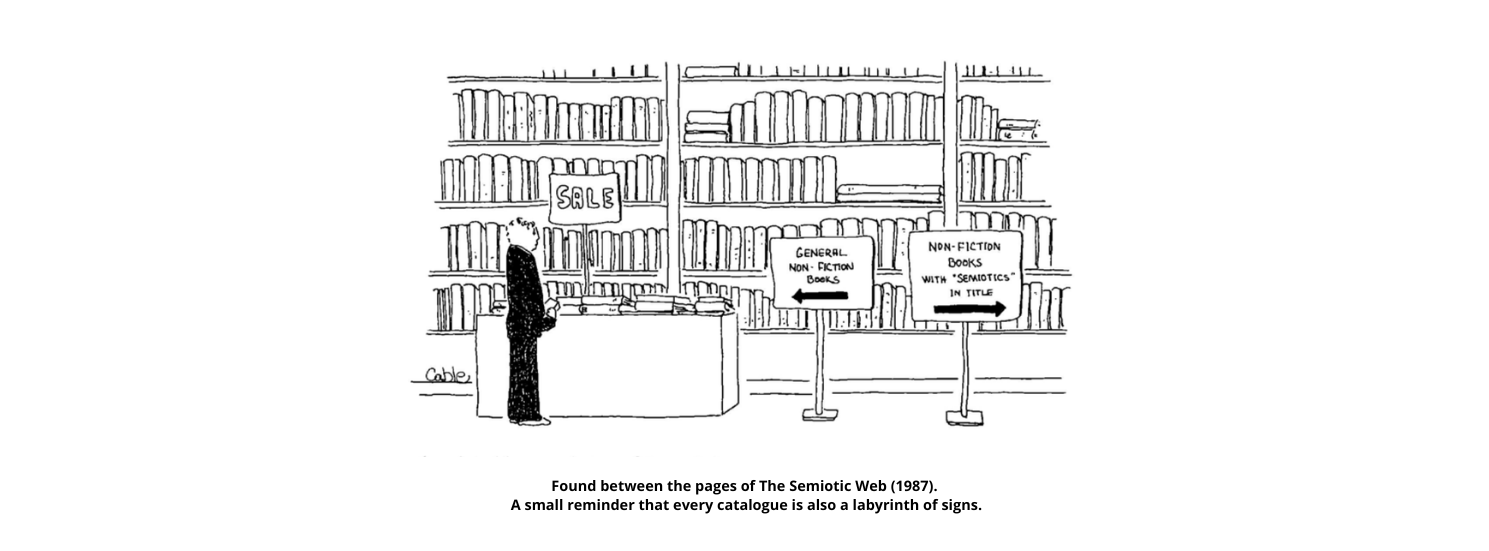
A unified academic catalogue for books, journal articles, book chapters, proceedings papers, conference abstracts and semiotic research materials.
A unified academic catalogue for books, journal articles, proceedings papers, collection articles and semiotic research materials. Search across the full database; results are shown with pagination.
Signs and the design of life – Uexküll’s significance today: A symposium, its significant history and future
In: Sign System Studies 2004, Volume 32, Issue 1/2
- Pages
- 379-383
View details
Identifier: 10.12697/SSS.2004.32.1-2.19
Symbol formation
In: Sign System Studies 2004, Volume 32, Issue 1/2
- Pages
- 209-227
View details
Identifier: 10.12697/SSS.2004.32.1-2.09
Systems of musical sense
- Dependent title
- essays on the analysis, semiotics, and hermeneutics of music
View details
Annotation: Systems of Musical Sense breathes new life into the field of music semiotics in its intuitive mix of logical rigor and hermeneutical interpretation and unique approach to paradigmatic analysis (Ruwet, Nattiez) and established theories of tinal music (Schoenberg). More significantly, te authors lay out an entirely new and innovative theory in their concept of musical homestasis, a phenomenon closely related to the fundamental law of physics which states that all things set in motion, organic and inorganic, tend to return to their initial point of rest. In tonal music, which also incorporates teology, this can take place at different levels, embodied by various parameters. The sensitive analyses here demonstrate ramifications of this axiom and cast new light on the structuring and effects de sens of tinal genres ranging in diversity from Bach chorales to Wagnerian opera. The culmination of mera tha a decade of research by this tea of widely published music scholars, the book is also a starting point: cognitivists, theorists, musicologists, and others can use the analytic methos "as is", develop it further, or transform it.The systems unvailed here need not be confined to tonal, "common-practice" art music. As universal axiom at least as dependable as the gestaltists "law of good continuation", the theory of homeostasis reveals new dimensions in earlier musical style and thos of more contemporary vintage.
Identifier: 9525431061
Status: Available
The Eternal Question: Biological variations on a Platonic dialogue
In: Sign System Studies 2004, Volume 32, Issue 1/2
- Pages
- 329-362
View details
Identifier: 10.12697/SSS.2004.32.1-2.15
The musical circle: The umwelt theory, as applied to zoomusicology
In: Sign System Studies 2004, Volume 32, Issue 1/2
- Pages
- 229-252
View details
Identifier: 10.12697/SSS.2004.32.1-2.10
The savage mind
View details
Notes: Originally published in 1962
Annotation: Discusses the significance of totemism among primitive peoples and its interpretation by anthropologists and philosophies
Identifier: 0297995235
Status: Available
Uexküll and contemporary biology: Some methodological reconsiderations
In: Sign System Studies 2004, Volume 32, Issue 1/2
- Pages
- 169-186
View details
Identifier: 10.12697/SSS.2004.32.1-2.07
Uexküll and the post-modern evolutionism
In: Sign System Studies 2004, Volume 32, Issue 1/2
- Pages
- 99-114
View details
Identifier: 10.12697/SSS.2004.32.1-2.04
Uexküllian Planmässigkeit
In: Sign System Studies 2004, Volume 32, Issue 1/2
- Pages
- 73-97
View details
Identifier: 10.12697/SSS.2004.32.1-2.03
Is language a primary modeling system? On Juri Lotman’s concept of semiosphere
In: Sign System Studies 2003, Volume 31, Issue 1
- Pages
- 9-23
View details
Identifier: 10.12697/SSS.2003.31.1.01
Lotman on mimesis
In: Sign System Studies 2003, Volume 31, Issue 1
- Pages
- 217-237
View details
Identifier: 10.12697/SSS.2003.31.1.09
Mimesis as a phenomenon of semiotic communication
In: Sign System Studies 2003, Volume 31, Issue 1
- Pages
- 191-215
View details
Identifier: 10.12697/SSS.2003.31.1.08
Modeling, dialogue, and globality: Biosemiotics and semiotics of self. 1. Semiosis, modeling, and dialogism
In: Sign System Studies 2003, Volume 31, Issue 1
- Pages
- 25-63
View details
Identifier: 10.12697/SSS.2003.31.1.02
Modeling, dialogue, and globality: Biosemiotics and semiotics of self. 2. Biosemiotics, semiotics of self, and semioethics
In: Sign System Studies 2003, Volume 31, Issue 1
- Pages
- 65-107
View details
Identifier: 10.12697/SSS.2003.31.1.03
Movement and Poetic Rhythm
- Dependent title
- Uncovering the Musical Signification of Poetic Discourse via The Temporal Dimension of the Sign
View details
Annotation: The musical sense in both poetry and music is fundamentally temporal. The question is not whether music is a language or whether language is music, but rather how the 'musicality' of language signifies. The musical sense of poetry is not only heard but it is also felt. In order to deal with these problems the author, Drina Hocevar, from Venezuela, has elaborated a highly original model. She tries to understand the temporal movement as a generative process, deeply rooted in the ontology of our being.
Identifier: 9525431063
Status: Available
Pragmatic approaches to intercultural ethics: The basis for fostering communication among nationalist groups
In: Sign System Studies 2003, Volume 31, Issue 1
- Pages
- 239-260
View details
Identifier: 10.12697/SSS.2003.31.1.10
Rothschild’s ouroborus
In: Sign System Studies 2003, Volume 31, Issue 1
- Pages
- 301-314
View details
Identifier: 10.12697/SSS.2003.31.1.14
Semiotics of culture and New Polish Ethnology
In: Sign System Studies 2003, Volume 31, Issue 1
- Pages
- 271-279
View details
Identifier: 10.12697/SSS.2003.31.1.12
Semiotics of guilt in two Lithuanian literary texts
In: Sign System Studies 2003, Volume 31, Issue 1
- Pages
- 163-175
View details
Identifier: 10.12697/SSS.2003.31.1.06
Signs of Light
View details
Other title information: A biophotonic approach to human (meta)physical fundamentals
Annotation: We could say that inside the pages of this book we have "holographically" integrated the whole semiosis of the "world genesis by sign". This sign is the "creative sign" by which the light colours were spread throughout the world and the signs of the "creative face and resemblance" by which the human being was granted the gift-power to love his / her fellow beings, the cosmos and God.
Identifier: 9738518040
Status: Available
Strange, very strange, like in a dream: Borders and translations in ‘Strogij Yunosha’
In: Sign System Studies 2003, Volume 31, Issue 1
- Pages
- 177-189
View details
Identifier: 10.12697/SSS.2003.31.1.07
The myth of the nation of poets and mass poetry in Lithuania
In: Sign System Studies 2003, Volume 31, Issue 1
- Pages
- 261-269
View details
Identifier: 10.12697/SSS.2003.31.1.11
The ontology of espionage in reality and fiction: A case study on iconicity
In: Sign System Studies 2003, Volume 31, Issue 1
- Pages
- 133-162
View details
Identifier: 10.12697/SSS.2003.31.1.05
Translation translation
View details
Annotation: Translation Translation contributes to current debate on the question of translation dealt with in an interdisciplinary perspective, with implications not only of a theoretical order but also of the didactic and the practical orders. In the context of globalization the question of translation is fundamental for education and responds to new community needs with reference to Europe and more extensively to the international world.In its most obvious sense translation concerns verbal texts and their relations among different languages. However, to remain within the sphere of verbal signs, languages consist of a plurality of different languages that also relate to each other through translation processes. Moreover, translation occurs between verbal languages and nonverbal languages and among nonverbal languages without necessarily involving verbal languages. Thus far the allusion is to translation processes within the sphere of anthroposemiosis.But translation occurs among signs and the signs implicated are those of the semiosic sphere in its totality, which are not exclusively signs of the linguistic-verbal order. Beyond anthroposemiosis, translation is a fact of life and invests the entire biosphere or biosemiosphere, as clearly evidenced by research in “biosemiotics”, for where there is life there are signs, and where there are signs or semiosic processes there is translation, indeed semiosic processes are translation processes. According to this approach reflection on translation obviously cannot be restricted to the domain of linguistics but must necessarily involve semiotics, the general science or theory of signs. In this theoretical framework essays have been included not only from major translation experts, but also from researchers working in different areas, in addition to semiotics and linguistics, also philosophy, literary criticism, cultural studies, gender studies, biology, and the medical sciences. All scholars work on problems of translation in the light of their own special competencies and interests.
Identifier: 9042009470
Status: Available
Umwelt ethics
In: Sign System Studies 2003, Volume 31, Issue 1
- Pages
- 281-299
View details
Identifier: 10.12697/SSS.2003.31.1.13
What relations are: A case study on conceptual relations, displacement of meaning and knowledge profiling
In: Sign System Studies 2003, Volume 31, Issue 1
- Pages
- 109-132
View details
Identifier: 10.12697/SSS.2003.31.1.04
‘Infernal’ subtexts in Brodsky’s poem The fifth anniversary
In: Sign System Studies 2002, Volume 30, Issue 2
- Pages
- 677-694
View details
Identifier: 10.12697/SSS.2002.30.2.19
A sign is not alive — a text is
In: Sign System Studies 2002, Volume 30, Issue 1
- Pages
- 327-336
View details
Identifier: 10.12697/SSS.2002.30.1.20
Atomistic versus holistic semiotics
In: Sign System Studies 2002, Volume 30, Issue 2
- Pages
- 513-527
View details
Identifier: 10.12697/SSS.2002.30.2.10
Author, landscape and communication in Estonian haiku
In: Sign System Studies 2002, Volume 30, Issue 2
- Pages
- 653-676
View details
Identifier: 10.12697/SSS.2002.30.2.18
Back to the science of life
In: Sign System Studies 2002, Volume 30, Issue 1
- Pages
- 129-147
View details
Identifier: 10.12697/SSS.2002.30.1.07
Beyond self and other: On the neurosemiotic emergence of intersubjectivity
In: Sign System Studies 2002, Volume 30, Issue 1
- Pages
- 57-100
View details
Identifier: 10.12697/SSS.2002.30.1.04
Biological evolution — a semiotically constrained growth of complexity
In: Sign System Studies 2002, Volume 30, Issue 1
- Pages
- 271-282
View details
Identifier: 10.12697/SSS.2002.30.1.16
Biorhetorics: An introduction to applied rhetoric
In: Sign System Studies 2002, Volume 30, Issue 2
- Pages
- 755-772
View details
Identifier: 10.12697/SSS.2002.30.2.24
Biosemiotic knowledge — a prerequisite for valid explorations of extraterrestrial intelligent life
In: Sign System Studies 2002, Volume 30, Issue 1
- Pages
- 283-292
View details
Identifier: 10.12697/SSS.2002.30.1.17
Boundaries and identities in religious conversion: The mirror
In: Sign System Studies 2002, Volume 30, Issue 2
- Pages
- 485-501
View details
Identifier: 10.12697/SSS.2002.30.2.08
Copenhagen, Tartu, world: Gatherings in biosemiotics 2002
In: Sign System Studies 2002, Volume 30, Issue 2
- Pages
- 773-775
View details
Identifier: 10.12697/SSS.2002.30.2.25
Does “quorum sensing” imply a new type of biological information?
In: Sign System Studies 2002, Volume 30, Issue 1
- Pages
- 221-243
View details
Identifier: 10.12697/SSS.2002.30.1.13
Editors’ comment
In: Sign System Studies 2002, Volume 30, Issue 1
- Pages
- 11-13
View details
Identifier: 10.12697/SSS.2002.30.1.00
Energy and evolutionary semiosis
In: Sign System Studies 2002, Volume 30, Issue 1
- Pages
- 361-381
View details
Identifier: 10.12697/SSS.2002.30.1.23
Eric Wolf: the crosser of boundaries
In: Sign System Studies 2002, Volume 30, Issue 2
- Pages
- 465-484
View details
Identifier: 10.12697/SSS.2002.30.2.07
Evolution of the “window”
In: Sign System Studies 2002, Volume 30, Issue 1
- Pages
- 259-270
View details
Identifier: 10.12697/SSS.2002.30.1.15
Feeling the signs: The origins of meaning in the biological philosophy of Susanne K. Langer and Hans Jonas
In: Sign System Studies 2002, Volume 30, Issue 1
- Pages
- 183-200
View details
Identifier: 10.12697/SSS.2002.30.1.10
Habit formation as symmetry breaking in the early universe
In: Sign System Studies 2002, Volume 30, Issue 1
- Pages
- 347-360
View details
Identifier: 10.12697/SSS.2002.30.1.22
How did the ideas of Juri Lotman reach the West?
In: Sign System Studies 2002, Volume 30, Issue 2
- Pages
- 420-427
View details
Identifier: 10.12697/SSS.2002.30.2.03
Human/animal communications, language, and evolution
In: Sign System Studies 2002, Volume 30, Issue 1
- Pages
- 201-212
View details
Identifier: 10.12697/SSS.2002.30.1.11
Intrasemiotics and cybersemiotics
In: Sign System Studies 2002, Volume 30, Issue 1
- Pages
- 113-128
View details
Identifier: 10.12697/SSS.2002.30.1.06
Introduction: Re-reading of cultural semiotics
In: Sign System Studies 2002, Volume 30, Issue 2
- Pages
- 395-404
View details
Identifier: 10.12697/SSS.2002.30.2.01
Is cultural logic an appropriate concept? A semiotic perspective on the study of culture and logic
In: Sign System Studies 2002, Volume 30, Issue 2
- Pages
- 455-464
View details
Identifier: 10.12697/SSS.2002.30.2.06
Juri Lotman on proper name
In: Sign System Studies 2002, Volume 30, Issue 2
- Pages
- 577-591
View details
Identifier: 10.12697/SSS.2002.30.2.13