
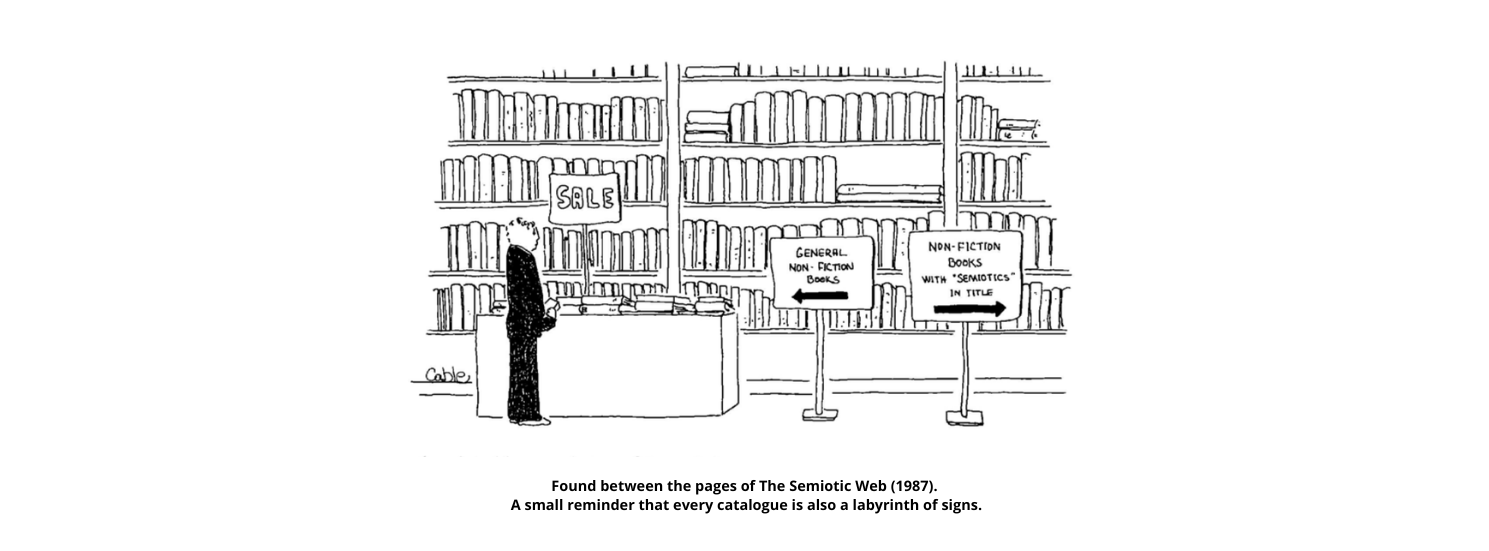
A unified academic catalogue for books, journal articles, book chapters, proceedings papers, conference abstracts and semiotic research materials.
A unified academic catalogue for books, journal articles, proceedings papers, collection articles and semiotic research materials. Search across the full database; results are shown with pagination.
Musical notation: The importance of the relative value of its signs for the interpretation
In: Synthesis in Diversity, Volume 1
- Pages
- 619-622
View details
On Peirce’s Pure Grammar as a general theory of cognition: From the thought-sign of 1868 to the semeiotic theory of assertion
In: Semiotica 1997, Issue 2024-01-02 00:00:00
View details
Identifier: DOI: 10.1515/semi.1997.113.1-2.107
Perception of proverbs and familiarity with them. Figurativeness as one of the most powerful markers of proverbiality
In: Synthesis in Diversity, Volume 1
- Pages
- 215-218
View details
Phaneroscopy and indeterminacy of translation
In: Synthesis in Diversity, Volume 2
- Pages
- 879-882
View details
Review article
In: Semiotica 1997, Issue 2024-01-02 00:00:00
View details
Identifier: DOI: 10.1515/semi.1997.113.1-2.189
Sacrality, myth, objects: Techniques of fabrication and semiotical, anthropological interpretation of carpets and jewels from Pakistan
In: Synthesis in Diversity, Volume 1
- Pages
- 281-282
View details
Sauron’s Newspeak: Black Speech, Quenya, and the nature of mind
In: Synthesis in Diversity, Volume 1
- Pages
- 219-222
View details
Semiotic Grammar
- Edition
- 1 edition
View details
Annotation: The label `semiotic grammar' captures a fundamental property of the grammars of human languages: not only is language a semiotic system in the familiar Saussurean sense, but its organizing system, its grammar, is also a semiotic system. This proposition, explicated in detail by William McGregor in this book, constitutes a new theory of grammar. Semiotic Grammar is `functional' rather than `formal' in its intellectual origins, approaches, and methods. It demonstrates, however, that neither a purely functional nor a purely formal account of language is adequate, given the centrality of the sign as the fundamental unit of grammatical analysis. The author distinguishes four types of grammatical signs: experiential, logical, interpersonal, and textural. The signifiers of these signs are syntagmatic relationships of the following types, respectively: constituency, dependency, conjugational and linking. McGregor illustrates and exemplifies the theory with data from a variety of languages including English, Acehnese, Polish, Finnish, Japanese, Chinese, and Mohawk; and from his pioneering research on Gooniyandi and Nyulnyul, two languages of the Kimberleys region of Western Australia.
Identifier: 0198236883
Status: Available
Situational effects on the quantification of frequency words
In: Synthesis in Diversity, Volume 1
- Pages
- 247-250
View details
Some comments on semiotics of graphic communication
In: Synthesis in Diversity, Volume 1
- Pages
- 255-258
View details
Some consonant strategies in spoken discourse
In: Synthesis in Diversity, Volume 1
- Pages
- 199-202
View details
Sonstiges
In: Semiotica 1997, Issue 2024-01-02 00:00:00
View details
Identifier: DOI: 10.1515/semi.1997.113.1-2.u
Structure and meaning
In: Semiotica 1997, Issue 2024-01-02 00:00:00
View details
Identifier: DOI: 10.1515/semi.1997.113.1-2.71
Textsemantics: A bridge between linguistics and literary theory
In: Synthesis in Diversity, Volume 1
- Pages
- 267-270
View details
The main statements of theories as determined by a semiotic method
In: Synthesis in Diversity, Volume 1
- Pages
- 187-190
View details
The possible worlds of the imaginary
In: Synthesis in Diversity, Volume 1
- Pages
- 223-226
View details
The production of values: The concept of modality in textual discourse analysis
In: Semiotica 1997, Issue 2024-01-02 00:00:00
View details
Identifier: DOI: 10.1515/semi.1997.113.1-2.43
The relationship between texts and their location
In: Synthesis in Diversity, Volume 1
- Pages
- 195-198
View details
The semiotics of catastrophe in linguistic change
In: Synthesis in Diversity, Volume 1
- Pages
- 179-182
View details
The social crystallization of language. Coercive traits of the social characterization in a Saussurean textus receptus tradition
In: Synthesis in Diversity, Volume 1
- Pages
- 271-276
View details
The socio-cognitive dimension of interpretation of verbal utterances
In: Synthesis in Diversity, Volume 2
- Pages
- 765-768
View details
The sources of Wittgenstein’s negation of the knowing subject
In: Semiotica 1997, Issue 2024-01-02 00:00:00
View details
Identifier: DOI: 10.1515/semi.1997.113.1-2.159
The uniqueness of ontological hermeneutics among contemporary semiotic theories of interpretation
In: Synthesis in Diversity, Volume 1
- Pages
- 461-464
View details
The value of the notion of contract to literary interpretation: Greimas, Propp, and West’s Miss Lonelyhearts
In: Synthesis in Diversity, Volume 1
- Pages
- 381-384
View details
Two kinds of semantics: Six intersemiotic theses
In: Synthesis in Diversity, Volume 1
- Pages
- 243-246
View details
Zero-derivation or syntagmatic derivation
In: Synthesis in Diversity, Volume 1
- Pages
- 207-210
View details
Caged in our own signs
View details
Other title information: A book about Semiotics
Annotation: The book is a primer of general semiotics, introducing basic models and frameworks of semiotic thinking as well as providing the reader with semiotic methodology to analyze issues of postmodernism, of text semiotics, and of mass cultural semiotics
Identifier: 156750213X
Status: Available
Commemorative essay. Ray L. Birdwhistell (1918-1994)
In: Semiotica 1996, Issue 2024-03-04 00:00:00
View details
Identifier: DOI: 10.1515/semi.1996.112.3-4.231
Contents / Sommaire Volume 112 (1996)
In: Semiotica 1996, Issue 2024-03-04 00:00:00
View details
Identifier: DOI: 10.1515/semi.1996.112.3-4.429
Contents/Sommaire Volume 109 (1996)
In: Semiotica 1996, Issue 2024-03-04 00:00:00
View details
Identifier: DOI: 10.1515/semi.1996.109.3-4.393
Contents/Sommaire Volume 110 (1996)
In: Semiotica 1996, Issue 2024-03-04 00:00:00
View details
Identifier: DOI: 10.1515/semi.1996.110.3-4.391
Contents/Sommaire Volume 111 (1996)
In: Semiotica 1996, Issue 2024-03-04 00:00:00
View details
Identifier: DOI: 10.1515/semi.1996.111.3-4.357
Cross-cultural similarities in gestures: The deep relationship between gestures and speech which transcends language barriers
In: Semiotica 1996, Issue 2024-03-04 00:00:00
View details
Identifier: DOI: 10.1515/semi.1996.111.3-4.269
Defining the emblem
In: Semiotica 1996, Issue 2024-03-04 00:00:00
View details
Identifier: DOI: 10.1515/semi.1996.112.3-4.289
Diagraming discourse structures: Illocution, interaction, or text?
In: Semiotica 1996, Issue 2024-03-04 00:00:00
View details
Identifier: DOI: 10.1515/semi.1996.110.3-4.197
Étude sémiologique des accessoires dans trois pièces de Beckett: En attendant Godot, Fin de partie, Oh les beaux jours
In: Semiotica 1996, Issue 2024-03-04 00:00:00
View details
Identifier: DOI: 10.1515/semi.1996.110.3-4.273
Heidegger says Being, and representation is dead
In: Semiotica 1996, Issue 2024-03-04 00:00:00
View details
Identifier: DOI: 10.1515/semi.1996.110.3-4.311
L’empreinte visuelle
In: Semiotica 1996, Issue 2024-03-04 00:00:00
View details
Identifier: DOI: 10.1515/semi.1996.112.3-4.359
L’expressivité vocale dans la parole chantée
In: Semiotica 1996, Issue 2024-03-04 00:00:00
View details
Identifier: DOI: 10.1515/semi.1996.111.3-4.295
Language and Human Behaviour
View details
Annotation: Bickerton argues that each of the properties distinguishing human intelligence and consciousness from that of other animals can be shown to derive straightforwardly from properties of language. In essence, language arose as a representational system, not a means of communication or a skill, and not a product of culture but an evolutionary adaptation.
Identifier: 1857285417
Status: Available
Linguistic production, ideology and otherness: Augusto Ponzio’s contribution to the philosophy of language
In: Semiotica 1996, Issue 2024-03-04 00:00:00
View details
Identifier: DOI: 10.1515/semi.1996.112.3-4.263
Metaphor, metonymy, and cross-cultural translation
In: Semiotica 1996, Issue 2024-03-04 00:00:00
View details
Identifier: DOI: 10.1515/semi.1996.110.3-4.301
Molecular biosemiotics: Molecules carry out semiosis in living systems
In: Semiotica 1996, Issue 2024-03-04 00:00:00
View details
Identifier: DOI: 10.1515/semi.1996.111.3-4.195
On surprise
In: Semiotica 1996, Issue 2024-03-04 00:00:00
View details
Identifier: DOI: 10.1515/semi.1996.109.3-4.283
Predation as predication: Toward an ecology of semiosis and syntax
In: Semiotica 1996, Issue 2024-03-04 00:00:00
View details
Identifier: DOI: 10.1515/semi.1996.109.3-4.221
Publications received
In: Semiotica 1996, Issue 2024-03-04 00:00:00
View details
Identifier: DOI: 10.1515/semi.1996.112.3-4.421
Publications received
In: Semiotica 1996, Issue 2024-03-04 00:00:00
View details
Identifier: DOI: 10.1515/semi.1996.109.3-4.387
Review article
In: Semiotica 1996, Issue 2024-03-04 00:00:00
View details
Identifier: DOI: 10.1515/semi.1996.112.3-4.383
Review article
In: Semiotica 1996, Issue 2024-03-04 00:00:00
View details
Identifier: DOI: 10.1515/semi.1996.111.3-4.319
Review article
In: Semiotica 1996, Issue 2024-03-04 00:00:00
View details
Identifier: DOI: 10.1515/semi.1996.110.3-4.341