
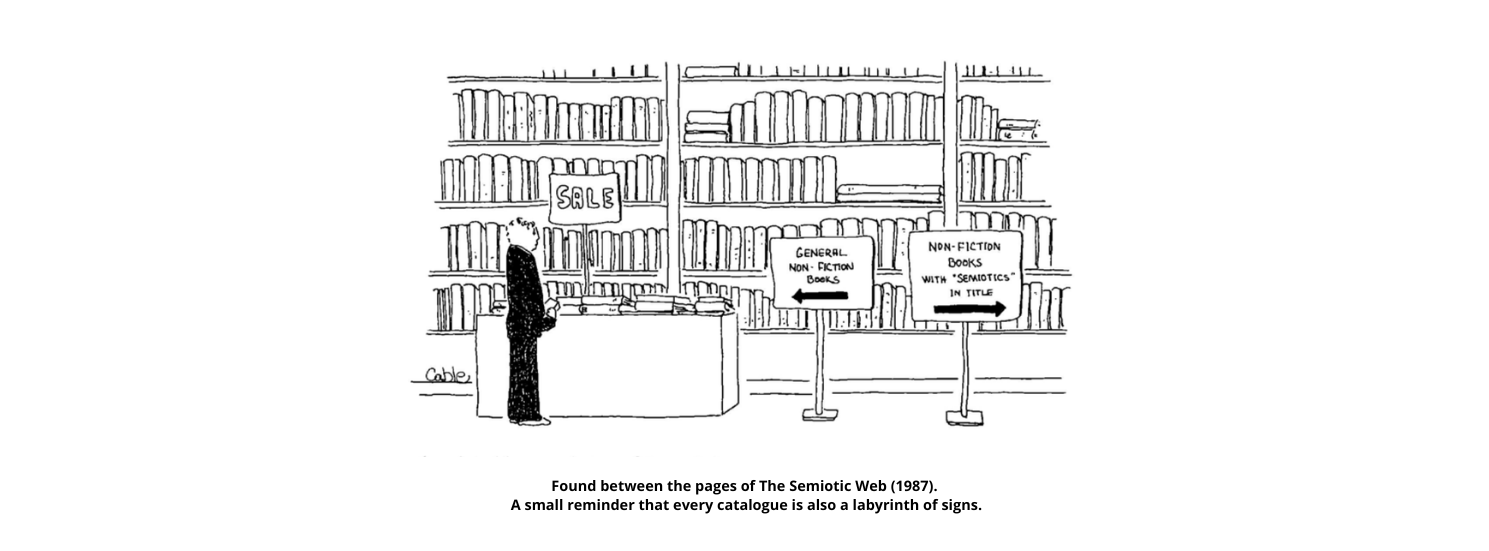
A unified academic catalogue for books, journal articles, book chapters, proceedings papers, conference abstracts and semiotic research materials.
A unified academic catalogue for books, journal articles, proceedings papers, collection articles and semiotic research materials. Search across the full database; results are shown with pagination.
The importance of Lotmanian semiotics to sign theory and the cognitive neurosciences
In: Sign Systems Studies 2015, Volume 43, Issue 2/3
- Pages
- 347-364
View details
Identifier: 10.12697/SSS.2015.43.2-3.10
The polyglot self in the semiotic spheres of language and culture
In: Sign Systems Studies 2015, Volume 43, Issue 2/3
- Pages
- 207-225
View details
Identifier: 10.12697/SSS.2015.43.2-3.04
Buono da pensare
- Dependent title
- Cutura e comunicazione del gusto
- Edition
- 1 edition
View details
Annotation: Lo sappiamo: l'uomo è ciò che mangia. Ma che cosa mangia? come lo mangia? quando? con chi? E cosi facendo, che tipo i uomo diventa? Ecco una serie di domande a cui questo libro prova a fornire delle risposte. Nella convinzione che, per poter fare una buona comunicazione sul cibo, la cucina, l'enograstronomia, occorra innanzitutto conoscerne gli aspetti culturali e storici, folosofici e semiotici.
Identifier: 9788843073733
Status: Available
Communicating the ideas and attitudes of spying in film music: A social semiotic approach
In: Sign System Studies 2014, Volume 42, Issue 1
- Pages
- 72-97
View details
Identifier: 10.12697/SSS.2014.42.1.04
Greimas close and far
View details
Parallel title: Parallel title: Greimas arti ir toli
Annotation: Algirdas Julien Greimas (born Algirdas Julius Greimas) is one the most prominent creators of semiotics who laid the foundations of the Paris School of Semiotics known all over the world. He was also a famous linguist who researched Lithuanian mythology. Algirdas Julien Greimas is one of the most prominent Lithuanians in the international world of science, in many aspects compared to Mikalojus Konstantinas Čiurlionis. The greatest influence on the life and works of Greimas came from French culture renowned for its science, literature and art. Nevertheless, the time spent in Lithuania was also significant. Greimas himself viewed Lithuanian and western (French) periods of his life as correlation between two cultures. Therefore, every moment of his life is important to us, each moment contributing to the whole picture and enriching his life. Neither Greimas' childhood nor his youth which is the genesis of intellectual and aesthetic signs is reviewed in literature. Various authors tend to start writing Greimas'biography starting from his years in Vytautas Magnus University. Professor Eero Tarasti, the president of the International Association for Semiotic Studies, offered me to prepare a work about Greimas' life in Lithuania. As I myself studied in Kupiškis and knew a lot of things about the Greimas family, I decided to look at Greimas'childhood period in Kupiškis. The sources I used in this work are as follows: Greimas' words about his childhood, national and personal archives, press of those days and stories told by those who knew the Greimas family.My experience with exceptionally gifted children in National M. K. Čiurlionis School of Art in Vilnius and consulting with famous scientist has helped me to discuss the genesis of intellectual and aesthetic signs in Greimas' biography. As for the form of the work, I have chosen to use the form of an exposition with elements of a poster presentation, which allowed me to participate in significant scientific forums in France, Finland, Russia and China. In Lithuania, in those places where Greimas lived, my exposition contributed to the studies of his biography, organisation of conferences and dedication to Greimas. As it turned out, the prestigious gymnasiums where Greimas studied in Šiauliai and Marijampolė established in 1851 and 1867 have raised about half (9 out of 20) of those who signed the Act of Independence of Lithuania on 16 February 1918 and 12 out of 100 most outstanding persons in Lithuania in a millennium. In this respect these two gymnasiums are the only ones in Lithuania. It should also be mentioned that Greimas attended lectures in Vytautas Magnus University by famous Lithuanian scientists Mykolas Romeris, Vladas Jurgutis, Vosylius Sezemanas and Jonas Bučas who later contributed to laying the foundation for the science of semiotics.
Identifier: 9789955038702
Status: Available
La Semiotica del espectaculo
- Dependent title
- En la Contruccion interdisciplinario
View details
Annotation: Este libro es el producto de un trabajo de investigación de cuatro profesionales del Arte, preocupados por entender, analizar y profundizar en el estudio del arte y, en particular, el Teatro, para acercar su trabajo al público, en general, y a todos los que se dedican a la creación y práctica del arte escénico.
Identifier: 9786075131122
Status: Available
Lectures on the Epistemology of Semiotics
- Edition
- 1 edition
View details
Annotation: This book presents a functional view of semiotics considering language as a system of signs. In such a means- and ends-oriented perspective, the signs as meaning-bearers are detached, both in concrete and mental existence modes, from their meanings or objects of reference. Some relevant words on the genesis of the author’s contribution to the development of semiotic thought will also include his indebtedness to his preceptors, teachers, friends and colleagues. Preliminary outlines for their foundation have been developed since the late 197os and 1980s in the Department of General Linguistics at Wrocław. Subsequent work on the following theme continued in the Institute of English Philology at Opole and in the School of English at Poznań, over the last five years, has contributed to its present state.
Identifier: 9788360097243
Status: Available
Mathematics as a Modeling System
- Edition
- 1 edition
View details
Other title information: a Semiotic Approach
Notes: Editors of the series: Kalevi Kull, Silvi Salupere, Peeter Torop
Annotation: Mathematics and semiotics share many intellectual features and interests, from the study of how representations stand for specific kinds of referents to philosophical considerations of how these interrelate with reality. Nonetheless, in-depth studies of this intrinsic relation between the two have rarely been undertaken, with a few notable exceptions (as will be discussed in the book). Especially relevant to the study of the nature of mathematics is the concept of model – a term and notion that is used widely in both disciplines. However, to the best of our knowledge the theory of models in semiotics, known as Modeling Systems Theory, has rarely, if ever, been applied to the study of mathematical modeling. The purpose of this book is to do exactly that since it is our view that mathematics is a de facto modelling system in the semiotic sense and it is our hope that from this it will be possible to gain considerable insights into how mathematics works and achieves the discoveries and forms of knowledge that it has since the dawn of antiquity. Hopefully, this will allow both mathematicians and semioticians to pursue similar or analogous research objectives with regard to understanding the biological and cognitive etiology of sign systems and their connection to reality.
Identifier: 9789949326105
Status: Available
Philosophies of Performance
View details
Annotation: In the years 2008-2009 The Finnish Academy of Sciences funded a research project entitled PHILOSOPHIES OF PERFORMANCE - Finnish music, art and avant-garde. The project focused on temporal, i.e. performing arts, their background philosophies and signifying processes. The empirical material was mostly about Finnish art. Yet, the idea was to develop also "universal" theoretical models relevant to other traditions and fields. Music served as the core phenomenon but it was also scrutinised in its intertextual connections. This anthology offers some results but also contributions from other scholars whom the project stimulated. The authors are Aurea Dominiguez, Joan Grimalt, Sergio Lanza, Otto Lehto, Grisell Macdonel Dario Martinelli, Bogumila Mika, Lina Navickaté-Martinelli, Pärttyli Rinne, Filip Sikorski, Eero Tarasti, Juha Torvinen, Alessia R. Vitale and Nayden Yotof.
Identifier: 9525431371
Status: Available
Semiotic management of communicative situations: New people(s) and old methods
In: Sign System Studies 2014, Volume 42, Issue 1
- Pages
- 42-71
View details
Identifier: 10.12697/SSS.2014.42.1.03
Semiotic models of legal argumentation
- Edition
- 1 edition
View details
Notes: Articles included: Charles Sanders Peirce, A Mastermind of (Legal) Arguments (2012), On relationships between the logic of law, legal positivism and semiotics of law (2011), The Semiotic Model of Legal Reasoning (2012), The Case of Lauris Kaplinski: A Guide to a Semiotic Reading of Incitement of Hatred in Modern Criminal Justice (2013), The Splendors and MIseries of Constitutional Reasoning in Times of Global Crisis: A Critical look from the Realist Perspectives of Semiotics (2013)
Annotation: The present doctoral dissertation is an exercise in exposition, comparison, criticism and construction, and this is the result of a project conceived ten years ago. We have taken different traditions of legal reasoning, and by juxtaposing them have sought to clarify and assess semiotic presuppositions, in order to outline a theoretical framework of legal semiotics that would help to lay the foundations for semiotic theory of legal argumentation. These semiotic presuppositions have been the object of our study at the University of Tartu since our bachelor's thesis (defended in 2001) and master's thesis (defended in 2006). Our interest in legal semiotics was motivated by a very strong sense of dissatisfaction with the traditional methods and paradigms of contemporary jurisprudence, especially with those ones of legal argumentation. Traditional jurisprudence committed to a model of legal unity, does not for the most part seeks to describe how the views of legal actors interact with the views of other legal actors/participants of legal discourse in real situations of legal communication. Thus, it was the consideration of legal communication as a semiotic activity that caused us to doubt that law could be conceived in terms of traditional legal concepts. Legal semiotics can be regarded as a major advance because it debunks the prevailing assumptions about the nature of legal reasoning and replaces them with what seems a far superior explanation. The main scientific objectives of this dissertation can be briefly formulated as follows: 1) to develop a conceptual framework for practical handling of complex problems of legal argumentation as they occur in the stages of legal communication; 2) to assess issues of compatibility/conflict between existing methods of legal reasoning and our semiotic model of legal reasoning; 3) to bridge the compatible aspects of different theories/models of legal argumentation to establish a generalizable model of legal argumentation.
Identifier: 9789949325016
Status: Available
Semiotics of “the fourth generation” – an unfinished project?
In: Sign System Studies 2014, Volume 42, Issue 1
- Pages
- 137-146
View details
Identifier: 10.12697/SSS.2014.42.1.06
Approaching a semiotics of exaptation: At the intersection between biological evolution and technological development
In: Sign System Studies 2013, Volume 41, Issue 4
- Pages
- 504-527
View details
Identifier: 10.12697/SSS.2013.41.4.07
Beginnings of the Semiotics of Culture
- Edition
- 1 edition
View details
Notes: Editors of the series: Kalevi Kull, Silvi Salupere, Peeter Torop
Annotation: Key historical texts of semiotics of culture in Tartu Moscow School
Identifier: 9789949323234
Status: Available
Crossing Boundaries
View details
Other title information: Intercontextual Dynamics Between Family and School
Notes: editor of the series Jaan Valsiner
Annotation: Crossing Boundaries is an invitation to cultural psychology of educational processes to overcome the limits of existing educational psychology. Emphasizing social locomotion and the dynamic processes, the book try to capture the ambiguous richness of the transit from one context to another, of the symbolic perspective that accompanies the dialogue between family and school, of practicies regulating the interstitial space between these different social systems.
Identifier: 9781623963941
Status: Available
Lotman’s tradition: Semiotics of culture from a Latin American perspective
In: Sign System Studies 2013, Volume 41, Issue 4
- Pages
- 528-532
View details
Identifier: 10.12697/SSS.2013.41.4.08
Man, nature, and semiotic modelling or How to create forests and backyards with language
In: Sign System Studies 2013, Volume 41, Issue 4
- Pages
- 488-503
View details
Identifier: 10.12697/SSS.2013.41.4.06
Music
- Dependent title
- function and value
View details
Other title information: proceedings of the 11th International Congress on Musical Signification, 27 IX – 2 X 2010, Krakow, Poland, Volume 2
Annotation: Proceedings of the 11th international congress on musical signification ICMS XI.
Identifier: 9788362743193
Status: Available
Peircean semiotics in the context of design praxis: Abduction and perception in dialogue
In: Sign System Studies 2013, Volume 41, Issue 4
- Pages
- 424-432
View details
Identifier: 10.12697/SSS.2013.41.4.03
Semiotics and interdisciplinarity: Lotman’s legacy
In: Sign System Studies 2013, Volume 41, Issue 4
- Pages
- 391-403
View details
Identifier: 10.12697/SSS.2013.41.4.01
The Edusemiotics of Images
View details
Other title information: Essays on the Art-Science of Tarot
Notes: a printed version
Annotation: Semetsky’s new book offers a bracing account of Tarot semiotics in view of its deep significance for educational experience. Analyzing the symbolic language of Tarot images that express the intimations of the unconscious, she invites readers to explore novel ways of learning about the nature of ourselves and the world we are situated in. Combining thorough research with an accessible style, this groundbreaking book is essential reading for present and future generations of practitioners, academics and students across disciplines. Pia Brînzeu, Professor of English Literature and Vice-Rector of the Universityof Timis¸oara, Romania; author of Corridors of Mirrors. A sequel to the author’s Re-Symbolization of the Self: Human Development and Tarot Hermeneutic and Semiotics Education Experience, Semetsky’s new book presents the Tarot sign-system as a school of ethical living. Bringing the philosophies of Peirce, Deleuze, Dewey, Whitehead and Gebser in a dialogue with the cutting-edge science of coordination dynamics, she grounds the art of Tarot in the logic of signs acting across nature, culture and human mind. Building on Noddings’ “maternal factor”, Semetsky demonstrates how the lessons embodied in Tarot symbolism recover the feminine value of relations and contribute to Self~Other integration. Such is the message of Tarot images. The Image is the Message. Igor Klyukanov, Professor of Communication, Eastern Washington University, USA; editor, Russian Journal of Communication; author of A Communication Universe: Manifestations of Meaning, Stagings of Significance. Semetsky’s amalgamation of the techniques of visual communication with the emerging field of edusemiotics is an absolute masterpiece in transdisciplinarity. By forging diverse strands of inquiry into an overall model of how images enhance learning, Semetsky’s new book provokes us to take a fresh look at iconic information and is a required reading for everyone who is engaged with the artand science of visual semiotics at the intersection of nature and culture. Marcel Danesi, Professor of Anthropology, University of Toronto, Canada; editor-in-chief, Semiotica; author of The Quest for Meaning: A Guide to Semiotic Theory and Practice. Finally. An in-depth look at Tarot from within the field of semiotics, a perspective that had been inexplicably overlooked until now. As a language of exile from language, Tarot cards are silent words that became images. Here is a book that turns our thirst for symbols into a learning tool. The sign sings in Inna Semetsky’s work.
Identifier: 9789462090538
Status: Available
Gatherings in Biosemiotics
- Edition
- 1 edition
View details
Notes: Editors of the series: Kalevi Kull, Silvi Salupere, Peeter Torop
Annotation: This is a special commemorative edition of Gatherings in Biosemiotics. It includes new material on the basics of biosemiotics, as well as a complete history of the Gatherings as told by their organizers. The first part, Approaches to Biosemiotics, includes five short papers on the importance of semiotics for biology. The second part, History of the Gatherings, begins with two retrospectives, by Jesper Hoffmeyer and Donald Favareau. The third part features nearly the entire set of submitted abstracts for this year's conference.
Identifier: 9789949320486
Status: Available
Identities
View details
Other title information: The world of Music in Relation to itself
Annotation: This book is a collection of scientific studies by Mirjana Veselinović-Hofman, Tijana Popović Mlađenović, Tiana Marković, Ivana Ili and Marija Masnikosa. Identities: The World of Music in Relation to Itself is interdisciplinary work in musicology which presents analytical ans synthetic studies of music and cultural identities.
Identifier: 9788688619219
Status: Available
Jakobsonova sémiotická teorie
- Edition
- 1 edition
View details
Notes: Two of the books in this collection are inherited from Ludmila Lackova
Annotation: In my thesis I present some critical commentary on the semiotic theory of Roman Jakobson. This theory I view as an effort to establish, consolidate and widen of the nomothetic principle by using semiotic terms. In my view, to describe the basis of Jakobson?s semiotic theory means to describe the basic characteristics of his use of the terms sign, code and communication. With reference to the work of Thomas Kuhn, Nelson Goodman and François Rastier I introduce three semiotic frames, i.e. the general descriptions of meaning from semiotic/sign perspective. These frames I see as a mechanism of privileging certain kinds of question with certain privileged terms, i.e. sign, code and communication are seen as models that highlight speci%c problematic areas and simultaneously relegate others. I try to locate Roman Jakobson?s theory in these frames with emphasis on the model and de%nition of sign. The concept of sign as a complex signum or combination of its components is highlighted or distorted to suit the preferences of a particular frame. The result of this work is the description of the Jakobson?s conceptual relations between semiotic terms as the consequences of attempts to establish nomothetical approach across the semiotic frames.
Identifier: 9788024433875
Status: Available
12 spojrzeń na muzykę polską wieku apokalipsy i nadziei
- Dependent title
- Studia, szkice, interpretacje
View details
Annotation: Zawartość: I. W perspektywie czasu i miejsca na ziemi 1. Sztuka w objęciach historii 2. O drodze twórczej, jej progach i fazach, przemianach i fiksacjach – po raz wtóry II. Szymanowski i inni 3. Szymanowskiego „ścieżki nocy” 4. Każde niech żyje! zawiera w sobie precz z! III. Wspomnienia, zadziwienia, zamyślenia 5. Kisielewski: muzyka i polityka 6. Wspominając Lutosławskiego 7. Świat Henryka Mikołaja Góreckiego 8. Prostota, światło i głębia. W zamyśleniu nad muzyką Marka Stachowskiego IV. Z archiwum 9. Miłość Józefa Kofflera 10. Konstantego Regameya Pieśni perskie 11. Ekspresja i forma u Lutosławskiego 12. Siedem pytań wokół Pendereckiego Nota źródłowa Indeks nazwis
Identifier: 9788362743063
Status: Available
A semiotic alternative to communication in the processes in management accounting and control systems
In: Sign System Studies 2011, Volume 39, Issue 1
- Pages
- 183-208
View details
Identifier: 10.12697/SSS.2011.39.1.06
Designing a semiotic-based approach to intercultural training
In: Sign System Studies 2011, Volume 39, Issue 1
- Pages
- 145-182
View details
Identifier: 10.12697/SSS.2011.39.1.05
Editors' comment
In: Sign System Studies 2011, Volume 39, Issue 2/4: Tartu Semiotics
- Pages
- 9-11
View details
Identifier: 10.12697/SSS.2011.39.2-4.00
From semantics to semiotics: A page of early Soviet intellectual history
In: Sign System Studies 2011, Volume 39, Issue 1
- Pages
- 224-235
View details
Identifier: 10.12697/SSS.2011.39.1.08
Hegemonic signification from cultural semiotics point of view
In: Sign System Studies 2011, Volume 39, Issue 2/4: Tartu Semiotics
- Pages
- 58-87
View details
Identifier: 10.12697/SSS.2011.39.2-4.03
In memoriam Alexander Moiseevich Piatigorsky
In: Sign System Studies 2011, Volume 39, Issue 2/4: Tartu Semiotics
- Pages
- 388-393
View details
Identifier: 10.12697/SSS.2011.39.2-4.17
Interview with Vyacheslav V. Ivanov about semiotics, the languages of the brain and history of ideas
In: Sign System Studies 2011, Volume 39, Issue 2/4: Tartu Semiotics
- Pages
- 290-313
View details
Identifier: 10.12697/SSS.2011.39.2-4.11
Juri Lotman in English: Bibliography
In: Sign System Studies 2011, Volume 39, Issue 2/4: Tartu Semiotics
- Pages
- 343-356
View details
Identifier: 10.12697/SSS.2011.39.2-4.13
Mapping the child’s world: The cognitive and cultural function of proper names in the book series Paula’s Life
In: Sign System Studies 2011, Volume 39, Issue 2/4: Tartu Semiotics
- Pages
- 224-248
View details
Identifier: 10.12697/SSS.2011.39.2-4.08
On Musical Self-Similarity
- Dependent title
- intersemiosis as synecdoche and analogy
View details
Annotation: In this study, Gabriel Pareyon presents a theory of musical meaning formation in the context of intersemiosis, that is, the translation of meaning from one cognitive domain to another cognitive domain (e.g. from mathematics to music, or to speech or graphic forms). From this perspective, the degree of coherence of a musical systems relies on a synecdochic intersemiosis: a system of related signs within other comparable and correlated systems. The author analyzes the modalities of such correlations, exploring their general and particular traits, and their operational bounds. Accordingly, the notion analofy is used as a rich concept through its two definitions quoted by the classical literature - proportion and paradigm, enormously valuable in establishinf mesurement, likeness and affinity criteria. At the same time, original arguments by Benoit B. Mandelbrot (1924-2010) are revised, alongside a systematic critique of the literature on the subject. In fact, connecting Charles S. Peirce!s synechism with Mandelbrot's fractality is on of the main developnets of the presents study.
Identifier: 9789525431322
Status: Available
On relationships between the logic of law, legal positivism and semiotics of law
In: Sign System Studies 2011, Volume 39, Issue 2/4: Tartu Semiotics
- Pages
- 145-196
View details
Identifier: 10.12697/SSS.2011.39.2-4.06
On the independence of the humanities: Tartu–Moscow School and official Soviet politics of science
In: Sign System Studies 2011, Volume 39, Issue 2/4: Tartu Semiotics
- Pages
- 357-365
View details
Identifier: 10.12697/SSS.2011.39.2-4.14
Proper name as an object of semiotic research
In: Sign System Studies 2011, Volume 39, Issue 2/4: Tartu Semiotics
- Pages
- 197-223
View details
Identifier: 10.12697/SSS.2011.39.2-4.07
Russian Formalist Criticism
View details
Other title information: Four essays
Annotation: College English Russian formalists emerged from the Russian Revolution with ideas about the independence of literature. They enjoyed that independence until Stalin shut them down. By then they had produced essays that remain among the best defenses ever written for both literature and its theory. Included here are four essays representing key points in the formalists' short history. Victor Scklovsky's pathbreaking "Art as Technique" (1917) vindicates disorder in literary style. His 1921 essay on Tristram Shandy makes that eccentric novel the centerpiece for a theory of narrative. A section from Tomashevsky's "Thematics" (1925) inventories the elements of stories. In "The Theory of the 'Formal Method'" (1927) Boris Eichenbaum defends Russian formalism from many attacks. An able champion, he describes formalism's evolution, notes its major workers and works, clears away decayed axioms, and rescues literature from "primitive historicism" and other dangers. These essays set a course for literary studies that led to Prague structuralism, French semiotics, and postmodern poetics. Russian Formalist Criticism has been honored as a Choice Outstanding Academic Book of the Year by the American Library Association.
Identifier: 9780803254602
Status: Available
Semiotic study of landscapes: An overview from semiology to ecosemiotics
In: Sign System Studies 2011, Volume 39, Issue 2/4: Tartu Semiotics
- Pages
- 12-36
View details
Identifier: 10.12697/SSS.2011.39.2-4.01
Semiotics as science
In: Sign System Studies 2011, Volume 39, Issue 2/4: Tartu Semiotics
- Pages
- 271-289
View details
Identifier: 10.12697/SSS.2011.39.2-4.10
Symbol i Muzyka
View details
Annotation: This book is an entry into the symbolicism of music. The book consists of three chapters. In the first, I deal with the concept of the symbol itself. I discuss its genesis, history changing understanding, and above all - it's functioning in contemporary thought in such fields as sociology, cultural anthropology, semiotics or semiology, philosophy, psychoanalysis, and musicology. In the second chapter I present the problem of symbol and meaning in European music in a historical outline. The third chapter is my analysis of musical interpretations.
Identifier: 9788362743018
Status: Available
The institution of semiotics in Estonia
In: Sign System Studies 2011, Volume 39, Issue 2/4: Tartu Semiotics
- Pages
- 314-342
View details
Identifier: 10.12697/SSS.2011.39.2-4.12
The place of art among other modelling systems
In: Sign System Studies 2011, Volume 39, Issue 2/4: Tartu Semiotics
- Pages
- 249-270
View details
Identifier: 10.12697/SSS.2011.39.2-4.09
The Semiotics of Law in Legal Education
- Edition
- 1 edition
View details
Annotation: This book offers educational experiences, including reflections and the resulting essays, from the Roberta Kevelson Seminar on Law and Semiotics held during 2008 – 2011 at Penn State University’s Dickinson School of Law. The texts address educational aspects of law that require attention and that also are issues in traditional jurisprudence and legal theory. The book introduces education in legal semiotics as it evolves in a legal curriculum. Specific semiotic concepts, such as “sign”, “symbol” or “legal language,” demonstrate how a lawyer’s professionally important tasks of name-giving and meaning-giving are seldom completely understood by lawyers or laypeople. These concepts require analyses of considerable depth to understand the expressiveness of these legal names and meanings, and to understand how lawyers can “say the law,” or urge such a saying correctly and effectively in the context of a natural language that is understandable to all of us. The book brings together the structure of the Seminar, its foundational philosophical problems, the specifics of legal history, and the semiotics of the legal system with specific themes such as gender, family law, and business law.
Identifier: 9789400713406
Status: Available
The space of culture
View details
Other title information: the place of nature in Estonia and beyond
Annotation: This volume sets out to construct a tentative bridge between the physical and perceived (academic) worlds, between the understandings of culture and nature, their spatiality and temporality by tackling the spatiality of culture phenomena across disciplinary boundaries. The contributions are arranged around a general question of how humans organise the spaces in which they live. The book is divided according to three themes: the humanities and ecosemiotic approach to nature, constructing nature, and examining environmental and landscape change. The first provides an historical review of the humanities and expands on the more theoretical themes. The second section discusses some ways in constructing (wild) nature with specific examples. The final one illustrates the changes that various cultures have brought about in the environment examining landscapes and domestication. The space of culture and the place of nature in various cultures are discussed critically throughout the volume in a way that challenges their ontological separations and invites to discuss culture-nature relationships on a more balanced basis
Identifier: 9789949196234
Status: Available
Time-plans of the organisms: Jakob von Uexküll’s explorations into the temporal constitution of living beings
In: Sign System Studies 2011, Volume 39, Issue 2/4: Tartu Semiotics
- Pages
- 37-57
View details
Identifier: 10.12697/SSS.2011.39.2-4.02
Transdisciplinarity in objects: Spatial signification from graffiti to hegemony
In: Sign System Studies 2011, Volume 39, Issue 2/4: Tartu Semiotics
- Pages
- 88-123
View details
Identifier: 10.12697/SSS.2011.39.2-4.04
Understanding the city through its semiotic spatialities
In: Sign System Studies 2011, Volume 39, Issue 2/4: Tartu Semiotics
- Pages
- 124-144
View details
Identifier: 10.12697/SSS.2011.39.2-4.05
What is actually essential in biosemiotics?
In: Sign System Studies 2011, Volume 39, Issue 2/4: Tartu Semiotics
- Pages
- 366-382
View details
Identifier: 10.12697/SSS.2011.39.2-4.15