
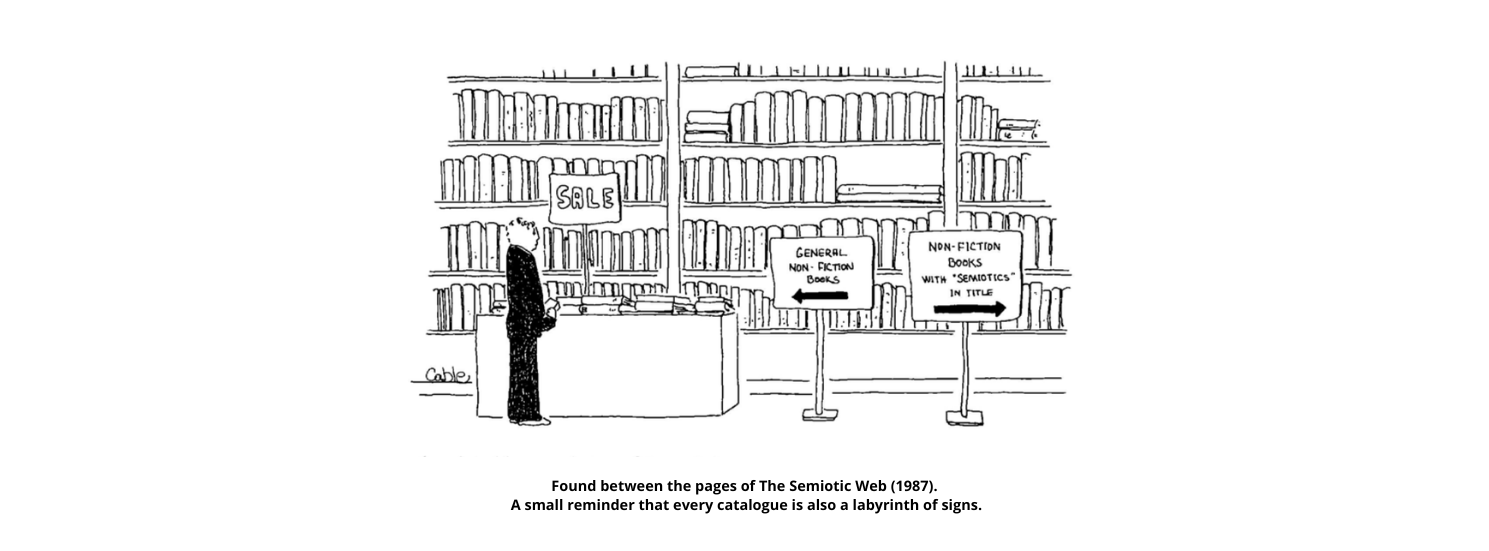
A unified academic catalogue for books, journal articles, book chapters, proceedings papers, conference abstracts and semiotic research materials.
A unified academic catalogue for books, journal articles, proceedings papers, collection articles and semiotic research materials. Search across the full database; results are shown with pagination.
Thesaurus
Browse authorized terms and raw keywords indexed across books, journals, articles, collections and proceedings. Authorized terms search variants and related concepts.
The Shared Mind
edited by Jordan Zlatev | Timothy P. Racine | Chris Sinha | Esa Itkonen
Social John Benjamins Publishing Company 9789027239068 Available
View details
Other title information: Perspectives on intersubjectivity
Annotation: The cognitive and language sciences are increasingly oriented towards the social dimension of human cognition and communication. The hitherto dominant approach in modern cognitive science has viewed social cognition through the prism of the traditional philosophical puzzle of how individuals solve the problem of understanding Other Minds. The Shared Mind challenges the conventional theory of mind approach, proposing that the human mind is fundamentally based on intersubjectivity: the sharing of affective, conative, intentional and cognitive states and processes between a plurality of subjects. The socially shared, intersubjective foundation of the human mind is manifest in the structure of early interaction and communication, imitation, gestural communication and the normative and argumentative nature of language. In this path breaking volume, leading researchers from psychology, linguistics, philosophy and primatology offer complementary perspectives on the role of intersubjectivity in the context of human development, comparative cognition and evolution, and language and linguistic theory.
Identifier: 9789027239068
Status: Available
Contents/Sommaire Volume 108 (1996)
In: Semiotica 1996, Issue 2024-03-04 00:00:00
Semiotica DOI: 10.1515/semi.1996.108.3-4.395
View details
Identifier: DOI: 10.1515/semi.1996.108.3-4.395
Review article
In: Semiotica 1996, Issue 2024-03-04 00:00:00
Semiotica DOI: 10.1515/semi.1996.108.3-4.307
View details
Identifier: DOI: 10.1515/semi.1996.108.3-4.307
Semiotic theory applied to free will, relativity, and determinacy: Or, why the unified field theory sought by Einstein could not be found
JOHN W. JR. OLLER
In: Semiotica 1996, Issue 2024-03-04 00:00:00
Semiotica DOI: 10.1515/semi.1996.108.3-4.199
View details
Identifier: DOI: 10.1515/semi.1996.108.3-4.199
Social semiotics, pragmatics, and the analysis of changing semiospheres: The Israeli case
LUIS RONIGER; MICHAEL FEIGE
In: Semiotica 1996, Issue 2024-03-04 00:00:00
Semiotica DOI: 10.1515/semi.1996.108.3-4.245
View details
Identifier: DOI: 10.1515/semi.1996.108.3-4.245
Sonstiges
In: Semiotica 1996, Issue 2024-03-04 00:00:00
Semiotica DOI: 10.1515/semi.1996.108.3-4.u
View details
Identifier: DOI: 10.1515/semi.1996.108.3-4.u
The semiotics of improvisation: The pragmatics of musical and verbal performance
R. KEITH SAWYER
In: Semiotica 1996, Issue 2024-03-04 00:00:00
Semiotica DOI: 10.1515/semi.1996.108.3-4.269
View details
Identifier: DOI: 10.1515/semi.1996.108.3-4.269